
Starting out as a notary public in Hawaii can feel a bit overwhelming, right? You hear about official rules, gather documents, and realize there’s a specific stamp you must use. But don’t worry, learning about Hawaii notary stamp requirements is simpler than it seems. In this post, we’ll walk through everything you need to know, from what your stamp should look like to where to get one, so that you can confidently tackle your notarial duties.
By the end, you’ll understand how to keep your stamp safe, what to do when your commission ends, and how to stay compliant with Hawaii’s regulations. Let’s dive in.
Understand hawaii notary stamp basics
The State of Hawaii places quite a bit of importance on your notary seal. You’ll be using it to authenticate all kinds of legal documents, so it needs to meet certain guidelines. In this section, we’ll talk through the shape, size, and wording your seal should include, along with why it matters.
Purpose of a notary stamp in Hawaii
Your Hawaii notary stamp isn’t just a fancy piece of office equipment. It proves that you, as a commissioned notary, have verified the identity of the signer and witnessed the signing of a document. If you leave off your stamp, that document might be rejected by a county clerk’s office or any institution requiring official notarization. So, whenever you perform a notarial act, you’ll need this seal to show that you acted under the authority of your notary commission.
Putting it simply, if the stamp is missing, storing or recording that document in Hawaii can become impossible. Think of the stamp as your notarial seal of trust—no matter the paperwork, that impression signals legitimacy.
Official seal design elements
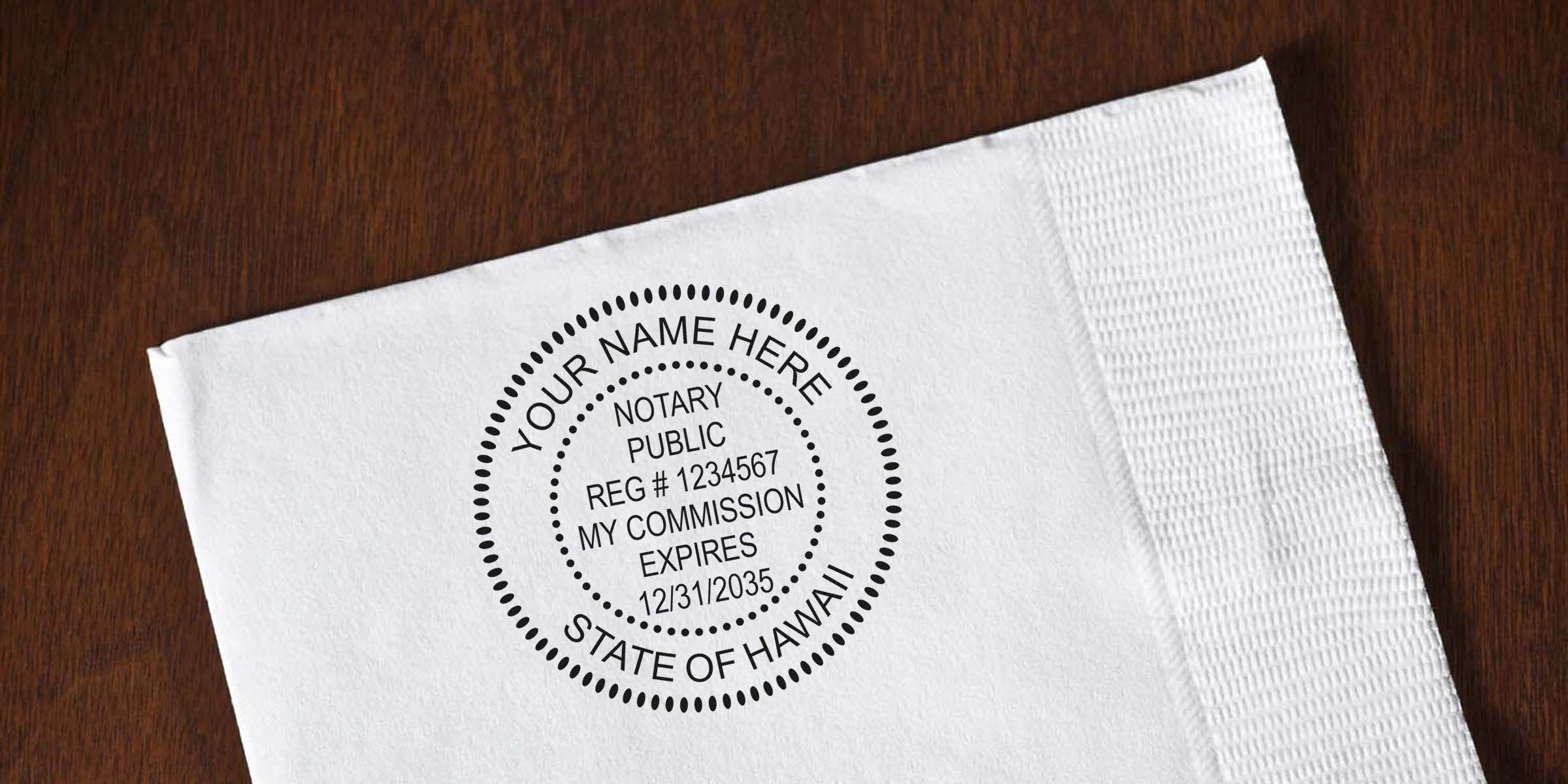
The State of Hawaii dictates that your notary seal be a circular, inked rubber stamp, not over two inches in diameter, with a serrated or milled edge border for clear distinction. Inside the design, you need to include:
- Your full name exactly as it appears on your commission.
- Your commission number (this is your official number from the state).
- The words “notary public” and “State of Hawaii.”
When you put your official signature on a document, you also have to add your typed or printed name and the expiration date of your commission. This combo of stamp plus signature details helps confirm that you are a valid notary in Hawaii and that everything is aboveboard.
Quick reference table
It helps to see these specifics at a glance. Here’s a simple rundown:
| Requirement | Explanation |
|---|---|
| Rubber stamp seal | Must be circular, up to 2" diameter, with serrated or milled edge border. |
| Required wording | Must include your name, commission number, "notary public," and "State of Hawaii." |
| Additional info on documents | Add your typed or printed name plus commission expiration date next to signature. |
| Recommended ink color | Black (oil-based ink is preferred for clear, long-lasting impressions). |
Following these guidelines shows that you’re taking your responsibilities seriously, and it keeps you in line with Hawaii’s notary requirements.
Manage your notarial timeline
Staying on top of your commission timeline is just as important as understanding the design of your seal. You’ll want to keep track of expiration, renewal times, and any legal obligations to return or replace your stamp. Let’s sort this out so you won’t get caught off guard.
When to replace your stamp
Many new notaries assume that once you’ve gotten your stamp, you’re done for the entirety of your notarial career. In Hawaii, that isn’t entirely true. Each notary commission comes with its own expiration date. A brand-new stamp is required with each commission renewal because your updated commission information must appear on your seal. Once your old commission date passes, the stamp that references that date becomes invalid.
Some folks forget or think they can use their old stamp “just one more time.” That’s a no-go. Using an expired stamp can invalidate documents and cause serious headaches. The safe bet is to order a new seal as soon as your renewal comes through, so you’re prepared to notarize seamlessly once your new term begins.
Completing the renewal process
Renewing your commission involves more than just purchasing a new notary seal, although you’ll definitely need a fresh one. The State of Hawaii typically requires:
- Submitting an application to renew your commission, plus any applicable fees.
- Taking a new oath of office.
- Awaiting the confirmation and updated commission details.
- Ordering a new Hawaii notary stamp that shows your current commission expiration date.
It’s easy to mistakenly think that only a new stamp is needed, but double-check you’ve handled all the renewal steps. Once you receive official notice that your new commission is active, you can start using the new stamp right away.
Protect your stamp from misuse
Your notary stamp carries legal authority, so keeping it safe is a top priority. In the wrong hands, it can be misused to create questionable documents, effectively placing your credibility on the line. Here’s how to maintain control and what to do if your commission ends.
Secure storage best practices
The rule of thumb is to keep your stamp either on your person or locked away. You don’t want your coworkers, friends, or family to borrow it for even the simplest tasks, because that would violate Hawaii regulations. You’re the only one authorized to use your notary seal. When you’re not notarizing documents:
- Store the stamp in a locked drawer or cabinet.
- Avoid leaving it in plain sight even if you step away for a minute.
- Consider a small personal lock box if you share an office.
On top of that, make it a habit to check your desk or briefcase for your stamp every time you head out. That simple routine helps prevent accidentally leaving it behind or misplacing it.
Proper disposal at commission end
Hawaii law requires that you deliver your stamp to the Attorney General for defacement or destruction immediately upon resignation, death, or commission expiration. In other words, you can’t just toss it in the trash. The State wants to make sure that no expired seals end up in circulation, preventing anyone from misusing an invalid stamp.
If your commission expires and you immediately renew, you won’t use the old stamp anyway, so be sure to submit that old seal to the Attorney General as soon as possible. This step helps maintain the integrity of the entire notarial system.
Select the right ink and brand
Ever wondered which ink color is best for Hawaii? Or whether any brand of notary seal will automatically meet the standards? Let’s look at what the experts recommend and why it matters.
Black ink recommendations
Hawaii generally recommends using black ink when you order a notary stamp. Some states allow or even require other ink colors, but black remains the gold standard in Hawaii because it’s readable on photocopied documents and stands out clearly on most paper stocks. Oil-based inks also tend to offer crisp, long-lasting impressions. That helps you avoid the risk of faint or smeared stamps, which can cause rejections.
You might be tempted to choose a colorful ink just to stand out, but trust me, it’s best to stick with black so every institution and county clerk recognizes it right away. If you’re uncertain whether the ink you’re using meets state guidelines, confirm with your notary commission office or an experienced supplier.
Why the Brother 2260 Elite stands out
When it comes to rubber stamps, not all are created equal. Some produce faded marks after just a few uses, forcing you to fuss with re-inking more often than you’d like. Meanwhile, others might not create the sharp, precise circle or text that Hawaii requires.
The Brother 2260 Elite is often touted as one of the best notary stamp options. It provides high-resolution impressions (around 600 dpi), so every detail from your name to your commission number remains crystal clear. Another key advantage: it can handle up to 50,000 impressions with the right care and re-inking schedule. Many notaries find it’s worth the investment to avoid performance hiccups during a busy commission term.
Rely on a trusted supplier
Getting the right stamp with the right specs can be painless when you find a reliable source. This is especially important when you’re juggling pending clients, your day-to-day tasks, and the learning curve of new responsibilities.
At Acorn Sales, we’ve been designing top-quality Hawaii notary stamps and seals for over 60 years. We pride ourselves on offering quick turnaround times and state-compliant seals that meet Hawaii’s strict regulations. Whether you’re renewing your commission or ordering your very first seal, our Hawaii notary supplies cover everything from standard rubber stamps to the popular Brother 2260 Elite. If you have unique needs, we’re also happy to guide you toward the best ink or design options to keep you fully in compliance.
If you’re ready to browse your options, check out our hawaii notary supplies. Our team can walk you through each element, answer questions about Hawaii notary laws, and ensure you’ve got every detail handled before you dive into your official notarial duties.
Wrap up your notary obligations
Hawaii notary regulations might sound rigid at first, but they’re there to protect both you and the public from fraudulent activities. Once you’ve got a handle on the design, storage, and usage requirements for your stamp, you’ll feel more confident in your day-to-day notarial acts.
To recap briefly:
- Your official seal must be a circular, rubber stamp design, no larger than two inches in diameter.
- It has to display your name as it appears on your commission, your commission number, and the words “notary public” and “State of Hawaii.”
- You’re responsible for storing it securely, renewing your commission on time, and delivering your old stamp to the Attorney General for defacement or destruction when your commission ends or if you resign.
- Always use black ink for clarity.
- A new stamp is needed for each new commission term, even if you’ve only tweaked your expiration date.
With these guidelines in place and a trustworthy supplier like Acorn Sales to help you out, you’ll be ready to handle your Hawaii notarial duties with zero second-guessing.
Feel free to reach out if you have any other questions or need support getting your official stamp set up. You’ve got this—and we’re here to help make each step easier.
Frequently Asked Questions
Can I use my Hawaii notary stamp outside the state?
No. Hawaii notary powers can only be exercised within the geographical boundaries of Hawaii. Likewise, out-of-state notaries aren’t allowed to perform notarial acts within Hawaii. Stick to conducting notarial acts within your home state to stay compliant.
What if I lose my notary stamp?
If your stamp is lost or stolen, it’s crucial to report it immediately to the State authorities. You’ll likely need to replace it, but you should also protect yourself from potential liability. Keeping your stamp locked away when not in use is the best way to avoid having to deal with this complication.
Do I need a new stamp each time I renew my commission?
Yes. In Hawaii, every notary commission includes an expiration date, which needs to appear on your stamp. That means when your commission expires, your stamp is no longer valid. Order a new stamp reflecting the updated expiration date once your renewal is approved, and don’t forget to properly dispose of the old one.








