
Written by Acorn Sales Company, manufacturing stamps and seals since 1964 · Reviewed by Holly R, VP of Sales and Marketing at Acorn Sales, against the Florida Board of Professional Surveyors and Mappers, within the Department of Agriculture and Consumer Services and Fla. Stat. § 472.025(1) on 21 September 2026 · Updated 21 September 2026
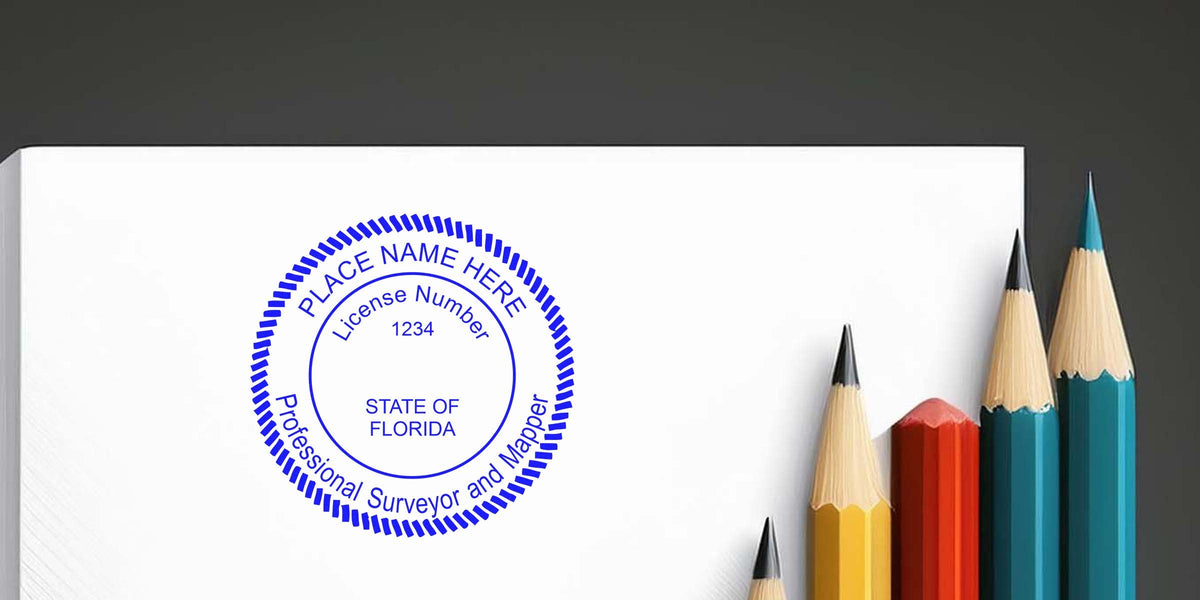
Most states publish one seal design. Florida surveying publishes five and then tells you which one you are allowed to use. Florida Administrative Code rule 5J-17.060(1) establishes five acceptable forms, whether impression or ink stamp, printed as figures numbered I through V. Seal I is reserved to people who on 30 June 1995 were in good standing under both chapter 471 and chapter 472. Seal II is for registrants licensed as of that same date. Seal III belongs to those initially licensed on or after 1 July 1995 and before 1 October 2002. Registrants initially licensed on or after 30 June 2002 “shall use only Seal IV,” and subsection (6) adds that “All registrants may use Seal IV.” Surveyors and mappers granted a temporary certificate use Seal V.
The practical consequence is that Seal IV is the only universally safe order. A newly licensed Florida surveyor may use nothing else, and a long established one may move to it voluntarily. Nothing may be added to whichever form applies.
No diameter is prescribed anywhere. Rule 5J-17.060 gives the forms as figures and states no size, and section 472.025 states none either, so any diameter presented as the Florida surveying standard is a trade convention rather than a Board specification. What the rule fixes is which of the five forms applies to you.
Florida land surveyor seal requirements at a glance
| Requirement | Florida rule | Source |
|---|---|---|
| Seal required | Yes | Fla. Stat. § 472.025(1) |
| Required elements | One of the five Board approved seal forms, numbered I through V, shown in the rule; Your name and PSM number as carried in the approved form; The form appropriate to your licensure vintage or your temporary certificate | Fla. Admin. Code r. 5J-17.060(1) to (7) |
| Size and shape | Not addressed. Rule 5J-17.060 prescribes five seal forms as figures and states no diameter, and section 472.025 states none either. Checked the whole of rule 5J-17.060, the electronic sealing rule 5J-17.062 and section. | Fla. Admin. Code r. 5J-17.060 (silent) |
| Device allowed | Impression or ink stamp for paper, with a computer generated representation allowed only under conditions. | Fla. Admin. Code r. 5J-17.060(1), 5J-17.062(2) |
| Signature and date | Signature, date and seal, and if the seal is computer generated a specific sentence has to travel with it. | Fla. Stat. § 472.025(1) |
| What must be sealed | Final drawings, plans, specifications, plats and reports prepared or issued in accordance with the board’s standards of practice. | Fla. Stat. § 472.025(1), (3) |
| Electronic seal | An electronic signature carries the same weight as an original, and the rule sets four tests and an alternative. | Fla. Admin. Code r. 5J-17.062 |
| Renewal and lapse | Section 472.025(2) makes it unlawful “for a person to stamp, seal, or digitally sign a document with a seal or digital signature after his or her certificate of registration has expired or been revoked or suspended, unless such certificate of registration has been reinstated or reissued.” Note the digital signature is named alongside the physical seal, which is not true of the older statutes in other states. | Fla. Stat. § 472.025(2) |
| Firm requirements | Required. Section 472.021, Certification of partnerships and corporations, provides that “a certificate of authorization shall be required for a corporation, partnership, association, or person practicing under a. | Fla. Stat. §§ 472.021, 472.025(1) |
| Regulator | The Florida Board of Professional Surveyors and Mappers, within the Department of Agriculture and Consumer Services | Fla. Stat. ch. 472, principally §§ 472.021 and 472.025, 2024 edition |
Is a seal required in Florida?
Florida Statutes section 472.025(1) directs the board to adopt by rule “a form of seal to be used by all registrants holding valid certificates of registration, whether the registrants are corporations, partnerships, or individuals,” and then imposes the duty: “All final drawings, plans, specifications, plats, or reports prepared or issued by the registrant in accordance with the standards of practice established by the board shall be signed by the registrant, dated, and stamped with his or her seal.” The board has answered subsection (1) with five numbered seal forms in Florida Administrative Code rule 5J-17.060, and which one a registrant may use depends on when that registrant was licensed.
What must appear on the seal
- One of the five Board approved seal forms, numbered I through V, shown in the rule
- Your name and PSM number as carried in the approved form
- The form appropriate to your licensure vintage or your temporary certificate
There is no design freedom at all, and the right answer depends on a date. Rule 5J-17.060(1) establishes five acceptable forms of seal, whether impression or ink stamp, printed as figures numbered I through V. Seal I may be used only by registrants in good standing under both chapter 471 and chapter 472 as of 30 June 1995. Seal II may be used only by registrants licensed as of 30 June 1995. Seal III is only for registrants initially licensed on or after 1 July 1995 and before 1 October 2002. Registrants initially licensed on or after 30 June 2002 “shall use only Seal IV,” and subsection (6) adds that “All registrants may use Seal IV.” Surveyors and mappers granted a temporary certificate to practice in Florida are required to use Seal V. Nothing may be added to whichever form applies.
Size and shape
Not addressed. Rule 5J-17.060 prescribes five seal forms as figures and states no diameter, and section 472.025 states none either. Checked the whole of rule 5J-17.060, the electronic sealing rule 5J-17.062 and section 472.025. Any diameter a supplier presents as the Florida surveying standard is a trade convention rather than a Board specification; what the rule fixes is which of the five forms applies.
Embosser, rubber stamp or digital
Impression or ink stamp for paper, with a computer generated representation allowed only under conditions. Rule 5J-17.060(1) establishes the five forms “whether impression or ink stamp.” Rule 5J-17.062(2) then draws the line for electronic work: a license holder may use a computer generated representation of the seal on electronically conveyed work, “however, the final hard copy documents of such surveying or mapping work must contain an original signature and seal of the license holder and date or the documents must be accompanied by an electronic signature as described in this section.” The same subsection bans the scanned signature image outright: “A scanned image of an original signature shall not be used in lieu of an original signature and seal or electronic signature.”
Signing and dating
Signature, date and seal, and if the seal is computer generated a specific sentence has to travel with it. Section 472.025(1) requires the registrant to sign, date and stamp final drawings, plans, specifications, plats or reports. Rule 5J-17.062(2) adds that surveying or mapping work containing a computer generated seal “shall be accompanied by the following text or similar wording: ‘The seal appearing on this document was authorized by [Example: Leslie H. Doe, P.S.M. 0112 on (date)]’” unless an electronic signature as described in the rule accompanies it instead.
Five seals, and yours depends on the year you were licensed
Most states publish one seal design. Florida surveying publishes five and then tells you which one you are allowed to use. Rule 5J-17.060 lists Seals I through V. Seal I is reserved to people who on 30 June 1995 were in good standing as both engineers under chapter 471 and surveyors under chapter 472. Seal II is for registrants licensed as of that same date. Seal III belongs to those initially licensed on or after 1 July 1995 and before 1 October 2002. Seal IV is mandatory for anyone initially licensed on or after 30 June 2002, and subsection (6) makes Seal IV available to everyone. Seal V is for holders of a temporary certificate to practice in Florida.
Which documents must be sealed
Final drawings, plans, specifications, plats and reports prepared or issued in accordance with the board’s standards of practice. Section 472.025(3) bars a registrant from affixing or permitting the affixing of the seal, the name or the digital signature “to any plan, specification, drawing, or other document which depicts work which he or she is not licensed to perform or which is beyond his or her profession or specialty therein,” which reaches across the specialties inside surveying and mapping as well as outside them.
Electronic and digital seals
An electronic signature carries the same weight as an original, and the rule sets four tests and an alternative. Rule 5J-17.062(3) defines an electronic signature as a digital authentication process attached to or logically associated with an electronic document that “shall carry the same weight, authority, and effect as an original signature and seal,” generated by either public key infrastructure or signature dynamics technology, and requires it to be unique to the person using it, capable of verification, under the sole control of that person, and linked to the document so that it is invalidated if any data in the document is changed. Rule 5J-17.062(4) offers an alternative signature file containing the surveyor and mapper’s name and PSM number. Rule 5J-17.062(1) states the base rule that information stored in electronic files representing plans, specifications, plats, reports or other documents that must be sealed under chapter 472 is to be signed, dated and sealed by the professional surveyor and mapper in responsible charge.
Renewal, lapse and retirement
Section 472.025(2) makes it unlawful “for a person to stamp, seal, or digitally sign a document with a seal or digital signature after his or her certificate of registration has expired or been revoked or suspended, unless such certificate of registration has been reinstated or reissued.” Note the digital signature is named alongside the physical seal, which is not true of the older statutes in other states. There is a repealed rule that still circulates: rule 5J-17.084, Surrender of Seal and Cancellation of Digital Signature, was repealed effective 13 November 2017, as was rule 5J-17.061, Seal and Signature. Guidance citing either is stale. The live rules are 5J-17.060 and 5J-17.062.
Firm requirements
Required. Section 472.021, Certification of partnerships and corporations, provides that “a certificate of authorization shall be required for a corporation, partnership, association, or person practicing under a fictitious name, offering surveying and mapping services to the public,” with a limited exception for an individual practicing under that individual’s own legal name. Rule 5J-17.063 carries the board’s certificate of authorization rule. Section 472.025(1) is unusual in contemplating that a registrant may be a corporation or partnership as well as an individual, but the five seal forms in rule 5J-17.060 are keyed to individual licensure vintage, so firm information does not belong on the die.
What to check before you order
Order the Board seal form that matches your licensure history, as printed in Florida Administrative Code rule 5J-17.060. If you were initially licensed on or after 30 June 2002 you must use Seal IV, and Seal IV is available to every registrant, so it is the safe order in almost every case. Holders of a temporary certificate use Seal V. The rule accepts either an impression or an ink stamp; an ink stamp reproduces better on recorded plats. No diameter is prescribed, so choose a size that keeps your name and PSM number legible. If you apply a computer generated seal to electronic work, remember that the document needs either a qualifying electronic signature or the authorization sentence naming you, your PSM number and the date.
Browse land surveyor stamps and seals.
- What You Need to Know About Florida Land Surveyor Stamp Cost
- Get It Right: Florida Land Surveyor Seal Embosser Tips
Frequently asked questions
Is a seal required for surveyors and mappers in Florida?
Yes. Florida Statutes section 472.025(1) directs the board to adopt by rule “a form of seal to be used by all registrants holding valid certificates of registration, whether the registrants are corporations, partnerships, or individuals,” and then imposes the duty: “All final drawings, plans, specifications, plats, or reports prepared or issued by the registrant in accordance with the standards of practice established by the board shall be signed by the registrant, dated, and stamped with his or her seal.”
Which Florida seal form applies to me?
It depends on when you were first licensed. Seal I is for registrants in good standing under both chapter 471 and chapter 472 as of 30 June 1995. Seal II is for registrants licensed as of 30 June 1995. Seal III is only for registrants initially licensed on or after 1 July 1995 and before 1 October 2002. Seal IV is mandatory for anyone initially licensed on or after 30 June 2002 and is available to every registrant. Seal V is for holders of a temporary certificate to practice in Florida.
What size is a Florida surveyor and mapper seal?
No size is prescribed. Rule 5J-17.060 gives the five forms as figures and states no diameter, and section 472.025 states none. Choose a size that keeps your name and PSM number legible after the document is copied and recorded.
Impression or ink stamp in Florida?
Either. Rule 5J-17.060(1) establishes the five forms “whether impression or ink stamp.” An ink stamp reproduces better on recorded plats. A computer generated representation of the seal has its own conditions under rule 5J-17.062(2).
What is required when I use a computer generated seal in Florida?
Rule 5J-17.062(2) permits a computer generated representation of the seal on electronically conveyed work, “however, the final hard copy documents of such surveying or mapping work must contain an original signature and seal of the license holder and date or the documents must be accompanied by an electronic signature as described in this section.” Work carrying a computer generated seal also has to be accompanied by “the following text or similar wording: ‘The seal appearing on this document was authorized by [Example: Leslie H. Doe, P.S.M. 0112 on (date)]’” unless a qualifying electronic signature accompanies it instead.
Can I use a scanned signature in Florida?
No. Rule 5J-17.062(2) bans it outright: “A scanned image of an original signature shall not be used in lieu of an original signature and seal or electronic signature.”
What counts as an electronic signature in Florida surveying?
Rule 5J-17.062(3) defines it as a digital authentication process attached to or logically associated with an electronic document that “shall carry the same weight, authority, and effect as an original signature and seal,” generated by either public key infrastructure or signature dynamics technology, and requires it to be unique to the person using it, capable of verification, under the sole control of that person, and linked to the document so that it is invalidated if any data is changed. Rule 5J-17.062(4) offers an alternative signature file containing the surveyor and mapper’s name and PSM number.
What may I not seal in Florida?
Anything outside your license. Section 472.025(3) bars a registrant from affixing or permitting the affixing of the seal, the name or the digital signature “to any plan, specification, drawing, or other document which depicts work which he or she is not licensed to perform or which is beyond his or her profession or specialty therein,” which reaches across the specialties inside surveying and mapping as well as outside them.
What happens if my Florida registration lapses?
Section 472.025(2) makes it unlawful “for a person to stamp, seal, or digitally sign a document with a seal or digital signature after his or her certificate of registration has expired or been revoked or suspended, unless such certificate of registration has been reinstated or reissued.” The digital signature is named alongside the physical seal, which is not true of the older statutes in other states. Note that two rules people still cite are gone: rule 5J-17.061, Seal and Signature, and rule 5J-17.084, Surrender of Seal and Cancellation of Digital Signature, were both repealed effective 13 November 2017. The live rules are 5J-17.060 and 5J-17.062.
Does a Florida surveying firm need a certificate of authorization?
Yes. Section 472.021 provides that “a certificate of authorization shall be required for a corporation, partnership, association, or person practicing under a fictitious name, offering surveying and mapping services to the public,” with a limited exception for an individual practicing under that individual’s own legal name, and rule 5J-17.063 carries the board’s rule. Section 472.025(1) is unusual in contemplating that a registrant may be a corporation or partnership as well as an individual, but the five seal forms are keyed to individual licensure vintage, so firm information does not belong on the die.








