
Choosing a Maryland geologist stamp is simpler than most guides make it sound, mainly because Maryland asks nothing of it. The state has no Board of Professional Geologists and no geologist license, so there is no prescribed wording, no set diameter and no design to match. Every choice below is about how you want the mark to look and work, not about clearing a state standard.
That is a better starting point than it sounds. A geologist's stamp in Maryland is a presentation tool: it puts your name on reports, maps, transmittals and proposals in a way that reads as deliberate. This guide walks through style, materials, wording, size, cost, customization and where to order, and it tells you what to skip. For the licensing picture and the sources behind it, read Maryland Geologist Stamps: Nobody Sets the Design but You.
Understand What Maryland Actually Asks
Maryland's Department of Labor runs occupational licensing through its Division of Occupational and Professional Licensing, and the Division's published inventory names twenty one boards, commissions and programs, covering architects, professional engineers, land surveyors, foresters and landscape architects among others. There is no geologists board on that list, and Maryland issues no geologist license, registration or certification.
- No license to hold. Maryland issues no geologist license or registration, so there is no state license number to put on a seal.
- No seal rule. With no credential, there is no provision telling a geologist in Maryland when to seal a document.
- No prescribed design. Nothing in the state's rules sets the shape, diameter, border or wording of a geologist's stamp.
- A narrow, separate credential exists. The Maryland State Board of Well Drillers licenses well drillers, pump installers and water conditioner installers. That is a drilling license under the Department of the Environment, not a geologist license, and it sets nothing about a geologist's stamp.
Vendor sites often list Maryland as a geologist licensing state. On the state's own board inventory and its own regulation index, it is not one. If a supplier offers to make your stamp match Maryland's geologist specifications, they are describing something that does not exist.
Explore Different Stamp Styles
Style here means how the stamp holds and delivers ink. Each one suits a different pace of work.


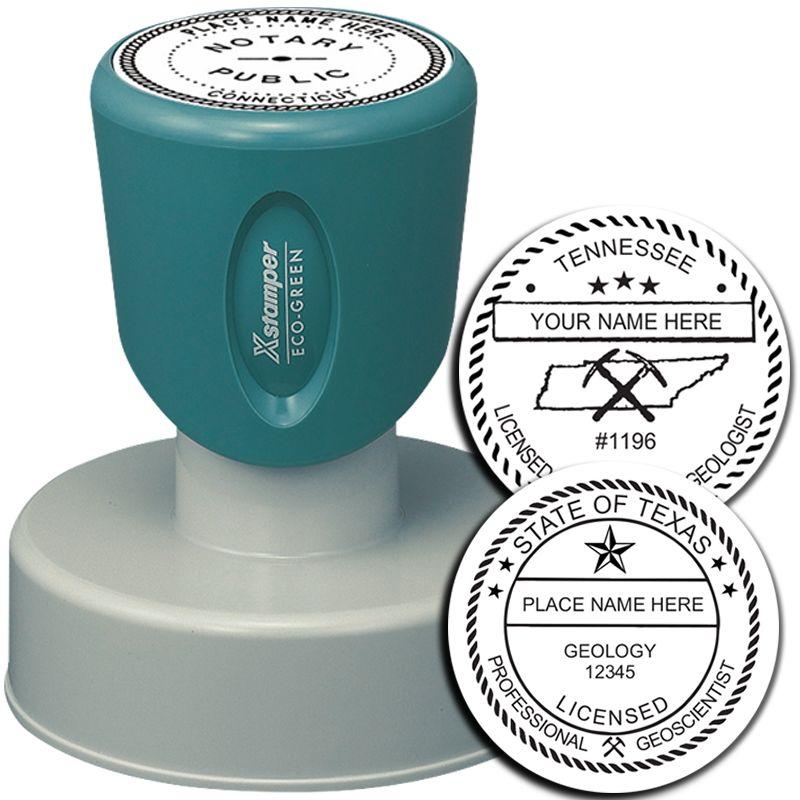



Self-Inking Stamps
A self inking stamp carries its own ink pad and inks the die after every impression. Press and lift, and it is ready again. This is the practical choice if you stamp a stack of reports at a sitting.
- Strengths: fast, clean, nothing extra to carry
- Trade-offs: the pad dries out eventually
Pre-Inked Stamps
A pre inked stamp holds ink inside the die material itself, which gives it the finest detail of the three and a quiet press. It is the one to pick when your mark has small type or several lines.
- Strengths: sharpest impression, high impression count
- Trade-offs: usually costs more
Traditional Rubber Stamps
A wood handle stamp needs a separate pad, which is the point for some people: you pick the ink color and control how much goes on the die.
- Strengths: choice of ink colors, lowest cost, simple to swap a pad
- Trade-offs: a pad to carry, and a messier press in a bag or a truck
Think about how often you stamp and where. Field geologists working out of a vehicle tend to prefer a self inking or pre inked mount that closes on its own ink. If your stamping happens at a desk, a wood handle and a pad work fine.
Consider Materials And Durability
Maryland geologists work indoors and out, and a stamp that lives in a field bag takes more abuse than one in a drawer.
- Casing. On a self-inking stamp or a pre inked mount, look for a rigid housing that will not flex when you press it on an uneven surface.
- Ink life. Ask how many impressions the pad is rated for.
- Grip. If you stamp many documents at once, a wider handle is easier on your hand than a narrow one.
- Die quality. A deep, cleanly cut die holds fine lines. A shallow one fills in and goes gray early.


Decide What The Stamp Should Say
With nothing prescribed, wording is the decision that matters most. Common choices:
- Your full name as you sign it
- The title you use professionally, for example Professional Geologist
- A registration from a state that does issue one, with that state named
- Firm name, city, or a contact line
One thing to avoid: wording that suggests Maryland issued you a geologist credential. A mark reading Registered Professional Geologist with Maryland around the border reads as a state registration to anyone who sees it, and Maryland has none to give. Name the issuing state if you hold a registration elsewhere, or keep the mark to your name and title.
Gauge The Right Stamp Size
Size is a legibility question here, not a rules question.
- Legibility after copying. Documents get scanned, faxed and photocopied. Type that is tight at full size turns to mush on the third copy.
- Line count. The more lines you want, the wider the die has to be. Three short lines fit where four long ones will not.
- Where it lands. If you stamp into a signature block or a title block, measure that space before you pick a size.
Ask your supplier to lay out your exact text at the sizes you are considering and compare the proofs side by side. That five minute check settles the question better than any dimension chart.
Factor In Cost And Budget
Price moves with the mount, the die size and the impression volume you are buying for.
- Mount type. Wood handle stamps sit at the low end, self inking in the middle, pre inked mounts and embossers higher.
- What comes with it. A digital seal file included with the order saves you buying or scanning one separately.
There is no state standard to clear, so buy on how much you will use it. Someone stamping twice a month and someone stamping daily should not buy the same mount.


Personalize Your Stamp
Personalizing is the main advantage of a state that prescribes nothing.
- Layout. Round, oval or rectangular, with your name on the outer ring or centered. It is your call.
- Firm consistency. If your company uses a particular typeface or mark, carrying it onto your stamp keeps your paperwork looking like one set of documents.
- Accuracy over decoration. Whatever you add, keep every claim on it true and every line readable.
Consider Ordering Online
Ordering online gets you a proof you can look at before anything is made, which is the part that prevents reprints.
- Preview the design. Look for a supplier that sends a digital proof with your exact text set.
- Check the turnaround. Confirm production and shipping time against your deadline before you order.
- Keep the proof. Save it, so you can compare it against what arrives.
Acorn Sales: A Trusted Supplier
Acorn Sales has been in business since 1964, making stamps and seals for professionals. Because Maryland sets no geologist seal design, we start from your text and the size you need rather than from a state template.
- Free digital seal. Your order includes a digital version for electronic reports and PDFs.
- Proof before production. You see the layout set at finished size before the die is cut.
If you want a second pair of eyes on your wording, contact us with the text and we will set a proof.
Summarize The Key Steps
- Read the licensing picture, so you know Maryland asks nothing
- Settle your wording and check every claim on it
- Pick a mount that matches how often you stamp
- Choose a size that stays legible after copying
- Compare cost against use, not against a standard
- Order from a supplier that proofs before production
- Read the proof letter by letter
A Maryland geologist stamp is office equipment with your name on it, and it earns its keep by making your documents look like the work of someone who signs what they send. That is worth the twenty minutes it takes to get the wording right.
Frequently Asked Questions
Does Maryland Ask Geologists To Use a Stamp?
No. Maryland has no geologist license and no board for geologists, so no state rule asks a geologist here to seal anything. People buy a stamp because it identifies the author on a report and finishes the page, not to satisfy a rule.
Do I Need Both a Seal and a Stamp?
Neither is asked for, so this is a preference. An inked stamp copies and scans well, which matters for documents that get reproduced. An embosser leaves a raised impression that reads well on a cover sheet or a bound original. Some people keep both, for those two uses.
How Do I Confirm My Design Is Right?
There is no state design to check it against. Read the proof for spelling, make sure every credential named on it is one you hold and shows the state that issued it, and confirm the type is legible at the finished size.
Can I Make Design Changes in the Future?
Yes. If your name, firm or details change, order a new stamp with the updated text. Send the exact wording you want and we will set a proof from it.
Are There Any Limitations on Stamp Size?
Not from the state. The practical limits are the space you stamp into and how small the type can get while staying readable on a photocopy.
Is There a Typical Price Range for a Quality Stamp?
Price depends on the mount, the die size and whether you add an embosser, so check the current listing for the style you want. Buying for the volume you actually stamp matters more than the gap between two nearby price points.