
When you are certified as a notary in the State of North Carolina, it means many things. First, your status proves that you have done the mandatory six-hours of training in a state-approved course. If you are renewing your commission, it means you have been able to repeatedly pass the exam, as well. Second, it means you need the essential North Carolina notary supplies, including your seal.
Requirements for the Design of Your North Carolina State Notary Public Seal
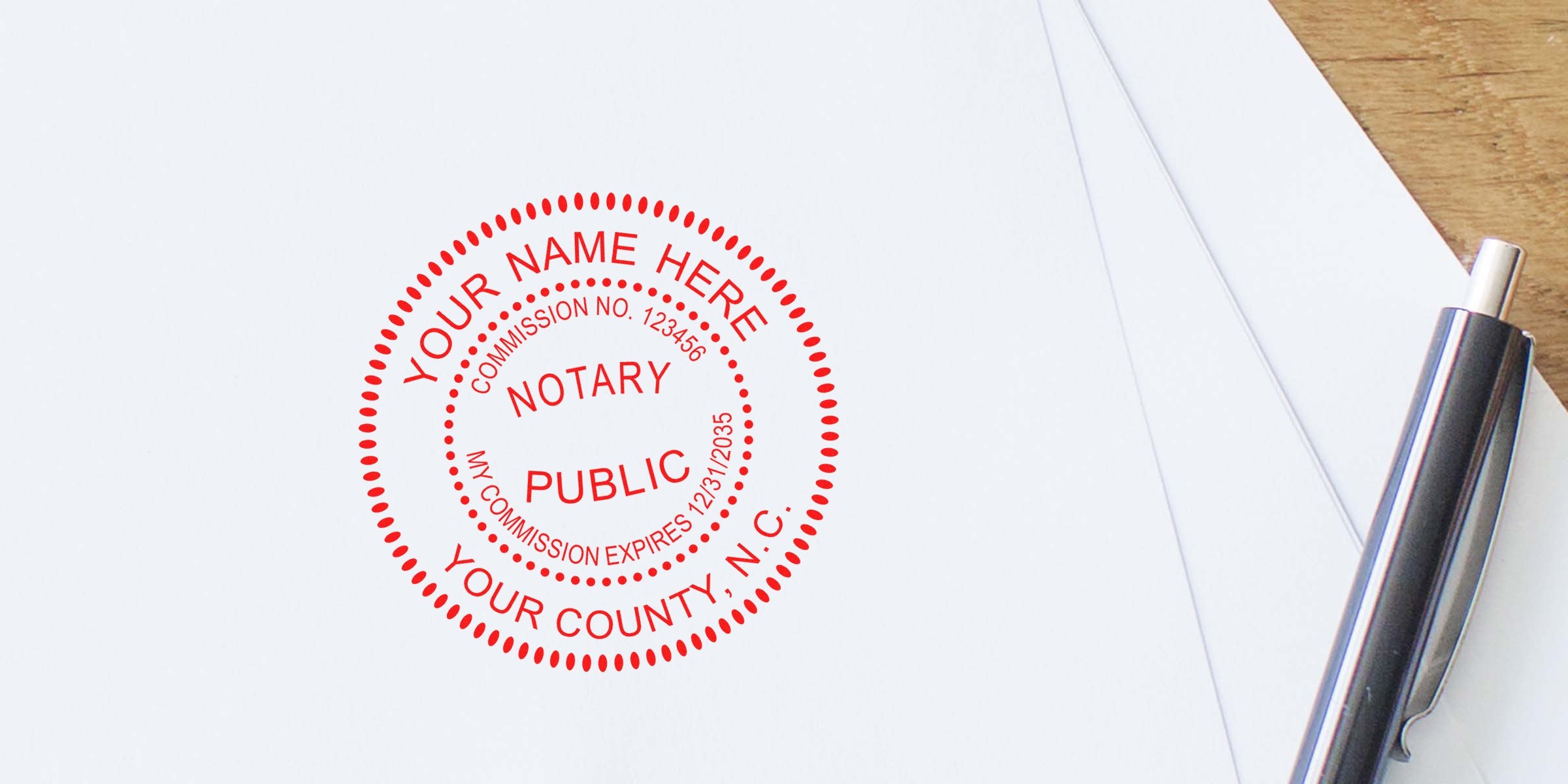
In North Carolina, your seal has to be capable of being photographically reproducible, which means that the most important of all North Carolina notary supplies is the rubber stamp you use to mark your work.
It has to meet the state's design and sizing criteria too, and these are:
- It must display your name, as commissioned
- The title "Notary Public" must appear on the seal
- The state name written out as "North Carolina" is required, or "N.C." may be used as well
- It can be rectangular in shape (no larger than 1" x 2.5") or circular (not exceeding 1.5" in diameter)
- There must be a visible border around the seal
- A seal may indicate the current expiration date for the notary's commission
Of course, before you can obtain a properly designed seal, you must count the official Notary Certificate among your North Carolina notary supplies.
Without this, a producer of seals is unable to provide you with the rest of your mandatory North Carolina notary supplies. Note that your commission number is not the same as the expiration, and it is not advised that any notary publicize their commission number.
With the Notary Certificate and seal, you can then consider your other North Carolina notary supplies.
Other Necessary Supplies for a North Carolina Notary
Unlike many other states, North Carolina notary supplies are limited to just a few things. As already mentioned, you have to get the education and pass the exam, but those are not actual North Carolina notary supplies. Realistically, it is the certification, commission, and the seal that count as your key North Carolina notary supplies.
The seal, as described, can be in the form of a rubber or inked stamp, or it may be an embossing seal. The key is to be sure that the impression is photographically reproducible no matter how it is imprinted.
As is the case in many states, the North Carolina notary supplies can include a notary journal or record book, but the state laws do not make this obligatory. During each five-year term of office, any notary will have the responsibility for:
- Administering oaths
- Administering affirmations
- Taking acknowledgements
- Taking proofs
- Taking verifications
And although these are all very unique and significant matters, the state does not require their notaries to keep journals or record books. However, it is always advisable to use them as part of your North Carolina notary supplies. Why? The state also has no requirement for a notary bond or surety bond, and that means that any legal questions that arise may be challenging to handle without thorough records of any specific transaction.
Though your list of essential North Carolina notary supplies is extremely short and limited strictly to a commission (and Notary Certificate), a seal (embosser or inked stamp), and the obligatory training and examination, you still want to be certain that you obtain any and all supplies from the most trusted resources possible.
Other Things to Consider
For the examination and education, simply be sure you are working in a state-approved course (most community colleges offer them). For your seal, it is best if you work with a firm that has experience in creating the devices. They understand size limitations, the specific images or designs the states require, and they tend to offer products that can endure the length of the commission.
In North Carolina, you will have to use your seal for five years before replacing it with new commission expiration information. Be sure you purchase a seal that can withstand this prolonged use, printing clearly and sharply every time you perform your duty for the state.
Frequently Asked Questions
What North Carolina notary supplies are required to become a notary public?
The essential North Carolina notary supplies are your commission, your Notary Certificate, and a compliant notary seal. While not required by law, many notaries also choose to use a notary journal for better recordkeeping.
What are the North Carolina notary stamp and seal requirements?
Your North Carolina notary seal must be photographically reproducible and include your name as commissioned, the words “Notary Public,” and either “North Carolina” or “N.C.” It must also have a visible border and meet the state’s size limits: rectangular seals cannot exceed 1" x 2.5", and circular seals cannot exceed 1.5" in diameter.
Do North Carolina notaries need a journal or record book?
North Carolina law does not require notaries to keep a journal or record book, but it is strongly recommended. A journal can help you document notarizations, protect yourself if questions arise, and keep accurate records throughout your five-year commission.
What is the difference between a North Carolina notary seal and an embosser?
A North Carolina notary seal can be an inked rubber stamp or an embossing seal, but the impression must be photographically reproducible. Many notaries prefer an inked stamp because it creates a clear image on standard documents, while an embosser may be used as a supplemental tool if the impression remains readable.
Do I need my Notary Certificate to order a North Carolina notary stamp?
Yes, you need your official Notary Certificate before a vendor can produce your North Carolina notary stamp or seal. The certificate confirms your commission details and allows the seal to be created with the correct commissioned name and information.
How often should I replace my North Carolina notary seal?
You should replace your North Carolina notary seal when your commission is renewed or if the seal becomes worn and no longer prints clearly. Since North Carolina notaries serve five-year terms, it is important to keep your seal current and legible for the full commission period.








