

Written by Acorn Sales Company, manufacturing stamps and seals since 1964 · Reviewed by Holly R, VP of Sales and Marketing at Acorn Sales, against the Indiana State Board of Registration for Professional Engineers and 864 IAC 1.1-7-3(c) on 21 September 2026 · Updated 21 September 2026
Indiana takes the opposite position from the boards that want you to sign through the impression. 864 IAC 1.1-7-3(b) requires the registrant’s signature and “the date the seal is being affixed” to be placed directly adjacent to the seal, but not across the seal. That is a layout requirement as much as a signing one: an impression at the top of the permitted size range, crowded into a title block, leaves no compliant place to sign.
The die runs generally between 1-5/8 and 1-7/8 inches outside diameter under 864 IAC 1.1-7-2(a), with a milled edge or two concentric circles matching the edges of the milling. Inside go your name and registration number exactly as they read on the certificate of registration, plus the legend professional engineer. The only permitted deviation is the prefix: “the letters ‘PE’ may be excluded from the certificate number.”
That name rule cuts harder than buyers expect. A nickname, a dropped middle initial or a married name not yet reported to the board makes the device non-compliant, because the rule ties the inscription to the certificate rather than to how the registrant signs.
Indiana PE seal requirements at a glance
| Requirement | Indiana rule | Source |
|---|---|---|
| Seal required | Yes | 864 IAC 1.1-7-3(c) |
| Required elements | Your name exactly as on the certificate of registration; Your registration number exactly as on the certificate; The legend “professional engineer”; The board design: milled edge or two concentric circles | 864 IAC 1.1-7-2(a), (c) |
| Size and shape | Generally between 1-5/8 inches and 1-7/8 inches outside diameter. | 864 IAC 1.1-7-2(a) |
| Device allowed | All three families are expressly legal. 864 IAC 1.1-7-2(b): the seal “may be embossed, electronically applied to a drawing, or applied by a rubber stamp in conformance with the design as shown in subsection (a).” Indiana names the rubber stamp in the rule itself, so an inked rubber or self-inking stamp is the safe buy for paper, and a matching electronic image covers digital delivery. | 864 IAC 1.1-7-2(b) |
| Signature and date | Indiana pins both the signature and a date beside the seal and forbids putting either on top of it. 864 IAC 1.1-7-3(b): whenever a registrant affixes the seal, it shall have “the registrant’s original handwritten, electronic, or other signature recognized under Indiana law” and “the date the seal is being affixed” placed “directly adjacent to the seal, but not across the seal.” The date is therefore the sealing date, not a drawing revision date. | 864 IAC 1.1-7-3(a), (b), (e) |
| What must be sealed | Every page of plans or drawings and the title page of every specification, once the work is in responsible charge and is required to be submitted for review by the state building commissioner or another governmental body: 864 IAC 1.1-7-3(c). | 864 IAC 1.1-7-3(c), (d) |
| Electronic seal | Indiana allows an electronic seal and an electronic signature without naming any cryptographic standard. 864 IAC 1.1-7-2(b) permits the seal to be “electronically applied to a drawing.” 864 IAC 1.1-7-3(b) accepts an electronic signature and defines it as “an electronic sound, symbol, or process attached to or logically associated with an electronic record and executed or adopted by a person with the intent to sign the electronic record.” That is the general Indiana electronic-records definition. | 864 IAC 1.1-7-2(b) |
| Renewal and lapse | Registration renews biennially. 864 IAC 1.1-8-1(2) provides that when the renewal fee is not paid on time the certificate of registration “becomes invalid” and the individual “cannot lawfully practice or offer to practice engineering” until the renewal fee, the delinquent fee and all reinstatement requirements are met. | 864 IAC 1.1-8-1 |
| Firm number on documents | No firm seal and no firm number on the document. | IC 25-31-1-18 |
| Licensing board | The Indiana State Board of Registration for Professional Engineers | 864 IAC 1.1 (Rule 7, Registrant’s Seal; Rule 8, Renewal; Rule 9, Name |
Rules for other states are on PE stamp requirements by state.





Is a seal required in Indiana?
Indiana requires a seal Indiana requires a seal on engineering documents that go to a reviewing authority. The statute grants the authority: IC 25-31-1-16(b) lets a registrant with a valid certificate apply the seal to “plans, specifications, studies, drawings, and reports” and makes that act an attestation of responsibility. The mandatory duty sits in the board rule. Under 864 IAC 1.1-7-3(c), when a registrant is in responsible charge of engineering work for which specifications, plans and drawings “are required to be submitted for review by the state building commissioner or other governmental body,” the registrant shall apply the seal “on each page of all drawings or plans and on the title page of all specifications.” IC 25-31-1-19(a) adds that a political subdivision may not build or maintain public work whose plans, specifications and estimates were not “prepared, certified, and sealed by” a professional engineer, and that a contract executed in violation is void.
What must appear on the seal
- Your name exactly as on the certificate of registration
- Your registration number exactly as on the certificate
- The legend “professional engineer”
- The board design: milled edge or two concentric circles
The one express option is the prefix. 864 IAC 1.1-7-2(c) requires that the name and registration number inscribed on the seal “correspond to the name and certificate number inscribed on the certificate of registration,” but adds that “the letters ‘PE’ may be excluded from the certificate number.” That cuts both ways: a nickname, a dropped middle initial or a married name that has not yet been reported to the board makes the device non-compliant, because the rule ties the inscription to the certificate and not to what you signs. 864 IAC 1.1-9-1(b) gives a registrant thirty days to report a name change, and a new name on the certificate means a new seal. The rule also prescribes the border: “a milled edge, as shown, or two (2) concentric circles with the outer and inner circles corresponding with the respective edges of the milling.” Beyond those words, 864 IAC 1.1-7-2(a) prescribes the layout by reproducing a drawing rather than by text. The drawing is published as an image in the Indiana Administrative Code and could not be read as text from iar.iga.in.gov, so any further wording on the face should be copied from the board design itself, not inferred.
Size and shape
Generally between 1-5/8 inches and 1-7/8 inches outside diameter. The rule says the seal “shall generally be” within that band, which is a range and not a single figure, so a device anywhere inside it is compliant. The rule then permits reduction in reproduction: “Plans containing an engineer seal of specified size may be reduced as long as the seal remains legible.” That allowance is about shrinking the drawing, not about buying a smaller stamp.








Embosser, rubber stamp or digital
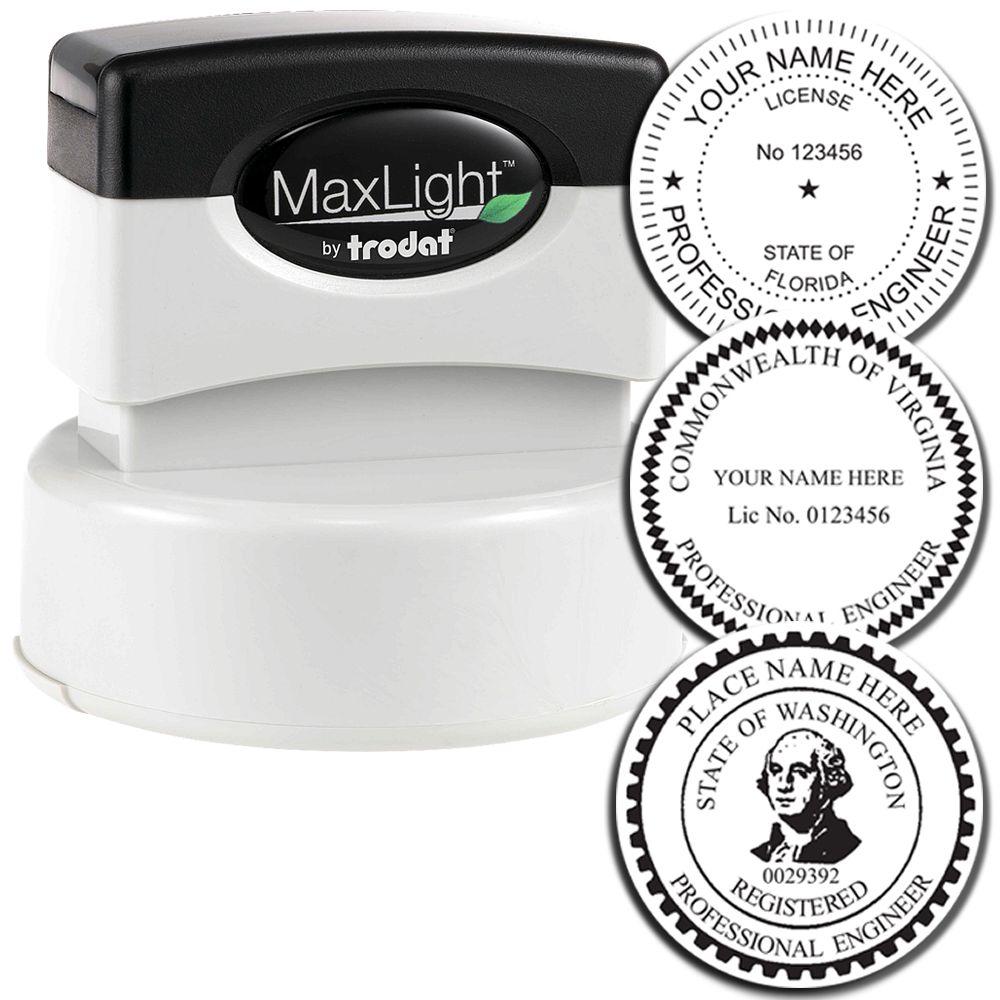
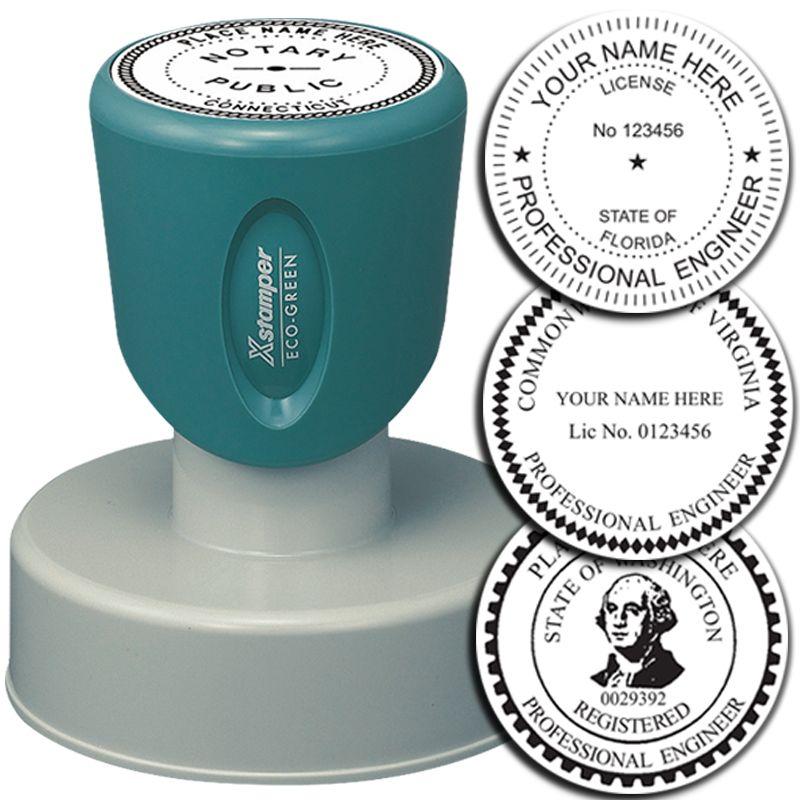
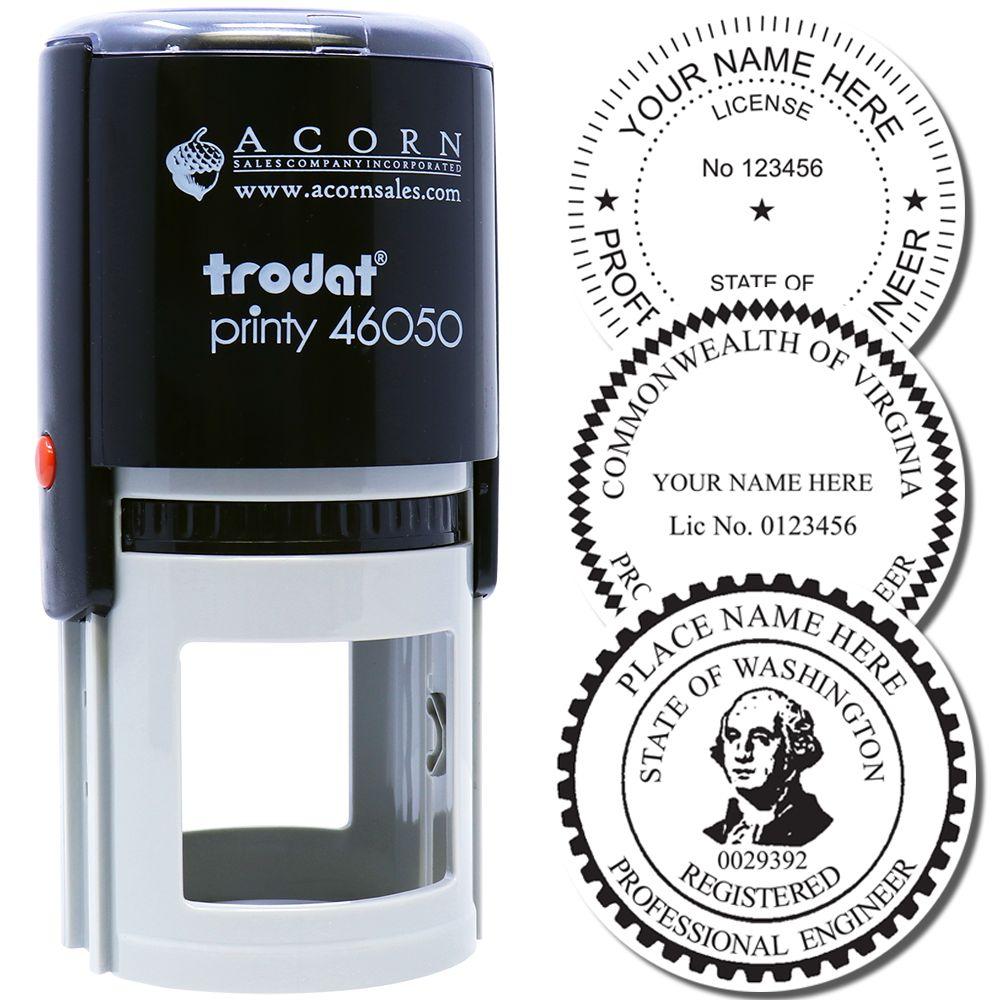
All three families are expressly legal. 864 IAC 1.1-7-2(b): the seal “may be embossed, electronically applied to a drawing, or applied by a rubber stamp in conformance with the design as shown in subsection (a).” Indiana names the rubber stamp in the rule itself, so an inked rubber or self-inking stamp is the safe buy for paper, and a matching electronic image covers digital delivery. An embosser alone is legal but weak in practice, because 864 IAC 1.1-7-3(a) puts the burden on the registrant to see that the seal “however affixed, and the signature shall be legible on the document,” and a blind emboss does not reproduce.
Signing and dating
Indiana pins both the signature and a date beside the seal and forbids putting either on top of it. 864 IAC 1.1-7-3(b): whenever a registrant affixes the seal, it shall have “the registrant’s original handwritten, electronic, or other signature recognized under Indiana law” and “the date the seal is being affixed” placed “directly adjacent to the seal, but not across the seal.” The date is therefore the sealing date, not a drawing revision date. A facsimile signature is not offered as an option; the rule contemplates an original handwritten signature or a recognized electronic one. Where a registrant takes responsibility for only part of the work, 864 IAC 1.1-7-3(e) requires wording below the signature and date “COVERING _____ DESIGN.”
The signature and date go beside the seal, never across it
Buyers who have sealed drawings in another state often arrive with a habit of signing through the impression, because several boards want the signature to cross the seal so that the seal cannot be lifted and reused. Indiana takes the opposite position. 864 IAC 1.1-7-3(b) requires the signature and the date to sit “directly adjacent to the seal, but not across the seal.”
Which documents must be sealed
Every page of plans or drawings and the title page of every specification, once the work is in responsible charge and is required to be submitted for review by the state building commissioner or another governmental body: 864 IAC 1.1-7-3(c). A registrant who is not in responsible charge of the whole job but accepts responsibility for part of it seals all pages of plans or drawings carrying that work and the title pages of the specifications carrying it: 864 IAC 1.1-7-3(d). Public work by a county, city, town, township or school corporation needs sealed plans, specifications and estimates or the contract is void: IC 25-31-1-19(a). Carve-outs are real and specific. IC 25-31-1-19(b) does not apply to architect-prepared plans, to structures listed in IC 22-15-3-3(a), or to plans or specifications in a permit application to the Indiana Department of Environmental Management under IC 13, unless a seal is required by other state or federal law, and it expressly does not require a seal for an air quality construction permit application under 326 IAC 2-1-3. IC 25-31-1-20 exempts employees and subordinates not in responsible charge, work on property the individual or business owns or leases where public health or safety is not involved, and engineering “which relates solely to the design or fabrication of manufactured products.”








Electronic and digital seals
Indiana allows an electronic seal and an electronic signature without naming any cryptographic standard. 864 IAC 1.1-7-2(b) permits the seal to be “electronically applied to a drawing.” 864 IAC 1.1-7-3(b) accepts an electronic signature and defines it as “an electronic sound, symbol, or process attached to or logically associated with an electronic record and executed or adopted by a person with the intent to sign the electronic record.” That is the general Indiana electronic-records definition. No public key infrastructure, no certificate authority, no FIPS standard and no tamper-evidence requirement appears in 864 IAC 1.1-7. A flattened image plus a typed or drawn signature and date satisfies the text of the rule.
Renewal, lapse and retirement
Registration renews biennially. 864 IAC 1.1-8-1(2) provides that when the renewal fee is not paid on time the certificate of registration “becomes invalid” and the individual “cannot lawfully practice or offer to practice engineering” until the renewal fee, the delinquent fee and all reinstatement requirements are met. IC 25-31-1-17(b) makes the expiration automatic, “without the board taking any action.” The seal follows the certificate: 864 IAC 1.1-7-3(a) allows the seal to be affixed “only during the time the certificate of registration is current and has not been suspended or revoked,” and IC 25-31-1-16(c) makes it unlawful for any person to stamp or seal a document after the certificate named on the seal has expired or been revoked. The registration number does not change on renewal. Nothing in 864 IAC 1.1 or IC 25-31-1 requires the physical device to be surrendered or destroyed, so the control is legal rather than custodial. A name change must be reported within thirty days under 864 IAC 1.1-9-1(b), and because the inscription must match the certificate, a reported name change forces a replacement device.
Firm registration
No firm seal and no firm number on the document. Indiana regulates the firm through the individual. IC 25-31-1-18(a) allows a registration certificate to issue “only to a natural person.” IC 25-31-1-18(b) bars a proprietorship, partnership or corporation from practicing or offering to practice unless the practice is carried on under the responsible direction and supervision of a registered professional engineer “who is a full-time employee of the business,” and requires that all plans, sheets of designs, specifications, reports, studies or other engineering documents requiring certification “carry the signature and seal of the registered professional engineer who is in responsible charge.” 864 IAC 1.1-14-1 applies the same test to a limited liability company, with the engineer a “full-time employee or member of the company.” So the only mark on the paper is the individual engineer’s.
What to check before you order
Take the inscription from your certificate of registration rather than your business card: the name and registration number have to correspond to the certificate, and the only permitted deviation is dropping the letters PE from the number. The outside diameter must fall generally between 1-5/8 and 1-7/8 inches, with a border that is a milled edge or two concentric circles matching the milling edges. Rubber stamps, embossers and electronic images are all named in the rule, so any of the three is available to you, and a rubber or self-inking stamp does most of the work because you are the one responsible for the seal being legible on the document. Leave room in the layout for a handwritten signature and a written date adjacent to the seal. No provision of 864 IAC 1.1 or IC 25-31-1 requires anyone to verify your licensure before the device is made.
Browse professional engineer stamps and seals.
Frequently asked questions
Is a PE seal required in Indiana?
Yes, on work headed for a reviewing authority. IC 25-31-1-16(b) lets a registrant with a valid certificate apply the seal to “plans, specifications, studies, drawings, and reports” and makes that an attestation of responsibility. The mandatory duty is in 864 IAC 1.1-7-3(c): where a registrant is in responsible charge of engineering work whose specifications, plans and drawings “are required to be submitted for review by the state building commissioner or other governmental body,” the registrant shall apply the seal “on each page of all drawings or plans and on the title page of all specifications.” IC 25-31-1-19(a) adds that a political subdivision may not build or maintain public work whose plans, specifications and estimates were not prepared, certified and sealed by a professional engineer, and that a contract executed in violation is void.
What goes on an Indiana PE seal?
Your name exactly as on the certificate of registration, your registration number exactly as on the certificate, the legend professional engineer, and the board design, which is a milled edge or two concentric circles with the outer and inner circles corresponding with the respective edges of the milling. 864 IAC 1.1-7-2(a) prescribes the rest of the layout by reproducing a drawing rather than by text, and that drawing is published as an image in the Indiana Administrative Code, so any further wording on the face should be copied from the board design rather than inferred.
What size is an Indiana PE seal?
Generally between 1-5/8 inches and 1-7/8 inches outside diameter, under 864 IAC 1.1-7-2(a). The rule says the seal “shall generally be” within that band, which is a range rather than a single figure, so any device inside it is compliant. The rule also permits reduction in reproduction: “Plans containing an engineer seal of specified size may be reduced as long as the seal remains legible.” That allowance is about shrinking the drawing, not about buying a smaller stamp.
Embosser, rubber stamp or electronic image in Indiana?
All three are expressly legal. 864 IAC 1.1-7-2(b) states that the seal “may be embossed, electronically applied to a drawing, or applied by a rubber stamp in conformance with the design as shown in subsection (a).” The inked rubber or self-inking stamp is the safe buy for paper, with a matching electronic image for digital delivery. An embosser alone is legal but weak in practice, because 864 IAC 1.1-7-3(a) puts the burden on the registrant to see that the seal, “however affixed, and the signature shall be legible on the document,” and a blind emboss does not reproduce.
Do I sign across an Indiana seal?
No. 864 IAC 1.1-7-3(b) requires the signature and the date to be placed “directly adjacent to the seal, but not across the seal.” Engineers who have sealed in states that want the signature to cross the impression have to unlearn the habit here.
Which date goes beside an Indiana seal?
The date the seal is being affixed, in the rule’s own words. It is not a drawing issue date and not a revision date, so a title block carrying those does not discharge the requirement, and the date changes each time the seal is applied. The signature beside it must be the registrant’s “original handwritten, electronic, or other signature recognized under Indiana law.” A facsimile signature is not offered as an option. Where a registrant takes responsibility for only part of the work, 864 IAC 1.1-7-3(e) requires wording below the signature and date reading “COVERING _____ DESIGN.”
Which Indiana documents have to be sealed, and what is exempt?
Every page of plans or drawings and the title page of every specification, once the work is in responsible charge and required to be submitted for review by the state building commissioner or another governmental body. A registrant who accepts responsibility for part of a job seals all pages of the plans or drawings carrying that work and the title pages of the specifications carrying it. Public work by a county, city, town, township or school corporation needs sealed plans, specifications and estimates or the contract is void. The carve-outs are specific: IC 25-31-1-19(b) does not apply to architect-prepared plans, to structures listed in IC 22-15-3-3(a), or to plans or specifications in a permit application to the Indiana Department of Environmental Management under IC 13 unless a seal is required by other state or federal law, and it expressly does not require a seal for an air quality construction permit application under 326 IAC 2-1-3. IC 25-31-1-20 exempts employees and subordinates not in responsible charge, work on property the individual or business owns or leases where public health or safety is not involved, and engineering “which relates solely to the design or fabrication of manufactured products.”
Can I seal an Indiana document electronically?
Yes, and no cryptographic standard is named. 864 IAC 1.1-7-2(b) permits the seal to be “electronically applied to a drawing,” and 864 IAC 1.1-7-3(b) accepts an electronic signature, defined as “an electronic sound, symbol, or process attached to or logically associated with an electronic record and executed or adopted by a person with the intent to sign the electronic record.” That is the general Indiana electronic-records definition. No public key infrastructure, certificate authority, FIPS standard or tamper-evidence requirement appears in 864 IAC 1.1-7.
Does an Indiana name change mean a new seal?
Yes. 864 IAC 1.1-7-2(c) requires the name and registration number inscribed on the seal to correspond to the name and certificate number on the certificate of registration, and 864 IAC 1.1-9-1(b) gives a registrant thirty days to report a name change. A new name on the certificate means the inscription no longer matches, so the device has to be replaced.
What happens to my Indiana seal if registration lapses?
Sealing stops with the certificate. 864 IAC 1.1-8-1(2) provides that when the renewal fee is not paid on time the certificate “becomes invalid” and the individual “cannot lawfully practice or offer to practice engineering” until the renewal fee, the delinquent fee and all reinstatement requirements are met, and IC 25-31-1-17(b) makes the expiration automatic “without the board taking any action.” 864 IAC 1.1-7-3(a) allows the seal to be affixed “only during the time the certificate of registration is current and has not been suspended or revoked,” and IC 25-31-1-16(c) makes it unlawful to stamp or seal a document after the certificate named on the seal has expired or been revoked. The registration number does not change on renewal, and nothing requires the physical device to be surrendered or destroyed, so the control is legal rather than custodial.
Does a firm number go on an Indiana sealed drawing?
No. Indiana regulates the firm through the individual. IC 25-31-1-18(a) allows a registration certificate to issue “only to a natural person,” and IC 25-31-1-18(b) bars a proprietorship, partnership or corporation from practicing unless the practice is carried on under the responsible direction and supervision of a registered professional engineer “who is a full-time employee of the business,” requiring that engineering documents needing certification carry the signature and seal of the engineer in responsible charge. 864 IAC 1.1-14-1 applies the same test to a limited liability company. The only mark on the paper is the individual engineer’s.








