
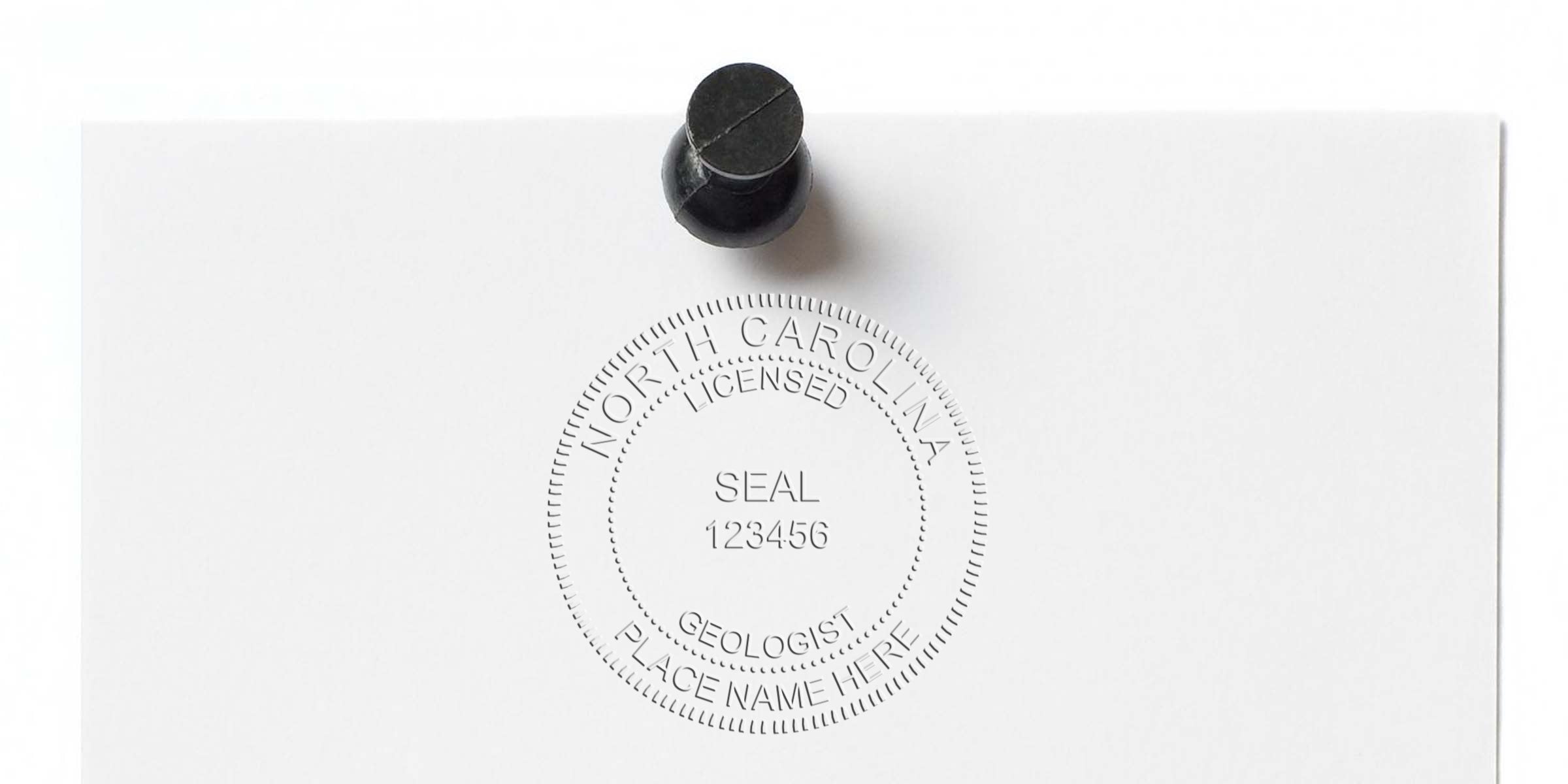
Written by Acorn Sales Company, manufacturing stamps and seals since 1964 · Reviewed by Holly R, VP of Sales and Marketing at Acorn Sales, against the North Carolina Board for Licensing of Geologists and N.C. Gen. Stat. § 89E-13 on 21 September 2026 · Updated 21 September 2026
North Carolina geologists do not buy this seal from a supplier. G.S. 89E-13 provides that “Each geologist licensed under this Chapter, upon the issuance of a license, shall obtain from the secretary at a cost prescribed by the Board, a seal of the design authorized by the Board bearing the licensee’s name and the legend ‘Licensed Geologist - State of North Carolina’.” The Board’s fee rule prices it at 21 NCAC 21.0107(a)(9): “Licensed geologist stamp or seal: cost plus $ 7.50.” The registered geological corporation seal comes from the Board as well, under 21 NCAC 21.0402(d), at cost plus the same handling charge. Order both from the North Carolina Board for Licensing of Geologists.
What the seal does not say is as notable as what it does. The statute names two content items, your name and the legend, and does not list the license number as a seal element. That is the opposite of the engineers and surveyors board a few chapters away, where G.S. 89C-16(c) puts the license number on the face. Assuming North Carolina practice is uniform across its design boards will get this wrong.
There is also no electronic seal provision at all. Chapter 89E and 21 NCAC 21 say nothing about a digital or electronic geologist seal, while 21 NCAC 56.1103(e) gives engineers and surveyors digital signature criteria and 21 NCAC 26.0207(h) gives landscape architects theirs. The statute speaks of a document impressed with the seal, which points to a physical impression, so ask the Board before relying on an electronic one.
North Carolina geologist seal requirements at a glance
| Requirement | North Carolina rule | Source |
|---|---|---|
| Seal required | Yes | N.C. Gen. Stat. § 89E-13 |
| Required elements | Your name as licensed, Licensed Geologist - State of North Carolina and The design authorized by the Board | N.C. Gen. Stat. § 89E-13 |
| Size and shape | Not addressed. No diameter appears in G.S. 89E-13 or anywhere in 21 NCAC 21. The sources here are chapter 89E in full and read 21 NCAC 21 in full, including.0105,.0107,.0303 and.0402. Because the Board supplies the. | N.C. Gen. Stat. § 89E-13 (silent) |
| Device allowed | Not a purchase decision. | N.C. Gen. Stat. § 89E-13 |
| Signature and date | Signature and seal, no date rule. | N.C. Gen. Stat. § 89E-13 |
| What must be sealed | All drawings, reports, or other geologic papers or documents involving geologic work prepared or approved by a licensed geologist, or by an exempted nonresident geologist, for delivery to any person or for public record in this State. | N.C. Gen. Stat. §§ 89E-6, 89E-7, 89E-13, 89E-18 |
| Electronic seal | Not addressed. Neither chapter 89E nor 21 NCAC 21 authorizes an electronic or digital geologist seal or names a standard. The sources here are 21 NCAC 21 in full and searched it for every occurrence of seal and stamp;. | N.C. Gen. Stat. ch. 89E (silent) |
| Renewal and lapse | G.S. 89E-12 governs issuance, renewal and replacement of licenses, and all licenses expire on July 1 under 21 NCAC 21.0107(b), with a fifty dollar late payment penalty between July 1 and August 1 and reinstatement thereafter under.0302. | N.C. Gen. Stat. § 89E-12 |
| Firm requirements | Yes, and the Board issues that seal too. | 21 N.C. Admin. Code 21.0402(d),.0107(a)(10),.0107(d) |
| Regulator | The North Carolina Board for Licensing of Geologists | N.C. Gen. Stat. ch. 89E, principally §§ 89E-6, 89E-7, 89E-12, 89E-13 and 89E-18, read from the North Carolina General Assembly |
Is a seal required in North Carolina?
North Carolina does not send its geologists to a stamp supplier. G.S. 89E-13 provides that “Each geologist licensed under this Chapter, upon the issuance of a license, shall obtain from the secretary at a cost prescribed by the Board, a seal of the design authorized by the Board bearing the licensee’s name and the legend ‘Licensed Geologist - State of North Carolina’.” The same section sets the duty: “All drawings, reports, or other geologic papers or documents involving geologic work that are prepared or approved by a licensed geologist, or a nonresident geologist who has been exempted under this Chapter, for delivery to any person or for public record in this State shall be signed by and impressed with the seal of the geologist.”
What must appear on the seal
- Your name as licensed
- Licensed Geologist - State of North Carolina
- The design authorized by the Board
Nothing is a choice, because you do not commission the device. G.S. 89E-13 names two content items, the licensee’s name and the legend, and leaves the design to the Board. Note what is absent: the statute does not list the license number as a seal element, which is unusual and is a reason not to reason by analogy from the engineer and surveyor seal at G.S. 89C-16(c), where the number is expressly required.
Size and shape
Not addressed. No diameter appears in G.S. 89E-13 or anywhere in 21 NCAC 21. The sources here are chapter 89E in full and read 21 NCAC 21 in full, including.0105,.0107,.0303 and.0402. Because the Board supplies the seal, the physical specification is whatever the Board’s authorized design is, and there is no figure for a supplier to work to.
Embosser, rubber stamp or digital
Not a purchase decision. The device comes from the Board. G.S. 89E-13 has the licensee obtain it “from the secretary at a cost prescribed by the Board,” and the fee schedule at 21 NCAC 21.0107(a)(9) prices it: “Licensed geologist stamp or seal: cost plus $ 7.50.” The Board passes on the cost of the device and adds a handling charge. A North Carolina geologist who walks into a stamp shop is in the wrong place.
Signing and dating
Signature and seal, no date rule. G.S. 89E-13 requires the covered documents to be “signed by and impressed with the seal of the geologist,” and states that “The signature and seal each indicate the geologist’s responsibility for the papers or documents.” Nothing requires the signature to cross the impression and nothing requires a date beside it. The sources here are chapter 89E in full and 21 NCAC 21 in full.
The Board sells you the seal, and it is the only lawful source
G.S. 89E-13 is unusual on its face: the licensee “shall obtain from the secretary at a cost prescribed by the Board” the seal of the design authorized by the Board. The Board’s own fee rule prices it at 21 NCAC 21.0107(a)(9), “Licensed geologist stamp or seal: cost plus $ 7.50,” and does the same for the corporate seal at (a)(10). A North Carolina geologist does not shop for this device. The registered geological corporation seal comes from the Board as well, under 21 NCAC 21.0402(d).
Which documents must be sealed
All drawings, reports, or other geologic papers or documents involving geologic work prepared or approved by a licensed geologist, or by an exempted nonresident geologist, for delivery to any person or for public record in this State. That reaches private client deliverables as well as public filings, which is broader than a public filing trigger. G.S. 89E-6 sets out exemptions and G.S. 89E-7 sets limitations. G.S. 89E-18 lists prohibitions and unlawful acts.
Electronic and digital seals
Not addressed. Neither chapter 89E nor 21 NCAC 21 authorizes an electronic or digital geologist seal or names a standard. The sources here are 21 NCAC 21 in full and searched it for every occurrence of seal and stamp; the references are the Board’s own seal at.0105, the fee items at.0107(a)(9) and (a)(10), the inactive status bar at.0303(d), and the corporate seal at.0402(d). The statute speaks of a document “impressed with the seal,” which points to a physical impression. That is a striking gap next to the neighboring boards, where 21 NCAC 56.1103(e) and 21 NCAC 26.0207(h) both set digital signature criteria.
Renewal, lapse and retirement
G.S. 89E-12 governs issuance, renewal and replacement of licenses, and all licenses expire on July 1 under 21 NCAC 21.0107(b), with a fifty dollar late payment penalty between July 1 and August 1 and reinstatement thereafter under.0302. Inactive status is the rule that touches the device: 21 NCAC 21.0303(d) provides that “A geologist with an inactive license shall no longer seal and certify documents with his or her seal,” and.0303(f) requires any reference to an inactive geologist to read Retired Geologist or N.C. Geology License No. __ (inactive). An individual may not stay inactive more than five years without Board permission before the license expires.
Firm requirements
Yes, and the Board issues that seal too. Rule 21 NCAC 21.0402(d) provides that “Each registered corporation or limited liability company shall obtain from the Board a seal approved by the Board,” containing the name of the corporation or limited liability company, its North Carolina registration number and the words “registered geological corporation” or “registered geological limited liability company” as applicable. The fee is set at 21 NCAC 21.0107(a)(10), again cost plus seven dollars fifty. Firm registration renews annually on the same July 1 cycle.
What to check before you order
Do not order this seal from a supplier. G.S. 89E-13 requires you to obtain it from the secretary of the North Carolina Board for Licensing of Geologists at a cost the Board prescribes, and 21 NCAC 21.0107(a)(9) prices it as cost plus seven dollars fifty. The Board’s authorized design carries your name and the legend Licensed Geologist - State of North Carolina. If you practice through a registered geological corporation or limited liability company, that entity also obtains its seal from the Board under 21 NCAC 21.0402(d). Use it on every drawing, report or geologic paper prepared or approved for delivery to any person or for public record, signing as well as sealing, and stop using it the moment your license goes inactive.
The regulator supplies the official device itself, so that part does not come from a stamp supplier. Go to the regulator named above for it.
What we can still make for you. The rule governs the official seal, not everything else that goes on a drawing or across a desk. Licensees on regulator-issued credentials regularly order supplemental devices from us: a raised embosser for the client copy or title sheet, a name and license block stamp, a "reviewed" or "as built" marker, a firm address stamp, or a duplicate of the official artwork for internal drafts where the official device would be inappropriate. None of those stands in for the seal, and none is what the rule restricts. Tell us what the regulator issued you and we will make the rest around it. Browse geologist stamps and seals.
Frequently asked questions
Where do I get a North Carolina geologist seal?
From the secretary of the Board, at a cost the Board prescribes. G.S. 89E-13 says so directly, and 21 NCAC 21.0107(a)(9) prices it as cost plus seven dollars fifty, meaning the Board passes on the cost of the device and adds a handling charge. A stamp shop is the wrong place for this one.
Is the seal required?
Yes. G.S. 89E-13 requires that “All drawings, reports, or other geologic papers or documents involving geologic work that are prepared or approved by a licensed geologist, or a nonresident geologist who has been exempted under this Chapter, for delivery to any person or for public record in this State shall be signed by and impressed with the seal of the geologist.” That reaches private client deliverables as well as public filings.
What does the seal say?
Your name as licensed and the legend “Licensed Geologist - State of North Carolina,” in the design the Board authorizes. The license number is not a statutory seal element, so do not expect the Board’s artwork to carry one and do not reason by analogy from the engineer and surveyor seal, which does.
What size is it?
No diameter appears in G.S. 89E-13 or anywhere in 21 NCAC 21. Because the Board supplies the seal, the physical specification is whatever the Board’s authorized design is, and there is no figure for a supplier to work to in any event.
Do the signature and seal have to overlap, or carry a date?
Neither. G.S. 89E-13 requires the covered documents to be “signed by and impressed with the seal of the geologist,” and states that “The signature and seal each indicate the geologist’s responsibility for the papers or documents.” Nothing requires the signature to cross the impression and nothing requires a date beside it.
Can I seal a North Carolina geologic report electronically?
Neither chapter 89E nor 21 NCAC 21 authorizes an electronic or digital geologist seal or names a standard. The seal and stamp references in the rules are the Board’s own seal at.0105, the fee items at.0107(a)(9) and (a)(10), the inactive status bar at.0303(d) and the corporate seal at.0402(d). Treat an electronic North Carolina geologist seal as unaddressed rather than authorized, and ask the Board.
Which documents have to be sealed?
All drawings, reports or other geologic papers or documents involving geologic work prepared or approved by a licensed geologist, or by an exempted nonresident geologist, for delivery to any person or for public record in the state. G.S. 89E-6 sets out exemptions, G.S. 89E-7 sets limitations and G.S. 89E-18 lists prohibitions and unlawful acts.
What happens when my license goes inactive?
You stop sealing. 21 NCAC 21.0303(d) provides that “A geologist with an inactive license shall no longer seal and certify documents with his or her seal,” and.0303(f) requires any reference to an inactive geologist to read Retired Geologist or N.C. Geology License No. __ (inactive). An individual may not stay inactive more than five years without Board permission before the license expires.
When does my North Carolina license expire?
All licenses expire on 1 July under 21 NCAC 21.0107(b), with a fifty dollar late payment penalty between 1 July and 1 August and reinstatement thereafter under.0302. Issuance, renewal and replacement of licenses are governed by G.S. 89E-12.
Does my geological corporation need its own seal?
Yes, and it comes from the Board too. Rule 21 NCAC 21.0402(d) provides that “Each registered corporation or limited liability company shall obtain from the Board a seal approved by the Board,” containing the entity name, its North Carolina registration number and the words registered geological corporation or registered geological limited liability company as applicable. The fee is at 21 NCAC 21.0107(a)(10), again cost plus seven dollars fifty, and firm registration renews annually on the same 1 July cycle.








