
Natural sunlight can brighten a room instantly, and in much the same way, understanding Missouri notary stamp requirements can illuminate the path to confident notarizations. In our experience, people who are just starting out as Missouri notaries often wonder why the state seems so particular about the wording, ink color, and overall design of the official stamp. We get it—it might feel cumbersome at first glance. But once you realize that a clear, compliant stamp helps maintain the integrity of each notarized document, it starts to make more sense. Stamps cut down on guesswork for the receiving party, ensure your notarial acts are valid in your state’s eyes, and reinforce trust between you and the people you serve.
We’re excited to share our thorough guide on these requirements, especially since our mission at Acorn Sales is to help Missouri notaries find exactly what they need—whether it’s a custom rubber stamp, an embosser, or a fully stocked notary kit. In fact, we’ve spent over 60 years perfecting our stamp and seal manufacturing process, so we’re all about quality, quick turnarounds, and ensuring your notarial items meet state regulations. Let’s walk through everything you should know before you choose, purchase, and start using your own Missouri notary stamp.
Know the legal essentials
When we talk about “legal essentials,” we’re talking about the must-have specifications that the State of Missouri places on notary stamps. Notarizing a document is more than just stamping a piece of paper—it’s a formal declaration that you’ve verified someone’s identity and willingness to sign. Because of this, Missouri law spells out what your stamp must look like, what details it has to contain, and how you should handle it. Getting these points right ensures your notary commission stays valid, and that any document you notarize will be accepted by the relevant county clerks’ offices or other receiving authorities.
Grasping the core components
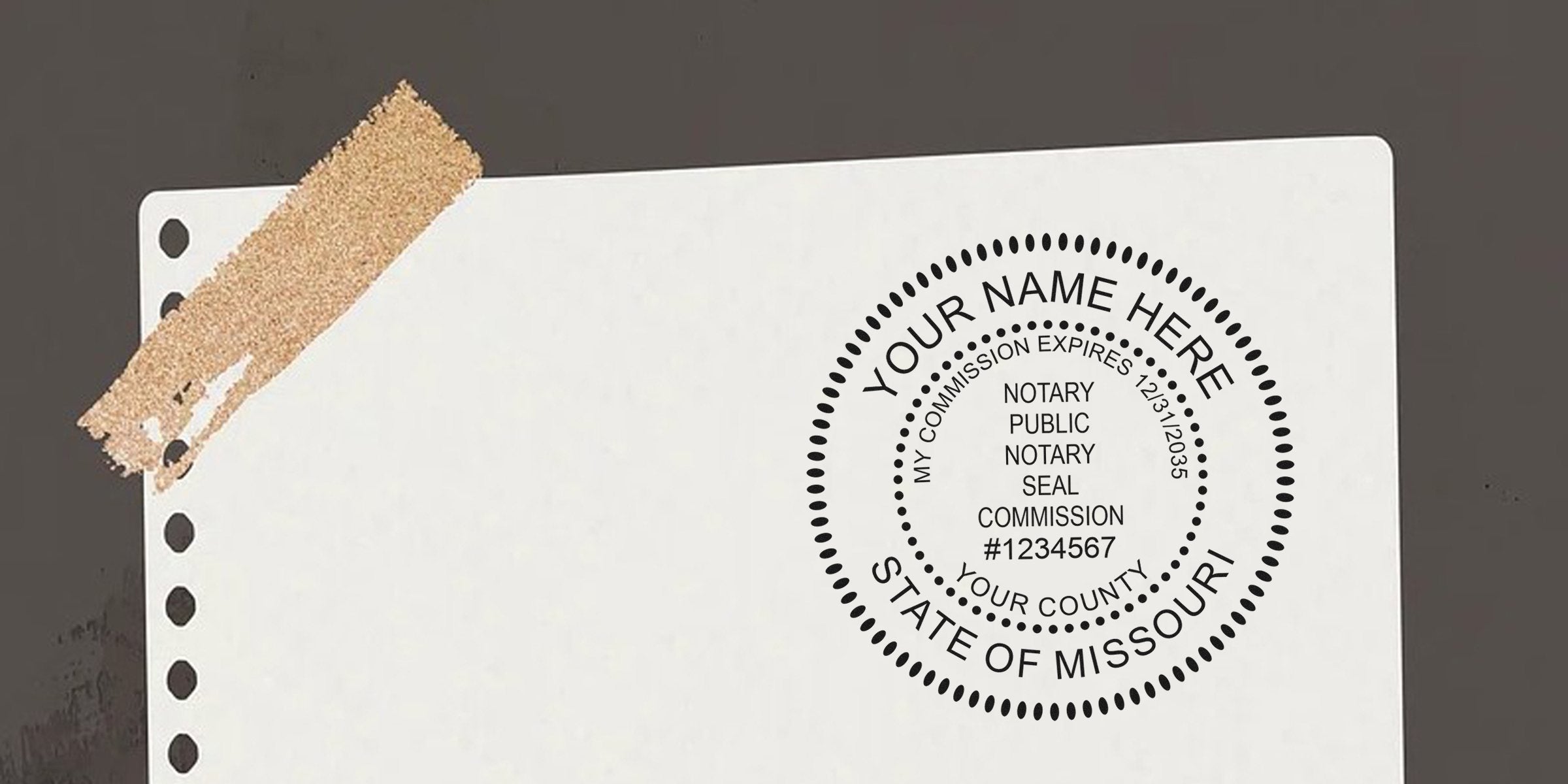
Missouri requires that your stamp include certain identifying details so that anyone reading the document can confirm its authenticity. Typically, these core components include:
- Your name exactly as it appears on your notary commission
- The words “Notary Public” and “State of Missouri”
- The county for which you are commissioned
- Your notary commission expiration date
Though the seal might be round or rectangular, it must display all essential details legibly. If any of this information is missing or unclear, your notarial act could be challenged. Missouri is fairly strict on the principle that your stamp, whether a rubber inked version or an embossed imprint, must disclose sufficient information about who you are, where you’re commissioned, and how long your commission is valid.
If you’d like more detailed pointers on the shape and size of your notary equipment, we cover these in our missouri notary seal requirements. You can also compare various product styles in our mo notary supplies section, where you’ll see everything from simple handheld stamps to deluxe embossers.
Why ink color matters
Although Missouri typically encourages black ink for notary stamps, there’s no absolute statewide rule that forbids other colors. Yet black is recommended for good reason: it scans, copies, and reproduces cleanly, which is crucial when your notarized documents get recorded. Some states, like Tennessee and Utah, are stricter about ink color, but Missouri is relatively flexible—just make sure you’re using a color that is photographically reproducible. Practically speaking, black ink also gives your stamp a professional look while minimizing any chance of rejection by the receiving office.
Staying within Missouri state lines
While it might be tempting to witness a friend’s signature across state borders, your Missouri notary stamp cannot be used outside of Missouri. Each state in the U.S. has its own rules about who can notarize documents, and your commission is specifically limited to Missouri. There’s no problem notarizing for someone from another state, as long as the actual notarization occurs within Missouri. It’s a boundary that keeps the process legally consistent. If you move to a new state or foresee needing to notarize elsewhere, you’ll need to look into the local regulations and get re-commissioned as required.
Exclusive control and safekeeping
One of the lesser-discussed—but incredibly important—facets of notarial work is the personal responsibility you carry for your stamp. Missouri law specifies that your stamp must remain under your direct control at all times. This means keeping it locked away when you’re not using it, never lending it to friends or coworkers, and never leaving it in a public space. Unauthorized use of your stamp can invalidate the notarial act and even jeopardize your standing as a notary. It goes without saying that your notary stamp is a critical asset, so treat it like you would treat your personal financial records or other sensitive materials.
Recommended disposal
Notary stamps aren’t immortal. When your commission expires (or if you receive a new one sooner), you’ll need to dispose of the old stamp to prevent any accidental or unauthorized use. You can deface it, remove the rubber die, cut it up—whatever method you choose, just make sure it’s impossible for anyone else to use. Missouri is explicit about making sure old stamps are not floating around, so be diligent and protect your professional credentials.
Choose the right stamp
Picking out your notary stamp might seem as simple as heading online and scooping up the first product that says “Missouri Notary,” but there’s more to it if you want the best long-term experience. Quality, compliance, durability, and ease of use each play a role. With so many options, from self-inking stamps to pre-inked versions and embossers, you’ll want to narrow your choice by thinking about the type of documents you handle most often, your personal work style, and your budget.
Rubber stamps vs. self-inking designs
A rubber stamp requires a separate ink pad; a self-inking stamp places the pad inside the device. Both are acceptable choices for Missouri notaries, as long as you confirm the stamp includes all essential text. Here are a few quick differences to consider:
Rubber stamp
-
Typically less expensive up front
Can be used with any color ink, although black is recommended
Requires carrying a separate ink pad
Self-inking stamp
More convenient if you need frequent stamping
Comes pre-loaded with a specific color (often black)
Typically costs a bit more, but speeds up your process
You can explore our missouri notary stamp self-inking inventory if you want something compact and hassle-free. If you like the traditional approach, a good old-fashioned rubber stamp remains a classic.
Embossers and raised impressions
Some Missouri notaries love using an embosser because it leaves a raised seal on the paper. While this isn’t strictly required by Missouri statutes, it offers a professional touch and can deter document tampering. If you do opt for an embosser, bear in mind that Missouri law still demands the same identifying information be present. You should also consider whether the raised mark is clearly visible in photocopies, because some receiving authorities want obvious, photographically reproducible stamps. For maximum versatility, some notaries prefer a combined approach: a rubber or self-inking stamp plus an embosser for added security and professionalism.
Curious about how embossers compare to ink stamps? Check out our missouri notary seal stamp options, which detail whether you want a purely embossed design or a standard inking device.
Quality and durability
Especially if you notarize multiple documents each week, the construction of your stamp can really matter. A cheap plastic model might save you a few dollars initially, but replacing it repeatedly could cost more in the long run. Look for well-reviewed products or talk to professionals who have been in the notary game for a while. Because we at Acorn Sales have been making stamps and seals for over six decades, we’ve learned how to craft durable models that last for the life of your commission. We also stand behind all our products, offering a quick turnaround and a State Board Guarantee that ensures your stamp matches Missouri requirements.
Position your stamp properly
Even the best stamp won’t help if you don’t place it neatly on the document. Proper positioning is about staying consistent, avoiding overlap with text, and maintaining clarity. You never want to obscure signatures or critical fields. Some documents have a designated “notary area” or blank space labeled for the seal. If that’s the case, stamp there. If not, choose a spot that’s easy to read but doesn’t interfere with the rest of the content. Also, always check if any portion of the document specifically says something like “affix seal here.” Follow those directives precisely to avoid rejections.
Common mistakes to avoid
- Stamping over text: If people can’t read the material underneath, the receiving authority may reject the document.
- Missing lines or partial impressions: Make sure the full circle or rectangle is visible. A half impression can appear tampered with.
- Illegible expiration date: If your date is smudged, rewrite the notarization or re-stamp in a clean spot to ensure clarity.
A final tip: always double-check you’re using the correct stamp. We’ve seen notaries accidentally grab an old or incorrect seal. Keep your current stamp clearly labeled or stored in a separate spot from any older ones.
Protect your stamp security
We touched on the importance of keeping your Missouri notary stamp under lock and key. Let’s dig a little deeper, because the security aspect isn’t merely a suggestion—it’s a legal duty. If someone else uses your stamp without your knowledge, it can lead to questioned documents and potential legal troubles. Courts take misuse of a notary stamp very seriously. Ultimately, the buck stops with you, so let’s talk about your role in safeguarding that stamp.
Locking up your tools
If you work in a shared office environment, your hurried routine might lead you to setting your stamp on the desk and dashing off to a meeting. That is riskier than you might think. The best practice is actually to keep a small locked drawer or container specifically for your notary equipment, including your journal (if used), extra ink pads, and any relevant paperwork. You’ll feel more at ease knowing that even if you step away, no one can misuse your official seal.
True exclusivity
It’s tempting to let a trusted colleague handle your stamp to expedite daily tasks, but that’s a big no-no under Missouri guidelines. The law explicitly states you must maintain “exclusive” control over your stamp. If someone else is affixing your seal, that’s not you performing the notarial act. Realize that every single time your stamp is used, it implies you’ve personally confirmed the signer’s identity, verified their willingness, and validated the document. Respect this boundary, and you’ll keep your commission safe and your credibility intact.
Handling stamps after commission changes
Periodically, as you renew your notary commission, you’ll need an updated stamp featuring the new expiration date—no handwriting or pen scratching allowed. Once the new stamp arrives, immediately lock it up until your new commission’s effective date. At that point, deface or destroy the old stamp to avoid confusion. Many notaries find this step nerve-wracking because they fear they might need the old stamp at some point. But Missouri law is clear: the second your new commission becomes effective, the old one ceases to be valid. So don’t keep extra or outdated stamps anywhere near your workspace.
Renew and update regularly
Even a perfectly cared-for stamp has a finite lifespan, because your commission will eventually expire. You don’t want to wake up one morning, realize your commission ended yesterday, and scramble to update everything. By planning ahead, you’ll avoid last-minute stress and keep your notarial services uninterrupted.
When it’s time to renew
In Missouri, your notary commission generally lasts four years (barring special circumstances). The best practice is to start the renewal process a few months before that expiration date. Renewing means:
- Filling out the renewal application.
- Paying the required fees.
- Taking the oath of office again or following any updated state steps.
- Ordering a new notary stamp that reflects your new commission dates.
We also recommend verifying that the notary bond you must carry is current. Some counties or local offices might have additional steps. Do your research early, since each region can have unique processes.
If you’re new to the world of re-commissioning, don’t stress. Our dedicated tutorial on missouri notary stamp renewal requirements can help you sail through each step with as little fuss as possible.
Ordering a fresh stamp
Missouri notaries are required to order a brand-new stamp for each commission cycle. This ensures the dates imprinted on your stamp are 100% accurate, with no risk of manually adjusting or handwriting anything. We have a range of missouri notary stamp styles to choose from, all designed to align with the current laws. Whether you want a basic self-inking stamp for quick, everyday tasks or you prefer the sleek lines of a pre-inked model with a built-in pad, we’ve got you covered at Acorn Sales.
Documenting your commission details
Make a habit of keeping a simple log—either digital or in a paper notary journal—of your commission’s effective and expiration dates. Missouri doesn’t strictly mandate that you keep a notary journal in every case, but it’s a best practice recommended by many experts. If you store all those details in one place, including the date you ordered your new stamp, you’ll maintain a ready reference in case anyone has questions about your qualifications. It’s also helpful if you need to recall exactly when your next renewal window is coming up.
Acorn Sales advantage
We wouldn’t be in business for over six decades if we didn’t love helping notaries navigate their roles with confidence. Our team at Acorn Sales focuses on delivering state-compliant products—for Missouri and beyond—and ensuring you have zero hassles with local regulations. We pride ourselves on:
- Quality: From the handles to the rubber dies, our products are built to last through your entire commission term.
- Variety: We carry everything from basic stamps to advanced embossers. Looking for a combined approach? Check our missouri notary stamp and seal kits.
- State Board Guarantee: If, for some reason, your stamp isn’t aligned with the current Missouri statutes, we’ll take care of it.
- Fast Turnaround: We know time is crucial. We expedite orders so you can get back to work without delay.
We also believe in educating our customers, which is why we share resources, tips, and best practices for all things notarial—from selecting a robust tote to store your notary gear to deciding which ink color is best for your situation. And if you opt for a missouri notary seal alongside your ink stamp, you’ll see why we’ve become a go-to for professionals who value reliability and top-notch service.
Explore commission boundaries
As we mentioned earlier, you must perform all official notarial acts within Missouri. One scenario that often confuses new notaries is crossing the state line for what appears to be a simple signing. Even if you live near a border—maybe Kansas or Illinois—your commission does not allow you to stamp documents outside Missouri. This is so the state can confidently regulate who is performing notarial duties and ensure local compliance with its legal framework. If you’re traveling regularly, it might be worth exploring how to become a notary in missouri if you relocated, but keep in mind that each state has its own laws. Just be clear-headed about where you’re operating.
Handling out-of-state signers
Working with out-of-state signers is absolutely normal. People move or do business from various locations. As long as the notarization physically happens on Missouri soil and you follow the standard rules for verifying identity, that is generally acceptable. The key is verifying you’re present in Missouri, you have a valid Missouri commission, and you affix the correct stamp when you finalize the notarial certificate.
Avoiding cross-border pitfalls
Now and then, you might find yourself near a border county where clients ask you to come directly to them. Politely remind them that you can only notarize within Missouri. If they aren’t able to travel to you, you can suggest they find a notary in their home state. This small inconvenience is still far preferable to using your Missouri stamp outside your jurisdiction—which could land you in legal trouble.
Select your ideal notary kit
Sometimes, you just want everything in one neat package, especially if you’re a brand-new notary unsure about the difference between stamps, seals, and extra supplies. That’s where a missouri notary kit can simplify the process. Typically, a kit may include:
- State-specific notary stamp (self-inking or pre-inked)
- Notary embosser with your required information
- Ink refills for future use
- A notary record or journal (optional, but highly recommended)
- Instruction or reference guide for Missouri notaries
If you’re explaining your new role to your employer, you might highlight how a notary kit ensures you have all the compliance essentials in one box. So, whether you are notarizing property deeds, legal affidavits, or everyday office paperwork, you’ll be prepared.
Customizing your bundle
At Acorn Sales, we like to be flexible. Maybe you don’t need an embosser, but you do want an extra set of ink refills. Or perhaps you prefer a specialized rectangular stamp because the round style doesn’t fit well on certain documents you handle. You can chat with us about building your own notary kit for missouri starter. Having a customized approach is sometimes easier than piecemeal. It allows you to know exactly how your items function together, so you’re confident from day one.
Avoid common mistakes
No matter how mindful you are, mistakes happen. The best defense is knowing what they are ahead of time so you can carefully avoid them. Here’s our short list of typical oversights that can lead to frustrations, re-dos, or even legal complications:
-
Using an expired commission stamp
- Once your commission’s date has passed, that stamp is no longer valid. Even a single accidental use can cause big headaches for your client and for you.
-
Not verifying ID or willingness
- Missouri law expects you to confirm the identity of the signer and their intent to sign the document. Failing to do so undermines the entire purpose of notarization.
-
Forgetting to include crucial details
- If any part of your stamp’s information is missing (for instance, the county or the words “State of Missouri”), the document may be considered improperly notarized.
-
Allowing others to borrow the stamp
- This breaks your exclusive control. If someone else uses your stamp, you risk losing your commission or facing legal fines.
-
Misjudging the stamp’s placement
- Smudged or partially applied ink can force you to start over. Always press firmly and evenly on a flat surface.
By remaining aware of these pitfalls, you’re a step ahead in making sure your notarial acts hold up under scrutiny.
No. Your Missouri commission only authorizes you to perform notarial acts within Missouri’s boundaries. If you frequently travel or move, you’ll need to check that state’s notary commissioning rules to remain compliant.
We hope this guide answers your biggest questions about Missouri notary stamp requirements and gives you the confidence to move forward. From selecting the right stamp style to mastering proper usage and secure storage, each step you take underscores your professionalism and dedication to Missouri’s legal standards. When you’re ready to shop for an updated stamp, an embosser, or a complete kit, Acorn Sales is here as your trusted partner. We have spent over 60 years perfecting everything from small desk stamps to heavy-duty embossers, guaranteeing a smooth experience and compliance with state regulations. Whether you’re a seasoned pro or a notary newbie, our quick turnaround times, flexible options, and State Board Guarantee have your back every step of the way. Let us know how we can help elevate your notarial practice today!
Frequently Asked Questions
Do I need a notary stamp if I’m brand new?
Yes. Missouri requires all notaries to use a properly formatted stamp or embosser once they’re commissioned. If you’re brand new and figuring it all out, consider checking our mo notary stamp selections. We’ve got starter-friendly choices that comply fully with the state’s specifications.
Which ink color is best for my Missouri notary stamp?
Black ink is strongly recommended because it scans well and is commonly accepted by county clerks and other authorities. You technically can use another color, but we advise sticking with black for clarity and to avoid any risk of rejection.
When should I replace my stamp?
Replace your stamp whenever your notary commission expires and you’re re-commissioned. Missouri laws state that each new commission requires a fresh stamp with updated information. Make sure you properly dispose of the old stamp, so no one else can use it.
How do I store my stamp safely?
Keep your notary stamp in a locked drawer, cabinet, or safe, and never let anyone else use it. Missouri law mandates that you maintain exclusive control. Storing it properly ensures no unauthorized notarial acts occur in your name.








