
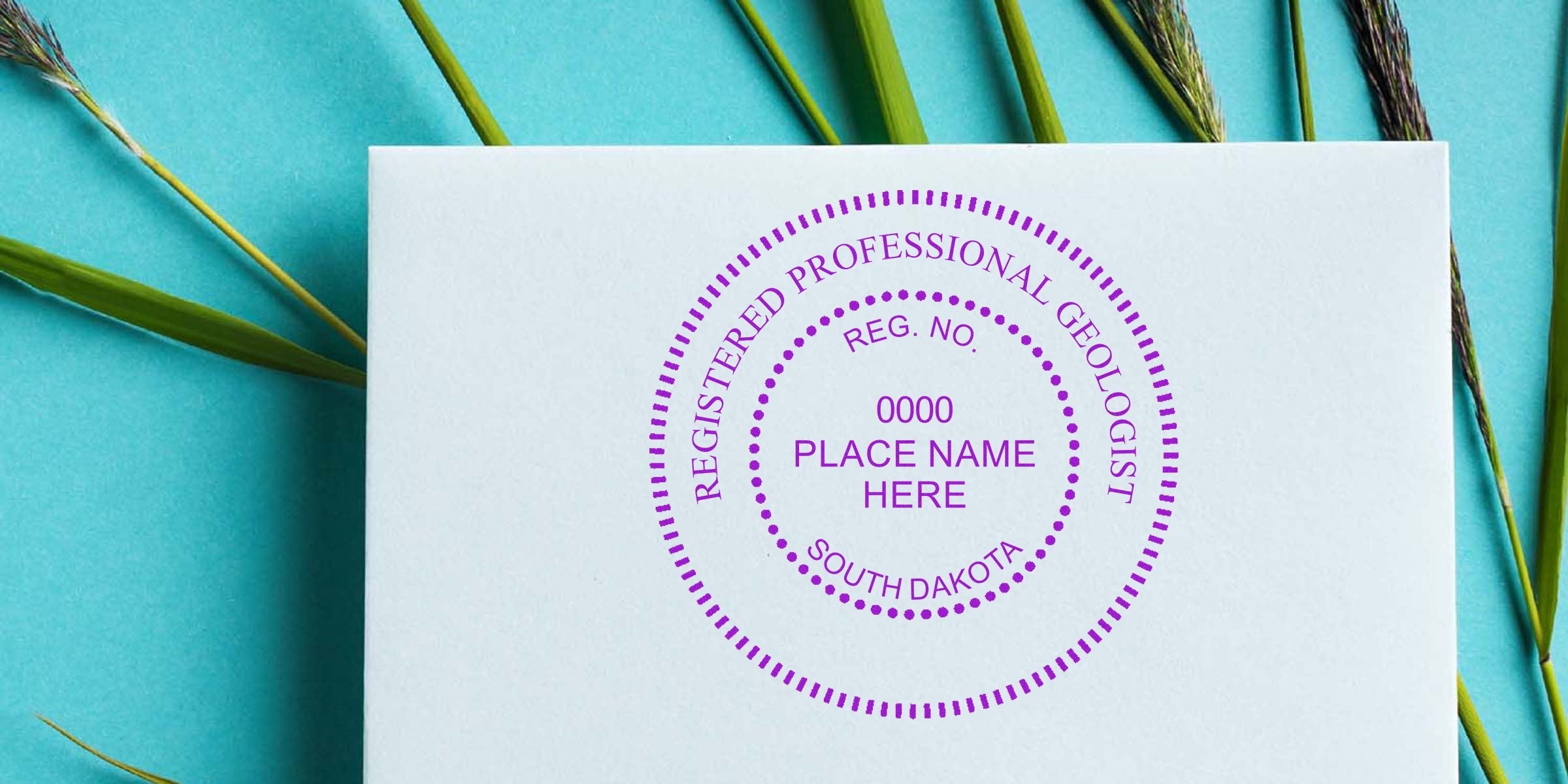
If you are weighing an embosser for your geology practice in South Dakota, begin with the part that most articles get wrong: South Dakota does not license geologists. There is no state geologist credential, no board that oversees the profession, and no rule requiring a geologist to seal a document or telling you what such a seal must look like. An embossed mark here is something you choose, and this guide covers what it does for your documents, how to make a clean impression, and how to keep the device working for years. The licensing research sits in South Dakota Geologist Stamp: What You Can Put on It.
Explore South Dakota Geologist Stamps
A geologist stamp in South Dakota is a professional mark, not a credential. It does not authorize anything and it does not certify anything to the state. What it does is put your name on your work in a way that survives copying, filing and forwarding, and that looks like it belongs on a finished report.
Most geologists choose between a rubber or self-inking stamp and an embosser. An embosser presses the design into the sheet, raising the paper rather than laying ink on it. The impression is difficult to reproduce with office equipment, and it reads as formal the moment someone picks up the page.
Ink Stamps vs. Embossers
- Ink stamp. Quick to use, visible on photocopies and scans, and the simpler option if your work mostly travels as files. Ink can fade with light and moisture over long storage.
- Embosser. Gives a crisp raised imprint, adds a formal finish to an original, and is hard to fake because it changes the texture of the paper.
Plenty of people keep both, using the embosser on client-facing originals and an ink stamp on everyday internal copies.


Decide What Goes On Your Seal
Because South Dakota issues no geologist credential, nothing about the design is prescribed. You are not matching a format set by a board, so the layout is a design decision rather than a rule to follow.
What Most People Include
- Their legal name, spelled the way they sign it.
- A professional line such as geologist, or a national or voluntary credential they actually hold.
- A firm name, if the mark represents a practice rather than an individual.
- A circular or rectangular border to frame the whole thing.
Two things to leave off. A South Dakota license number, because the state does not issue one to geologists. And any wording that implies state registration, which would misrepresent your standing to a reader. A helpful comparison: the South Dakota Board of Technical Professions does prescribe a seal for the professions it covers, under SDCL 36-18A-44. That provision runs to professional engineers, architects, land surveyors and landscape architects, and it does not extend to geologists. Worth knowing about the same chapter: petroleum release assessors and remediators, a separate credential the same board issues, are expressly barred from using a seal at all. Neither of those is a geologist rule, and neither one applies to you unless you hold that other license.
If you want the exact statutory language and where it came from, it is laid out in our South Dakota seal research. You can also browse a geologist stamp and see how other people have arranged theirs.
Discover Why Embossing Matters
Nobody is going to make you emboss anything here, so the question is what you get out of it.
Resistance To Copying
A raised impression cannot be reproduced by a copier or a desktop printer. Scan or photocopy an embossed page and the seal flattens into a faint gray smudge, which is exactly how a reader tells an original from a duplicate. If you hand over environmental reports or geological assessments that matter to a public project, that distinction is worth having.


Professional Credibility
There is a plain visual argument too. An embossed mark signals care in a way an ink impression does not quite match. Clients and stakeholders often expect it on the documents they keep, and a report that arrives with a raised seal beside the signature looks like the product of a practice that takes the work seriously. In a field where analyses feed into public safety and environmental decisions, looking careful is not a small thing.
Long-Lasting Imprint
Embossed impressions stay readable for decades because there is no ink to fade. A contract or geological report pulled out of an archive years from now will still carry a visible seal. That is one fewer question when old records get reviewed.
Master the Embossing Process
Using an embosser is simple, and a few habits get you a consistent imprint every time.
Position and Pressure
Put the document on a flat, stable surface and line the device up so the impression lands where you want it. Check the orientation before you squeeze. An upside-down seal in a signature block is a small embarrassment that sticks around on the page.
- Apply steady pressure. A quick jab leaves a faint mark, and too much force can tear the sheet.
- Practice on a spare sheet of the same paper to find the right force before you do it for real.
Paper Thickness
Medium and heavy paper take an embossed impression well. Very thick cardstock can defeat a lighter device. If you plan to seal certificate stock or a report cover, confirm the model you are buying is rated for that weight, because some are built for standard stock only.


Location on the Page
Near the signature and clear of the margins is the usual choice. Keep the impression off important text, since overlapping a paragraph makes both the words and the seal harder to read. No state rule governs placement for geologists, so pick a spot and use it consistently across your documents.
Maintain Your Geologist Seal
An embosser is a mechanical device and it rewards a little attention. Most problems people bring to us are storage problems.
Cleaning and Storage
- Clean regularly. Wipe the plates gently with a soft, dry cloth to clear dust and paper fibers.
- Keep it dry. Damp air invites rust and corrosion on metal parts. A cool, dry drawer is ideal.
- Keep it out of the sun. Long exposure can discolor metal and make plastic components brittle.
Repairs and Replacement
Incomplete impressions and a creaking hinge are the usual signs that something has shifted. Often it is just alignment, and your supplier can talk you through the adjustment. If the frame itself is worn or bent, a new device is the answer. Hold on to your order details and the approved proof, since reordering the same design is far quicker with them in hand.
Choose a Trusted Supplier
Where you buy matters more than it looks like it should. Acorn Sales has been making stamps and embossers since 1964, and we make them for South Dakota geologists among many others. You get a device built for durability and precision, and someone to answer the wording questions that come up when no board has answered them for you.
A free electronic stamp comes with your purchase. That digital version of your design goes into PDFs and other electronic files, which is where a lot of geological work now lives. With a physical embosser and a digital file, you have the same mark available whichever way a document travels.
What to Look For in a Supplier
- A long track record. Decades of making these devices shows up in how consistently the impressions come out.
- Honest information. A supplier who tells you South Dakota does not license geologists is more useful than one who sells you a rule that does not exist.
- Responsive support. Fast answers matter when a document deadline is close.
- Useful extras. A free electronic stamp saves a separate purchase later.
Once you have found a maker you trust, reorders, upgrades and stamps for other people on your team are easy, and they all come out looking like they belong together.
Your embossed mark is part of your professional signature, and in South Dakota it is entirely your own. Keep the device clean, keep the wording accurate, and it will give you the same clean impression for years. If you want help settling on a layout or picking a model, our contact us page is the place to start.
Frequently Asked Questions
Is a geologist seal required in South Dakota?
No. The state does not license, register or certify geologists, so no rule requires a seal and no rule sets its design. Geologists buy one because a raised impression finishes a report and identifies its author. If a specific client or agency asks for a sealed copy, that request is theirs.
Does the seal itself ever need renewing?
There is no South Dakota geologist license to renew, so there is no renewal cycle attached to the seal either. The only reason to order a new one is a change in what it says, such as a legal name change or different professional wording.
Can I use an embossed seal on electronic documents?
Not directly, since you cannot press a PDF. What people do instead is use a scanned image of the impression or the free electronic stamp that suppliers like Acorn Sales include, and place that in the file.
What if my embosser breaks or wears out?
Contact your supplier. Many issues are alignment and can be sorted out over a message or two. If the frame is badly worn, ordering a replacement from your saved proof is quick, and a backup ink stamp covers you in the meantime.
Is it acceptable to only use an ink stamp instead of embossing?
Yes. Nothing in South Dakota law treats one as better than the other for geologists, because neither is required. Ink is the practical choice for work that gets copied and scanned. Embossing is the better look on originals that a client keeps.








