
Written by Acorn Sales Company, manufacturing stamps and seals since 1964 · Reviewed by Molly, VP Marketing at Acorn Sales, against Title 35 of the Louisiana Revised Statutes, LAC 46:XLVI, Louisiana Civil Code article 1833 and the Secretary of State’s Notary Division on 20 September 2026 · Updated 20 September 2026
Louisiana requires no notary seal at all. The rule is a single sentence: “A notary’s signature is his seal.” If you choose to use one, you are expressly not required to have a particular style. What actually matters in Louisiana, and what will get a document bounced at the recorder if you omit it, is your notary identification number. Louisiana notaries are civil-law notaries with far broader powers than anywhere else in the country, and the seal rules reflect that difference rather than resembling the other forty-nine states.
Louisiana notary stamp requirements at a glance
| Requirement | Louisiana rule | Source |
|---|---|---|
| Stamp required | No | LAC 46:XLVI.131(A) |
| Required wording | Nothing is prescribed, because no seal is required; If you use a stamp to satisfy R.S. 35:12, it carries your name, typed, printed legibly or stamped; And the notary identification number assigned by the secretary of state, or for a Louisiana-licensed attorney the bar roll number | La. R.S. 35:12(B) |
| Size and shape | Not addressed, and affirmatively disclaimed: you are “not required to have a particular style of seal”. We checked R.S. 35:1, 35:2, 35:3, 35:11, 35:12, 35:191, 35:191.2, 35:191.3, 35:199, 35:201 and 35:202, Civil Code article 1833, and LAC 46:XLVI.101 through .144 including the rule titled Notary Seal. | LAC 46:XLVI.131(A) |
| Ink color | Not addressed. | La. R.S. tit. 35 chs. 1-11 (silent) |
| Embosser | Permitted and wholly optional, like every other style, since the rule leaves the choice entirely to you. | LAC 46:XLVI.131(A) |
| Commission term | There is no term. | LAC 46:XLVI.111(B), .115, .117, .121, .125 |
| Name or address change | For an address change, notify the Secretary of State “within sixty days after the date of any change in residential address, mailing address, or both”, a duty that binds anyone holding a state-assigned notary identification number. | LAC 46:XLVI.111(B), .115, .117, .121, .125 |
| Lost or stolen stamp | Not addressed. | LAC 46:XLVI.127 |
| Commissioning authority | The Governor, by and with the advice and consent of the Senate, with the Secretary of State’s Notary Division running the statewide examination, the commissioning paperwork, the notary database, the annual report and remote notarization authority, and the parish clerk of court approving your bond | Title 35 of the Louisiana Revised Statutes, LAC 46:XLVI, Louisiana Civil Code article 1833 |
Rules for other states are on notary stamp requirements by state.
Is a notary stamp required in Louisiana?
No. Louisiana does not require a seal at all. The rule is one sentence, and note that it lives in the administrative code rather than the Revised Statutes: “A notary’s signature is his seal. If he elects to have a seal to use when notarizing documents, he is not required to have a particular style of seal to give authenticity to his copies.” What the law does require on the document is the notary’s name and the notary identification number assigned by the secretary of state
The governing text is LAC 46:XLVI.131(A); La. R.S. 35:12(A)(1), (B).
What must appear on a Louisiana notary stamp?
- Nothing is prescribed, because no seal is required
- If you use a stamp to satisfy R.S. 35:12, it carries your name, typed, printed legibly or stamped
- And the notary identification number assigned by the secretary of state, or for a Louisiana-licensed attorney the bar roll number
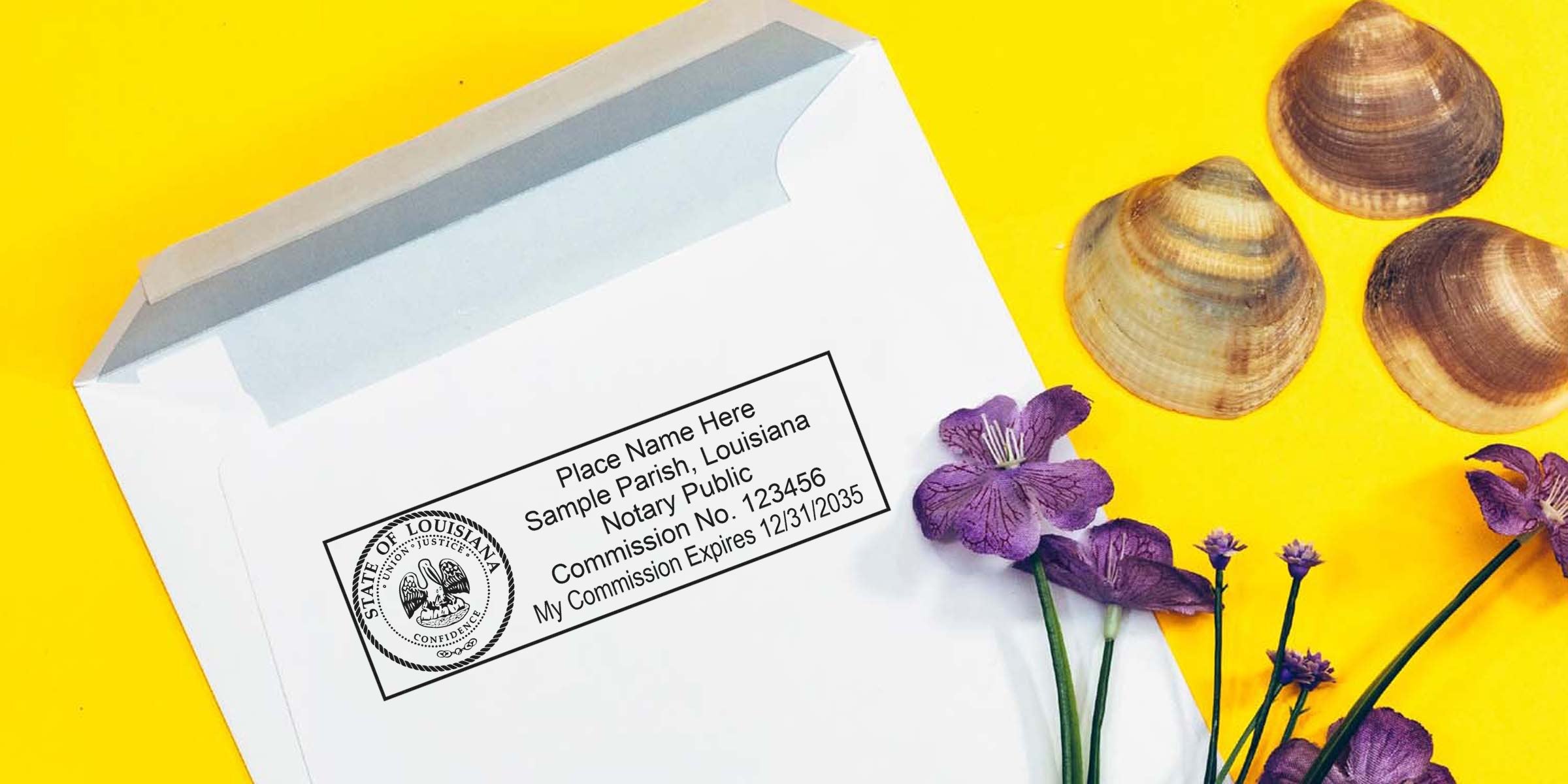
The parish and the words “Notary Public” are customary and useful, since a non-attorney notary’s jurisdiction is parish-limited, but neither is required on the stamp. There is no commission expiration date to carry, because there is no term. Only a commissioned notary may use the title “Notary Public”; an ex officio notary must clearly indicate the actual position or title alongside the identification number (R.S. 35:12(C)). Keep the statutory and regulatory sources straight: the identification number requirement is statutory (R.S. 35:12(B)), while the signature-is-the-seal rule and the permission to stamp the names are regulatory (LAC 46:XLVI.131(A), (B), promulgated in October 2013).
What size and shape must a Louisiana notary stamp be?
Not addressed, and affirmatively disclaimed: you are “not required to have a particular style of seal”. We checked R.S. 35:1, 35:2, 35:3, 35:11, 35:12, 35:191, 35:191.2, 35:191.3, 35:199, 35:201 and 35:202, Civil Code article 1833, and LAC 46:XLVI.101 through .144 including the rule titled Notary Seal. No dimension, no shape, no border anywhere.
Notary public stamps are made to these conventions, and we check your lines against the statutory wording before we make the stamp.
What ink color is required for a Louisiana notary stamp?
Not addressed. We checked the whole of Revised Statutes Title 35, Chapters 1 through 11, LAC 46:XLVI.101 through .144, and Civil Code article 1833. There is no ink-color requirement. Outside the notary law there is no statewide Louisiana recording statute imposing an ink color that reaches a notary’s stamp either: we checked R.S. 44:116 on photographic and electronic copies of records and R.S. 13:844 on recorder fees. Individual parish clerks publish local document standards covering margins, font size and paper size, and those are local administrative standards rather than Louisiana law.
More on the trade-off in stamp ink color rules.
Is a notary embosser required or optional in Louisiana?
Permitted and wholly optional, like every other style, since the rule leaves the choice entirely to you. No statute or rule requires, prohibits or prefers an embosser, and none asks for one as a supplement. There is a practical limit worth knowing: an embosser alone will not satisfy R.S. 35:12(B), which wants the identification number “typed or printed legibly”, and a raised uninked impression is not printed legibly.
Notary embossing seal kits and inked stamp kits cover both formats. See also notary stamp vs. embosser.
A Louisiana notary is a civil-law notary, and the signature is the seal
Louisiana is the one state running on civil law rather than the common law, and its notary rules follow from that instead of from the seal tradition every other state inherited. The regulation settles it in a sentence: “A notary’s signature is his seal.” No prescribed design, no required elements, no shape, no size, no color, because there is no required seal (LAC 46:XLVI.131(A)).
What actually gets a Louisiana document accepted is the notary identification number. R.S. 35:12(B) requires the number assigned by the secretary of state to appear, typed or printed legibly, next to your name, and R.S. 35:12(D) lets any Louisiana recorder, register of conveyances or mortgages, or clerk of court refuse a document notarized after 1 January 2005 that lacks it. A beautifully embossed seal with no identification number is rejectable. A bare signature with a legibly printed name and number is not.
So that is what a Louisiana notary stamp really is: a name and identification number block, which LAC 46:XLVI.131(B) expressly blesses by saying the names “must be typed, printed legibly, or stamped”. Order one because it puts R.S. 35:12 on the page in one motion, not because the state makes you carry a seal.
Two more that follow from the civil-law structure. Your commission is for life (LAC 46:XLVI.111(B)), so there is no expiration date to reprint and no renewal reorder. And a remote online notarization cannot produce an authentic act under Civil Code article 1833 (R.S. 35:623(C)), which matters because Louisiana conveyances, mortgages and successions run on authentic acts. Remote notarization is also flatly prohibited for testaments and codicils, trust instruments, donations inter vivos, matrimonial agreements, and acts affecting spousal support (R.S. 35:623(B)).
Finally, a trap for anyone keyword searching. R.S. 35:2(A)(1)(f) gives notaries the power “to affix the seals upon the effects of deceased persons, and to raise the same”. That is the succession practice of physically sealing a decedent’s property. It has nothing to do with a stamp, and it is the most misquoted line in Louisiana notary law.
Do I need a new stamp when my commission is renewed or my name changes?
There is no term. A Louisiana notary is commissioned for life, in those words, with no expiration date and no renewal cycle. What has to be maintained instead is the paperwork: an annual report and filing fee to the Secretary of State on or before your anniversary date, a late fee of up to $50, and automatic suspension if the report is more than 60 days late, lasting until every report, fee and late charge is paid. Notaries aged 70 or older may elect inactive status and are then exempt from the bond and the annual report, but must keep the address current. Bond or errors-and-omissions coverage is filed with the Secretary of State and renewed every five years, with automatic suspension for a late renewal. On the bond amount the sources conflict: LAC 46:XLVI.111(A) and the Secretary of State’s own legislative-history page say $10,000, the text of R.S. 35:71 on legis.la.gov reads fifty thousand dollars, and the statute was amended by Acts 2025, No. 258, effective 1 February 2026. Confirm the figure with the Notary Division before relying on it. As for a new stamp, almost never: no expiration date, no term. You reorder only on a name change, where you are re-commissioned under the new name, or on a parish change if your stamp shows the parish. The identification number is permanent.
For an address change, notify the Secretary of State “within sixty days after the date of any change in residential address, mailing address, or both”, a duty that binds anyone holding a state-assigned notary identification number. For a name change, send the Secretary of State two executed oath-of-office forms (one for the state, one for the parish clerk of court), the name-change form, an official signature page, a new or amended bond or errors-and-omissions policy or a rider showing the new name, and the commission filing fee. No deadline is stated for the name change. A parish change takes a qualifying application and fee, two oaths, a signature page, and a bond or rider for the new parish.
What do I do if my Louisiana notary stamp is lost or stolen?
Not addressed. There is no reporting duty, deadline or recipient anywhere in Revised Statutes Title 35, Chapters 1 through 11, or in LAC 46:XLVI.101 through .144. Commission revocation and suspension run through R.S. 35:15 (judicial) and R.S. 35:16 (administrative), and neither addresses a physical stamp.
How do I dispose of an expired Louisiana notary stamp?
Not addressed, and there is nothing to dispose of. Louisiana imposes no surrender or destruction duty, unsurprisingly, since no seal is required. The resignation rule is the closest the law comes and it never mentions a seal: a notary resigns by signing a letter of resignation and forwarding it to the secretary of state’s office, after which the notary may not exercise any notarial function and may become active again only by completing the parish application process, including the examination if applicable.
More on retiring an old device in how to dispose of an expired notary stamp.
Can I notarize electronically or remotely in Louisiana?
Authorized, separately registered and sharply limited. Since 1 February 2022 only a regularly commissioned Louisiana notary may be authorized by the secretary of state to perform remote online notarization. Registration is a separate step: the Secretary of State application form, an education program on the remote notarization statutes and rules, and a one-time $100 fee. The rules set dynamic knowledge-based identity proofing (five questions, at least five answer choices each) or biometric analysis, credential analysis, technology standards, and a state-maintained registry of approved identity-proofing, credential-analysis and communication providers. No electronic seal is prescribed. What R.S. 35:627(B) requires is that the act state it is a remote online notarial act, that your electronic signature and all other required information (the R.S. 35:12 name and identification number) be attached or logically associated, and that you digitally sign in a manner rendering later changes evident. Retention is at least 10 years for both the electronic copies and the audio-video recording. You must be physically located in a parish where you have notarial power, and a witness has to be in the physical presence of the party. Louisiana has no general notary journal requirement; the remote notarization records are the only mandated ones.
If you need your seal as an image file for electronic work, see electronic notary seal images.
Related Louisiana guides
Next step
Have your commission details in front of you before you order, because they go on the stamp and a wrong line means a reorder. Then browse notary public stamps, or call 804-359-0505 and we will check your wording against the statute before we make it.
Frequently asked questions about Louisiana notary seals
Is a notary seal required in Louisiana?
No. The Louisiana administrative code states that a notary's signature is his seal, and that a notary who elects to use one is not required to have a particular style. We swept the whole of Revised Statutes Title 35 and found no section imposing a seal requirement anywhere. Note that this rule lives in the administrative code rather than the statutes.
If no seal is required, what do I actually need on the document?
Your notary identification number assigned by the Secretary of State, alongside your typed, printed or stamped name. This is the requirement that bites, and it bites harder than most sources admit. A clerk may refuse a document without it, and separately no state office, agency, department or political subdivision shall accept, file or record one. The second of those is mandatory, not discretionary. Most Louisiana notaries use a stamp precisely because it puts the ID number on the page reliably.
What should a Louisiana notary stamp say if I choose to use one?
Nothing is prescribed. In practice a useful Louisiana stamp carries your name, the words “Notary Public”, your parish, and above all your notary identification number, since that is the element with legal consequences.
How long does a Louisiana notary commission last?
For life, subject to maintaining the required bond and continuing obligations. That statement comes from the administrative code rather than the statutes, which set no term. The practical effect for a stamp is that there is no expiration date to print and none to reprint, so a Louisiana stamp only needs replacing if your name or your parish changes.
What ink color does Louisiana require?
None. We checked the whole of Title 35 and the administrative code and found no ink-color requirement. Choose a color that copies cleanly.
Can I notarize remotely in Louisiana?
Remote notarization exists but it cannot produce an authentic act, which is the instrument type at the heart of Louisiana practice. That limitation matters more in Louisiana than the availability of remote notarization does.
Why are Louisiana notaries different from other states?
Louisiana follows the civil law rather than the common law. A Louisiana notary can draft and execute instruments that in other states only an attorney could prepare, which is why the qualification process is far more demanding and the commission runs for life.
What do I do with my Louisiana seal when I stop practicing?
Louisiana sets no disposal rule for a seal, which follows from the fact that no seal is required. Destroy it as a matter of good practice.








