
Written by Acorn Sales Company, manufacturing stamps and seals since 1964 · Reviewed by Holly R, VP of Sales and Marketing at Acorn Sales, against the Wyoming State Board of Architects and Landscape Architects and Wyoming Board of Architects and Landscape Architects Rules, ch. 9 §§ 1, 3 on 21 September 2026 · Updated 21 September 2026
A Wyoming seal proves nothing unless it is signed and dated. Chapter 9 Section 3(c) is drafted as a conditional: the seal is prima facie evidence that the technical submission was prepared by or under the responsible control of the individual named on it “only if the seal has been signed and dated.” Most states require a signature and a date without saying what happens if you skip them. Wyoming says it. A stamped but unsigned sheet gives up the evidentiary presumption the seal exists to create.
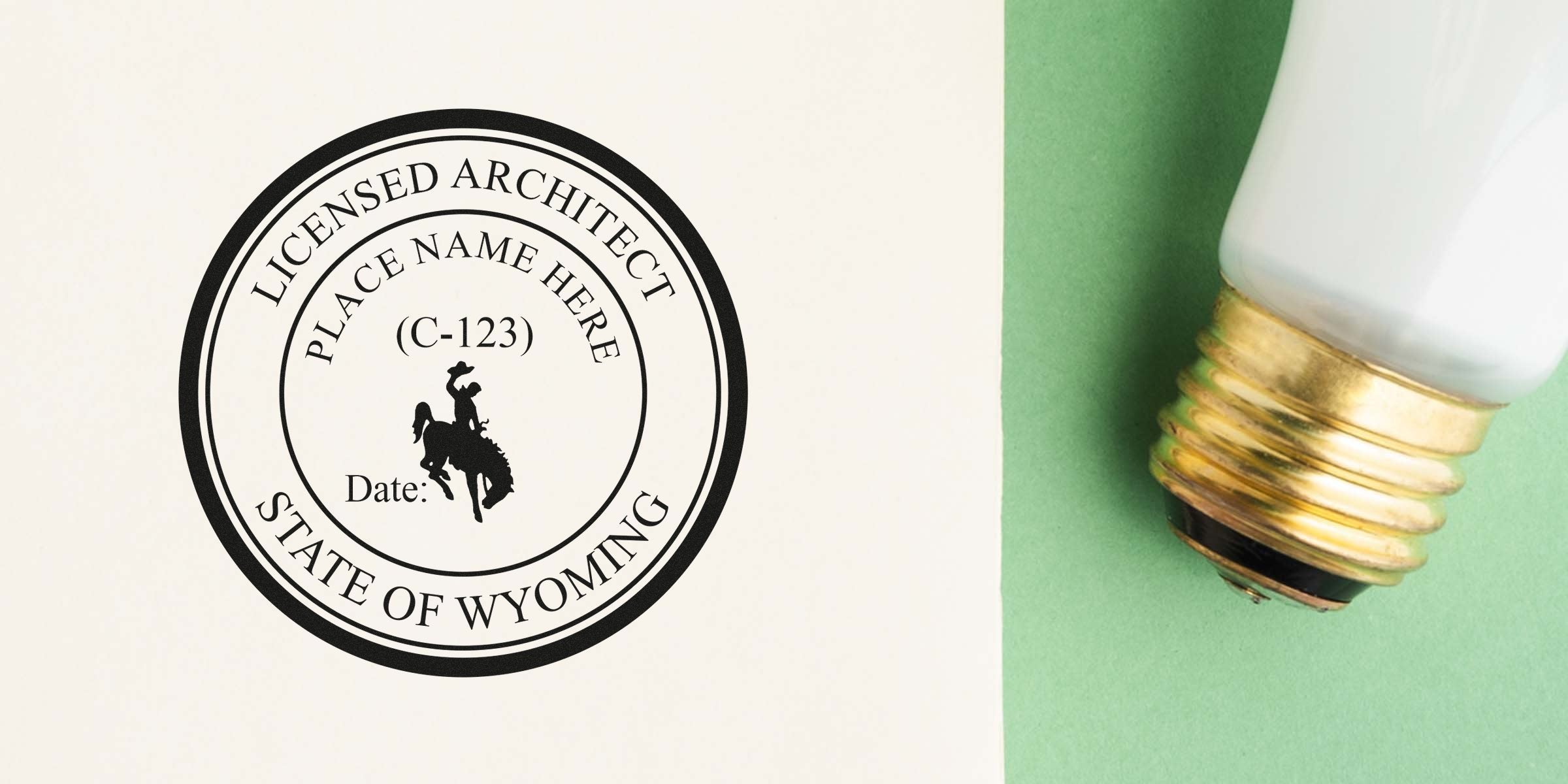
The die itself carries a date field. Section 2(a) lists the contents as your name as licensed, your license number, “the word ‘Date:’” and the legend LICENSED ARCHITECT-STATE OF WYOMING. Order a clean three-line die and you are missing a listed element. The diameter is a band: no less than 1 1/2 inches and no more than 2 inches.
One sourcing point affects which text you rely on. The Board’s own posted copy of Chapter 9 is the file titled Seal Specifications, Chapter 9, dated 21 September 2020, while the Wyoming Secretary of State’s rules system lists Chapter 9, Seal Specifications and Use, as current with an effective date of 17 December 2025. The Board’s posted copy is what is published in readable form, and the filed version may differ, so check the filed chapter with the Board before committing to wording for a new die.
Wyoming architect seal requirements at a glance
| Requirement | Wyoming rule | Source |
|---|---|---|
| Seal required | Yes | Wyoming Board of Architects and Landscape Architects Rules, ch. 9 §§ 1, 3 |
| Required elements | Your name as licensed, Your license number, The word Date: and The words LICENSED ARCHITECT-STATE OF WYOMING | Wyoming Board of Architects and Landscape Architects Rules, ch. 9 § 2(a) |
| Size and shape | No less than one and one-half inches and no more than two inches in diameter. | Wyoming Board of Architects and Landscape Architects Rules, ch. 9 § 2(a) |
| Device allowed | Three formats, named and all permitted: “The format of the seal may be a rubber stamp, an embosser, or a digital image.” An embosser is expressly lawful for the required seal here. | Wyoming Board of Architects and Landscape Architects Rules, ch. 9 § 2(b) |
| Signature and date | Sign across the face, and date the signing. | Wyoming Board of Architects and Landscape Architects Rules, ch. 9 § 3(b), (c) |
| What must be sealed | All technical submissions, with placement fixed by class in Chapter 9 Section 3(a): “(i) On each final design and each final drawing; (ii) On the cover, title, or index pages of each set of specifications; and. | Wyoming Board of Architects and Landscape Architects Rules, ch. 9 § 3(a) |
| Electronic seal | A digital image is one of the three permitted seal formats, and Chapter 9 Section 3(b) accepts digital seals and signatures with one duty attached: “it is the responsibility of the licensee to provide adequate security when documents with digital seals are distributed.” No certificate authority, cryptographic standard or authentication procedure is named. | Wyoming Board of Architects and Landscape Architects Rules, ch. 9 §§ 2(b), 3(b) |
| Renewal and lapse | Not addressed in Chapter 9. | Wyoming Board of Architects and Landscape Architects Rules, ch. 8 |
| Firm requirements | Not addressed in Chapter 9. | Wyoming Board of Architects and Landscape Architects Rules, ch. 9 § 2(c) |
| Regulator | The Wyoming State Board of Architects and Landscape Architects | Wyoming State Board of Architects and Landscape Architects Rules, Chapter 9, Seal Specifications and Use, sections 1 through 3, read from the Board’s published copy linked from its seal specifications page at architects.wyo.gov |
Is a seal required in Wyoming?
The board rule states the duty and the statute supplies the authority. Chapter 9 Section 1 of the Board’s rules is adopted under Wyo. Stat. § 33-4-104(a) and the Wyoming Administrative Procedure Act. Chapter 9 Section 3(a) requires that “The seal shall be imprinted on all technical submissions,” and then sets placement sheet by sheet. Section 3(c) explains what the imprint buys: the seal is prima facie evidence that the technical submission was prepared by or under the responsible control of the individual named on it “only if the seal has been signed and dated.”
What must appear on the seal
- Your name as licensed
- Your license number
- The word Date:
- The words LICENSED ARCHITECT-STATE OF WYOMING
The word “Date:” is a required content of the die, not just something you write beside it. The legend is prescribed in capitals as LICENSED ARCHITECT-STATE OF WYOMING, with the landscape architect variant LICENSED LANDSCAPE ARCHITECT-STATE OF WYOMING in the same sentence, so a dual-credentialed licensee needs two dies. The rule says the seal “shall approximate the format shown below,” which points at the Board’s printed artwork. Two legacy designs stay valid: Section 2(a)(i) accepts the design adopted April 27, 2001 for persons licensed before the current rules, and Section 2(a)(ii) accepts the June 18, 1992 design for persons licensed before April 27, 2001. Section 2(c) puts procurement on you.
Size and shape
No less than one and one-half inches and no more than two inches in diameter. Chapter 9 Section 2(a): “Each licensed architect and landscape architect’s seal shall be no less than 1 1/2″ and no more than 2″ in diameter.” A band, and you choose within it. Do not take the figure from the Wyoming engineering and land surveying board, whose Chapter 5 Section 1(a) fixes two concentric circles at exactly one and three-quarter inches and one and one-quarter inches.
Embosser, rubber stamp or digital
Three formats, named and all permitted: “The format of the seal may be a rubber stamp, an embosser, or a digital image.” An embosser is expressly lawful for the required seal here. The practical choice is a rubber or self-inking stamp inside the size band, because your original signature must run across the face of each original imprint along with the date of signing, and a dry impression will not carry that on a reproduced set.
Signing and dating
Sign across the face, and date the signing. Chapter 9 Section 3(b): “The original signature of the individual named on the seal shall appear across the face of each original seal imprint, along with the date of signing. Digital seals and signatures are acceptable; however, it is the responsibility of the licensee to provide adequate security when documents with digital seals are distributed.” Section 3(c) then makes the evidentiary value conditional: the seal is prima facie evidence of responsible control only if it has been signed and dated. An unsigned or undated imprint therefore proves nothing.
The seal proves nothing unless it is signed and dated
Chapter 9 Section 3(c) is drafted as a conditional: the seal appearing on any technical submission “shall be prima facie evidence that the technical submission was prepared by or under the responsible control of the individual named on the seal only if the seal has been signed and dated.” Most states require a signature and a date without saying what happens if you skip them. Wyoming says it. A stamped but unsigned sheet gives up the evidentiary presumption the seal exists to create.
Which documents must be sealed
All technical submissions, with placement fixed by class in Chapter 9 Section 3(a): “(i) On each final design and each final drawing; (ii) On the cover, title, or index pages of each set of specifications; and (iii) On the cover or index page of all other technical submissions.” Note the absence of a title-sheet shortcut for drawings: each final design and each final drawing carries the seal, while the cover or index concession runs to specifications and to other technical submissions.
Electronic and digital seals
A digital image is one of the three permitted seal formats, and Chapter 9 Section 3(b) accepts digital seals and signatures with one duty attached: “it is the responsibility of the licensee to provide adequate security when documents with digital seals are distributed.” No certificate authority, cryptographic standard or authentication procedure is named. Note the verb distributed, which matches the Utah architect rule and differs from the submitted used in some engineering rules.
Renewal, lapse and retirement
Not addressed in Chapter 9. The seal chapter says nothing about what becomes of the device on expiration, lapse, retirement or revocation, and nothing about whether a license number is reissued. What it does address is the opposite question, continuity of design: Section 2(a)(i) and (ii) keep the 2001 and 1992 seal designs valid for licensees who held them, so a long-held die is not made obsolete by the current rule. Renewal and continuing licensure are governed by Chapter 8 of the Board’s rules.
Firm requirements
Not addressed in Chapter 9. The seal chapter creates no firm seal and no firm number on the face of a document, and Section 2(c) frames the device as personal: “Each licensee is responsible for procuring their own seal.” Firm and entity practice is governed by the Practice Act, Wyo. Stat. §§ 33-4-101 through 33-4-117, and by the Board’s other rule chapters rather than by the seal rule.
What to check before you order
Order a circular device between one and one-half and two inches in diameter carrying your name as licensed, your license number, the word Date: and the legend LICENSED ARCHITECT-STATE OF WYOMING. The date field is a required content of the die. A rubber stamp, an embosser or a digital image is permitted, and a rubber or self-inking stamp is the practical choice because your original signature must appear across the face of each original imprint together with the date of signing. Seal each final design and each final drawing, the cover, title or index page of each set of specifications, and the cover or index page of all other technical submissions. If you also hold the Wyoming landscape architect license you need a second die, because the legend names one profession.
Browse architect stamps and seals.
Frequently asked questions
Is an architect seal required in Wyoming?
Yes. Chapter 9 Section 3(a) of the Board’s rules requires that “The seal shall be imprinted on all technical submissions,” and then sets placement sheet by sheet. The chapter is adopted under Wyo. Stat. § 33-4-104(a) and the Wyoming Administrative Procedure Act.
What has to appear on a Wyoming architect seal?
Four contents under Chapter 9 Section 2(a): your name as licensed, your license number, the word Date: and the words LICENSED ARCHITECT-STATE OF WYOMING. The legend is prescribed in capitals, with the landscape architect variant LICENSED LANDSCAPE ARCHITECT-STATE OF WYOMING in the same sentence, so a dual-credentialed licensee needs two dies. The rule says the seal “shall approximate the format shown below,” which points at the Board’s printed artwork.
What size is a Wyoming architect seal?
Chapter 9 Section 2(a): “Each licensed architect and landscape architect’s seal shall be no less than 1 1/2″ and no more than 2″ in diameter.” A band, and you choose within it. Do not take the figure from the Wyoming engineering and land surveying board, whose Chapter 5 Section 1(a) fixes two concentric circles at exactly one and three-quarter inches and one and one-quarter inches.
Can I use an embosser in Wyoming?
Yes. Three formats are named and all are permitted: “The format of the seal may be a rubber stamp, an embosser, or a digital image.” A rubber or self-inking stamp inside the size band is the practical choice, because your original signature must run across the face of each original imprint along with the date of signing, and a dry impression will not carry that on a reproduced set.
Where do the signature and date go in Wyoming?
Across the face. Chapter 9 Section 3(b): “The original signature of the individual named on the seal shall appear across the face of each original seal imprint, along with the date of signing.”
Where does the seal go on a Wyoming set?
Chapter 9 Section 3(a): “(i) On each final design and each final drawing; (ii) On the cover, title, or index pages of each set of specifications; and (iii) On the cover or index page of all other technical submissions.” Note the absence of a title-sheet shortcut for drawings: each final design and each final drawing carries the seal, while the cover or index concession runs to specifications and to other technical submissions.
Can I use a digital seal in Wyoming?
Yes. A digital image is one of the three permitted seal formats, and Chapter 9 Section 3(b) accepts digital seals and signatures with one duty attached: “it is the responsibility of the licensee to provide adequate security when documents with digital seals are distributed.” No certificate authority, cryptographic standard or authentication procedure is named. Note the verb distributed, which matches the Utah architect rule and differs from the submitted used in some engineering rules.
My Wyoming seal is an old design. Is it still valid?
Two legacy designs stay valid. Section 2(a)(i) accepts the design adopted April 27, 2001 for persons licensed before the current rules, and Section 2(a)(ii) accepts the June 18, 1992 design for persons licensed before April 27, 2001. A long-held die is not made obsolete by the current rule.
What happens to my Wyoming seal if my license lapses?
Chapter 9 says nothing about what becomes of the device on expiration, lapse, retirement or revocation, and nothing about whether a license number is reissued. Renewal and continuing licensure are governed by Chapter 8 of the Board’s rules.
Does a Wyoming architecture firm get a seal?
Not under the seal chapter. Chapter 9 creates no firm seal and no firm number on the face of a document, and Section 2(c) frames the device as personal: “Each licensee is responsible for procuring their own seal.” Firm and entity practice is governed by the Practice Act, Wyo. Stat. §§ 33-4-101 through 33-4-117, and by the Board’s other rule chapters rather than by the seal rule.








