
Written by Acorn Sales Company, manufacturing stamps and seals since 1964 · Reviewed by Holly R, VP of Sales and Marketing at Acorn Sales, against Arizona Department of Agriculture, Weights and Measures Services Division on 22 September 2026 · Updated 22 September 2026
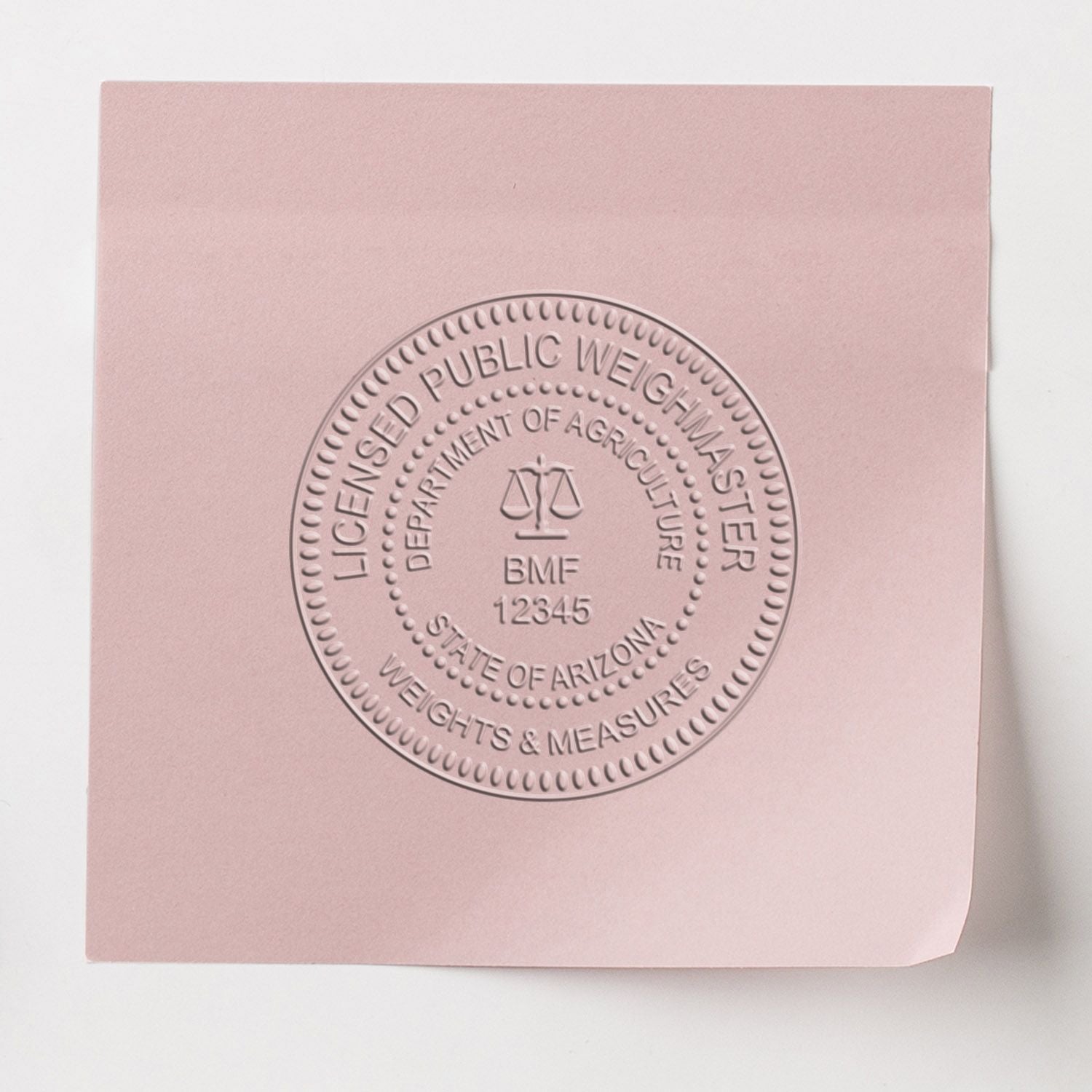
Arizona requires a seal on every weight certificate, and you cannot buy that seal from us or from any other stamp company, because the state supplies it. Ariz. Admin. Code R3-7-506(A) provides that “a public weighmaster shall obtain a Seal of Authority for the certification of weight certificates at cost through the Division”. R3-7-506(C) then settles the ownership question: “A Seal of Authority is the property of the state.” The same subsection requires a weighmaster to surrender the assigned seal to the Division within 30 days after ceasing to operate as a licensed public weighmaster, where the seal carries the weighmaster’s name. A commercially made device is not an option here, and a commercially made copy would not be the Division’s seal.
So this page tells you how to get the Arizona seal rather than how to order one. It also covers the part of Arizona practice that does involve printed wording you control, which is the weight certificate itself: R3-7-505(H) lists seven items every certificate has to carry, including a certification statement the rule sets out word for word. One item we could not establish is the price. The Division’s own weighmaster pages and its published weighmaster handbook refused automated retrieval, so the rule’s phrase “at cost” is as close to a figure as this page can honestly get. Ask the Division before you budget.
Arizona public weighmaster seal requirements at a glance
| Requirement | Arizona rule | Source |
|---|---|---|
| Seal required | Yes, and it is the Division’s seal rather than your own. A weight certificate “is valid only when marked with the Seal of Authority and signed by the issuing public weighmaster or deputy public weighmaster”, and a public weighmaster “shall obtain a Seal of Authority for the certification of weight certificates at cost through the Division”. | Ariz. Admin. Code R3-7-505(D); Ariz. Admin. Code R3-7-506(A) |
| Required elements | No wording list is published, because the Division makes the seal. The one element the rule names is the number: “The Division shall assign a number to a Seal of Authority that identifies the specific location for which the Seal of Authority is issued.” R3-7-506(C) also contemplates that the seal may carry the weighmaster’s name. The engravable content in Arizona sits on the certificate, not on the die. | Ariz. Admin. Code R3-7-506(B), (C) |
| Size and shape | Not addressed. We read R3-7-506 and R3-7-505 in full and neither publishes a diameter, a dimension or a shape. Because the Division supplies the device, no dimension is prescribed to the licensee, and none should be inferred from another state. | Ariz. Admin. Code R3-7-506(A) through (G) |
| Device allowed | The physical Seal of Authority issued by the Division, plus an electronic recreation of it. R3-7-506(G): a weighmaster “may recreate the Seal of Authority assigned by the Division in an electronic format”. R3-7-505(E): it “may be printed electronically on a weight certificate if it is identical in appearance to the Seal of Authority issued by the Division”. Nothing permits a commercially made substitute. | Ariz. Admin. Code R3-7-506(G); R3-7-505(E) |
| Signature and date | Both are required. The certificate is valid only when marked with the seal and signed, and “by signing a weight certificate, a public weighmaster or deputy public weighmaster shall be responsible for the accuracy of all entries”. A signature “may be printed electronically on the weight certificate in lieu of a handwritten signature” where it is that of the weighmaster who weighed the commodity. The date of issuance is a required entry. | Ariz. Admin. Code R3-7-505(C), (D), (F), (H)(1) |
| What must be sealed | Weight certificates. The seal exists for “the certification of weight certificates”, and a certificate is valid only when marked with it and signed by the issuing public weighmaster or deputy public weighmaster. | Ariz. Admin. Code R3-7-506(A); R3-7-505(D) |
| Electronic seal | Permitted, with no third party certificate authority required by anything we read. The electronic version has to be “identical in appearance to the Seal of Authority issued by the Division”, which makes it a reproduction of the state’s device rather than a new design. R3-7-505(J) makes a weighmaster liable for forged physical, printed or electronic signatures. | Ariz. Admin. Code R3-7-505(E), (J); R3-7-506(G) |
| Renewal and lapse | Licenses are issued for twelve calendar months and the license is posted at the licensed scale site. A timely renewal application keeps the existing license valid for thirty days past expiration or until the renewal issues, whichever comes first. On leaving the work, the seal goes back: surrender it to the Division within 30 days where it carries your name. | A.R.S. 3-3453(B), (C); Ariz. Admin. Code R3-7-506(C) |
| Firm requirements | The seal is tied to a scale location rather than to a firm. “A public weighmaster shall have one Seal of Authority for use at each scale location”, and the assigned number identifies that location. Deputies certify with the principal’s seal: the public weighmaster “shall provide the necessary training for any deputy weighmaster using the public weighmaster’s seal to certify weigh tickets”. | Ariz. Admin. Code R3-7-506(B), (D); A.R.S. 3-3453(D) |
| Regulator | Arizona Department of Agriculture, Weights and Measures Services Division. The statute and the rules call it the Division, and A.R.S. 3-3453 assigns licensing to the division. This is a department program, not a professional board. | A.R.S. 3-3453; Ariz. Admin. Code Title 3, Ch. 7, Art. 5 |




Who makes the Arizona Seal of Authority, and who owns it
Two sentences decide the whole commercial question. R3-7-506(A): “A public weighmaster shall obtain a Seal of Authority for the certification of weight certificates at cost through the Division.” R3-7-506(C): “A Seal of Authority is the property of the state.” The first puts the source of the device with the Division. The second says you never own it, even after paying for it.
The statute backs that up at a higher level. A.R.S. 3-3453(H) provides that the division shall approve all forms, certificates, seals and other documents together with the practices, procedures and equipment used by public weighmasters. Read the statute and the rule together and there is no gap for an outside supplier to fill. If you have found an Arizona weighmaster seal for sale somewhere, it is not the Seal of Authority, and a weight certificate marked with it would not be marked with the seal R3-7-505(D) names.
That is worth spelling out for anyone arriving from a state that works the other way. In Maine, Mississippi and New Jersey the statute tells the weighmaster to procure a seal at the weighmaster’s own expense and then tells a manufacturer what to engrave on it. Arizona wrote neither instruction, because it kept the device. The design questions those states leave to you, meaning wording, size and material, do not arise here at all. What Arizona leaves to you is the certificate, and that is where the rest of this page goes.
How to get yours
The route runs through the Division, in this order. Hold or obtain a public weighmaster license first: A.R.S. 3-3453(A) provides that a person shall not serve as a public weighmaster or deputy weighmaster unless the person is issued a public weighmaster or deputy weighmaster license by the division. Then obtain the Seal of Authority at cost through the Division under R3-7-506(A). The Division assigns the number, and it assigns it to a place: R3-7-506(B) says the number “identifies the specific location for which the Seal of Authority is issued”.
That order matters for anyone setting up a new scale site. The seal is not something you arrange in parallel with the license from a different vendor while you wait. It comes after, from the same office, and it is numbered to the site you told them about.
The cost, which we could not establish
R3-7-506(A) says “at cost” and stops there. No figure appears in the rule. We tried to find one in the Department’s own material and could not: the Department’s weighmaster program pages and its published PUBLIC and DEPUTY PUBLIC WEIGHMASTER HANDBOOK both returned HTTP 403 to our fetcher, so neither could be read.
We are saying that plainly rather than repeating a number from somewhere else. Ask the Division what the Seal of Authority costs and how long it takes to receive, and ask before you commit to an opening date for a new scale location. Nothing on this page should be used as a budget figure.
One seal for each scale location
R3-7-506(D) is short and easy to miss: “A public weighmaster shall have one Seal of Authority for use at each scale location.” Combined with R3-7-506(B), which ties the assigned number to a specific location, this makes the Arizona seal a property of the site rather than a personal instrument you carry between yards.
An operator running three scales therefore deals with three seals and three numbers, and a certificate issued at one yard carries that yard’s seal. Moving a seal to cover a second site because the first is quiet is not a workaround the rule leaves open. If you open a location, that location needs its own seal from the Division.
Deputies use the principal weighmaster’s seal
A.R.S. 3-3453(D) puts a training duty on the principal: “A public weighmaster shall provide the necessary training for any deputy weighmaster using the public weighmaster’s seal to certify weigh tickets.” The statute assumes deputies mark certificates with the principal’s Division-issued seal rather than each deputy holding a separate device.
R3-7-506(E) and (F) sit alongside that. The seal has to be accessible to the weighmaster and to authorized deputies during all business hours at the scale location, and it has to be available for Division inspection. That is the opposite of the personal-custody model used for a professional seal in the design trades. Here the device belongs to the state, lives at the site, and is shared by the licensed people working there.



The certificate is where the wording lives
Arizona does not publish seal artwork, but it does publish certificate content, and that is where a weighmaster’s printing decisions actually get made. R3-7-505(H) requires each weight certificate to state: the date of issuance; the name of the declared owner, agent, or consignee of the material weighed; the accurate weight of the material weighed or counted; the means by which the material is being transported at the time it is weighed or counted; the license plate number of the transporting unit; and the printed name, signature, and license number of the public weighmaster or deputy public weighmaster issuing the weight certificate.
Note the sixth item carefully. It asks for a printed name and a license number in addition to a signature. That combination is the part of Arizona practice most often set in type on the certificate stock, and it is worth checking against your current license before a reprint, because a stale number on preprinted stock is a defect on every ticket in the box.
Item four repays a second look as well. The certificate states the means by which the material is being transported at the time it is weighed or counted, and item five asks for the license plate number of the transporting unit. Those two together tie the weight to a physical vehicle at a moment in time, which is the same job the date of issuance does for the paperwork. A form that leaves either as an optional field invites an incomplete ticket, so it is worth designing the stock so that every one of the seven items has a labeled space rather than relying on the operator to remember them.
The certification statement, word for word
R3-7-505(H)(7) prescribes a statement, and it prescribes the words. The certificate carries: “PUBLIC WEIGHMASTER’S CERTIFICATE OF WEIGHT AND MEASURE. This is to certify that the described merchandise was weighed, counted, or measured by a public or deputy public weighmaster, and when properly signed and sealed, is prima facie evidence of the accuracy of the weight, count, or measure shown as prescribed by law.”
Read the phrase “properly signed and sealed” in that statement against R3-7-505(D). The evidentiary value Arizona attaches to a weight certificate depends on both marks being present. A ticket that is signed but not sealed, or sealed but not signed, does not carry the effect the printed statement claims for it.
Signing, and what your signature commits you to
R3-7-505(C) is direct: “By signing a weight certificate, a public weighmaster or deputy public weighmaster shall be responsible for the accuracy of all entries on the weight certificate.” Not the weights alone. All entries, including the vehicle identification and the consignee name someone else may have written in.
Two related rules tighten that. R3-7-505(A) allows a weighmaster to enter only weight information or other required information that the weighmaster has accurately and personally determined. R3-7-505(B) forbids making any entries on a weight certificate issued by another person. And where something goes wrong, R3-7-505(G) does not allow a correction on the face of the ticket: the weighmaster voids the certificate and issues a new one.
The void and reissue rule is the one that changes daily habits. There is no initialed correction on an Arizona weight certificate, which means a mistyped plate number is a new certificate rather than a pen stroke, and it means the voided copy has to be kept and accounted for rather than discarded. Build the certificate book around that from the start, because a scale house that corrects on the face of the ticket is producing documents the rule does not contemplate.
The electronic version of the Division’s seal
Arizona permits an electronic seal, and it defines it narrowly. R3-7-506(G) allows a weighmaster to recreate the Seal of Authority assigned by the Division in an electronic format. R3-7-505(E) sets the test that recreation has to pass: it may be printed electronically on a weight certificate “if it is identical in appearance to the Seal of Authority issued by the Division”.
Identical in appearance is the operative phrase. This is not a license to design a digital mark that reads sensibly; it is permission to reproduce the state’s own device. In practice that means the image comes from the physical seal the Division gave you, and any difference in wording, number or layout defeats the permission. Signatures get similar treatment under R3-7-505(F), with R3-7-505(J) making the weighmaster liable for forged physical, printed or electronic signatures.


Keeping it available, and Division inspection
R3-7-506(E) and (F) require the Seal of Authority to be accessible to the public weighmaster and authorized deputy public weighmasters during all business hours at the scale location, and to be available for inspection by the Division. That is a custody standard written for a shared, state-owned device at a fixed site.
The practical reading is that the seal lives at the scale house during business hours and does not go home in a truck. If your site has a routine for locking up the certificate book, the seal belongs in the same routine, with the difference that it also has to be producible on request when an inspector arrives.
Renewal, the thirty day window, and giving the seal back
A.R.S. 3-3453(B) issues licenses for twelve calendar months and requires the license to be posted at the licensed scale site. Subsection (C) gives a grace path: a timely renewal application keeps the existing license valid for thirty days past expiration or until the renewal is issued, whichever comes first.
The seal has its own thirty day clock, running the other way. R3-7-506(C): a public weighmaster “shall surrender their assigned Seal of Authority to the Division within 30 days after the public weighmaster no longer operates as a licensed public weighmaster if the Seal of Authority contains the public weighmaster’s name”. Closing a yard, selling the operation or letting a license go are all events that start that count. Put the seal in the closing checklist with the license, because it is the one item on that list that belongs to somebody else.
What Acorn can do for an Arizona weighmaster, and what we cannot
We cannot make you a Seal of Authority. Nobody outside the Division can, and a device that imitates one would not satisfy R3-7-505(D) or R3-7-506(A). That is the honest answer, and it is the reason this page is short on product and long on procedure.
What Arizona does leave open is ordinary shop printing: the certificate stock carrying the items in R3-7-505(H) and the R3-7-505(H)(7) statement, and the printed name and license number block that subsection (H)(6) requires beside the signature. A plain text stamp can set that block if you would rather not reprint stock every time a deputy changes, and we make text stamps to order from the custom made rubber stamps range. If you want to check whether a particular block is worth stamping rather than printing, contact us with the layout. For the seal itself, go to the Division. This page is a research summary and not legal advice.
- Public Weighmaster Stamps and Seals
- Nevada Weighmaster: No Seal, Signature Instead
- California Weighmaster: No Seal, a Legend Instead
Frequently asked questions
Can I buy an Arizona public weighmaster seal?
No. Ariz. Admin. Code R3-7-506(A) requires a public weighmaster to obtain the Seal of Authority at cost through the Division, and R3-7-506(C) says the seal is the property of the state. There is nothing here for a stamp company to sell you, and a lookalike device would not be the seal the rule names.
What does the Seal of Authority cost?
The rule says only “at cost” and publishes no figure. We could not establish the amount: the Arizona Department of Agriculture’s weighmaster pages and its published weighmaster handbook both refused automated retrieval. Ask the Division directly before budgeting.
Do I have to give the seal back?
Yes, where it carries your name. R3-7-506(C) requires a public weighmaster to surrender the assigned Seal of Authority to the Division within 30 days after no longer operating as a licensed public weighmaster. The seal is state property throughout.
How many seals do I need?
One for each scale location. R3-7-506(D) requires a public weighmaster to have one Seal of Authority for use at each scale location, and R3-7-506(B) ties the Division-assigned number to that specific location.
Can I use an electronic seal in Arizona?
Yes, within limits. R3-7-506(G) permits a weighmaster to recreate the assigned Seal of Authority in an electronic format, and R3-7-505(E) permits it to be printed electronically on a weight certificate if it is identical in appearance to the seal the Division issued. It is a reproduction of the state’s device, not a design of your own.
What size is an Arizona weighmaster seal?
No size is published. We read R3-7-506 and R3-7-505 in full and neither states a diameter, a dimension or a shape. Because the Division supplies the device, the question does not arise for the licensee, and a figure from another state should not be substituted.
What has to appear on an Arizona weight certificate?
R3-7-505(H) lists the date of issuance; the name of the declared owner, agent or consignee; the accurate weight of the material weighed or counted; the means of transport at the time of weighing; the license plate number of the transporting unit; the printed name, signature and license number of the issuing weighmaster or deputy; and the prescribed certification statement beginning “PUBLIC WEIGHMASTER’S CERTIFICATE OF WEIGHT AND MEASURE”.
Does a deputy weighmaster need a separate seal?
The rules do not describe one. A.R.S. 3-3453(D) speaks of a deputy weighmaster using the public weighmaster’s seal to certify weigh tickets, and requires the public weighmaster to provide the necessary training. R3-7-506(E) requires the seal to be accessible to authorized deputies at the scale location during business hours.








