
Written by Acorn Sales Company, manufacturing stamps and seals since 1964 · Reviewed by Holly R, VP of Sales and Marketing at Acorn Sales, against the Board of Professional Engineers, Architects, Surveyors, and Landscape Architects and Haw. Rev. Stat. § 464-11 on 21 September 2026 · Updated 21 September 2026
The date beside a Hawaii seal is your license expiration date, not today’s date. HAR § 16-115-9(a) builds a three-line authentication block below the seal: the statement “This work was prepared by me or under my supervision,” your signature, and a line captioned “Expiration Date of the License.” An architect who fills that line with the day they signed has not complied, and a die sold with a DATE caption invites exactly that mistake.
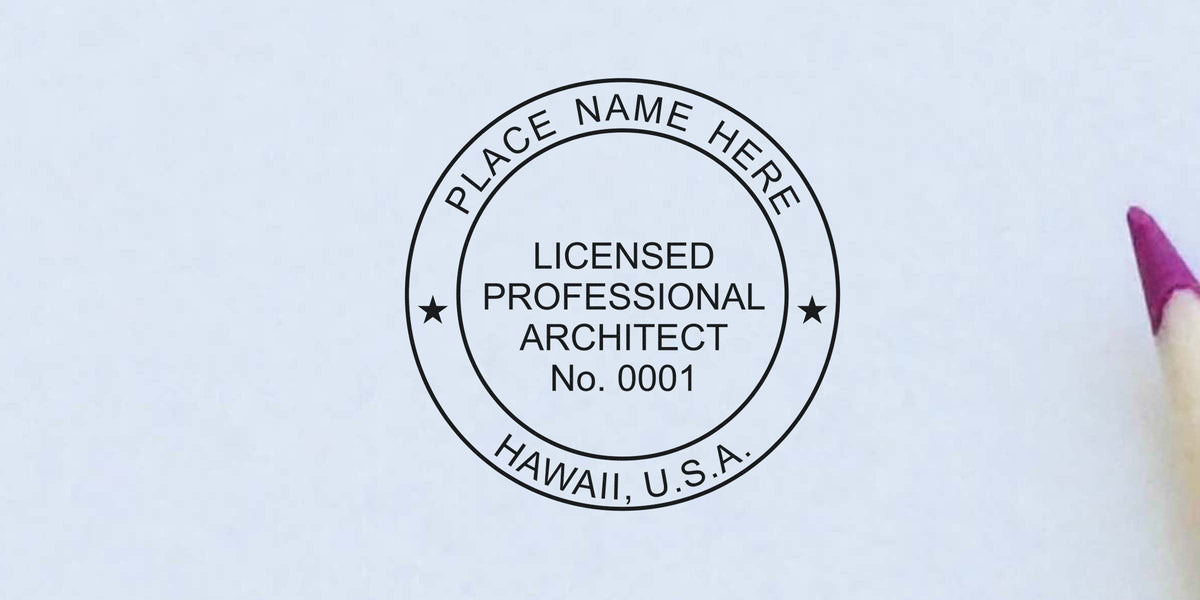
The seal itself is two concentric circles, a smaller one 1-1/8 inches in diameter inside a larger one 1-1/2 inches in diameter, with your name and the words Hawaii, U.S.A. in the outer ring and Licensed Professional Architect with your license number in the center. Nothing else goes inside the circles, because the signature, the attestation and the date all sit below the seal on the sheet.
Watch the legend. HRS § 464-11 authorizes the words “licensed architect,” but the current rule prescribes “Licensed Professional Architect” in the center, and the statute lets the board authorize other wording. Cut the rule wording.
Hawaii architect seal requirements at a glance
| Requirement | Hawaii rule | Source |
|---|---|---|
| Seal required | Yes | Haw. Rev. Stat. § 464-11 |
| Required elements | Two concentric circles, Your name as licensed, The words “Hawaii, U.S.A.” in the outer ring, Licensed Professional Architect in the center and Your license number in the center | Haw. Admin. R. § 16-115-8(a) |
| Size and shape | Two circles: a smaller one 1-1/8 inches in diameter inside a larger one 1-1/2 inches in diameter. | Haw. Admin. R. § 16-115-8(a)(1) |
| Device allowed | HRS § 464-11 authorizes “a seal or rubber stamp of the design authorized by the board” and HAR § 16-115-8 says seal or stamp throughout, so both an embosser and an inked rubber stamp are lawful. | Haw. Rev. Stat. § 464-11 |
| Signature and date | Hawaii does not use a plain signature and date. | Haw. Admin. R. § 16-115-9(a), (b), (c), (e) |
| What must be sealed | All plans, specifications, maps, reports, surveys, descriptions and “every sheet in a set of design drawings” prepared by or under the supervision of a licensee, when filed with public officials. | Haw. Admin. R. § 16-115-9(a) |
| Electronic seal | HAR § 16-115-2 defines a digital signature as a digital code, generated and authenticated by public encryption, attached to an electronically transmitted document to verify its contents and the sender’s identity, containing encryption protections using a set of algorithms to determine authenticity. | Haw. Admin. R. §§ 16-115-2, 16-115-9(e) |
| Renewal and lapse | Every license expires April 30 of each even-numbered year and becomes invalid after that date unless renewed. | Haw. Rev. Stat. §§ 464-9(c), 464-11 |
| Firm requirements | Not applicable. | Haw. Rev. Stat. § 464-12 |
| Regulator | The Board of Professional Engineers, Architects, Surveyors, and Landscape Architects | Haw. Rev. Stat. ch. 464 (Professional Engineers, Architects, Surveyors and Landscape Architects), read on the Hawaii State Legislature site |



Is a seal required in Hawaii?
Hawaii ties the seal to filing with public officials. HRS § 464-11 provides that all plans, specifications, maps and reports prepared by or under the supervision of a licensed architect “shall be stamped with such seal or stamp when filed with public officials.” The board rule widens the list and adds the authentication block: HAR § 16-115-8(c) requires those documents “submitted to public officials for approval” to be stamped with the authorized seal and authenticated as provided in section 16-115-9. HRS § 464-11 also bars a state or county building official from accepting plans that are not stamped by a licensed architect or by an engineer qualified in the structural branch, unless the structure is exempt under HRS § 464-13.
What must appear on the seal
- Two concentric circles
- Your name as licensed
- The words “Hawaii, U.S.A.” in the outer ring
- Licensed Professional Architect in the center
- Your license number in the center
Nothing else goes inside the circles. The signature, the attestation sentence and the date all sit below the seal under HAR § 16-115-9, so a die with a built-in signature line or date line is wrong here. The legend is the item to watch. HRS § 464-11 authorizes the words “licensed architect”, but the current rule prescribes “Licensed Professional Architect” in the center of the seal, and the statute lets the board authorize other wording. Cut the rule wording. The branch abbreviation that Hawaii engineers add after the license number is an engineering requirement and has no place on an architect seal, and HAR § 16-115-8(b), which requires a separate seal for each branch, reaches engineers only.
Size and shape
Two circles: a smaller one 1-1/8 inches in diameter inside a larger one 1-1/2 inches in diameter. That larger figure is the outside diameter of the device, so a 1-1/2 inch die is the target. HAR § 16-115-8 adds a performance test on top of the geometry: the licensee “shall use a seal or stamp that is legible and reproducible”, which rules out fine lettering that fills in when the sheet is scanned or reduced.



Embosser, rubber stamp or digital
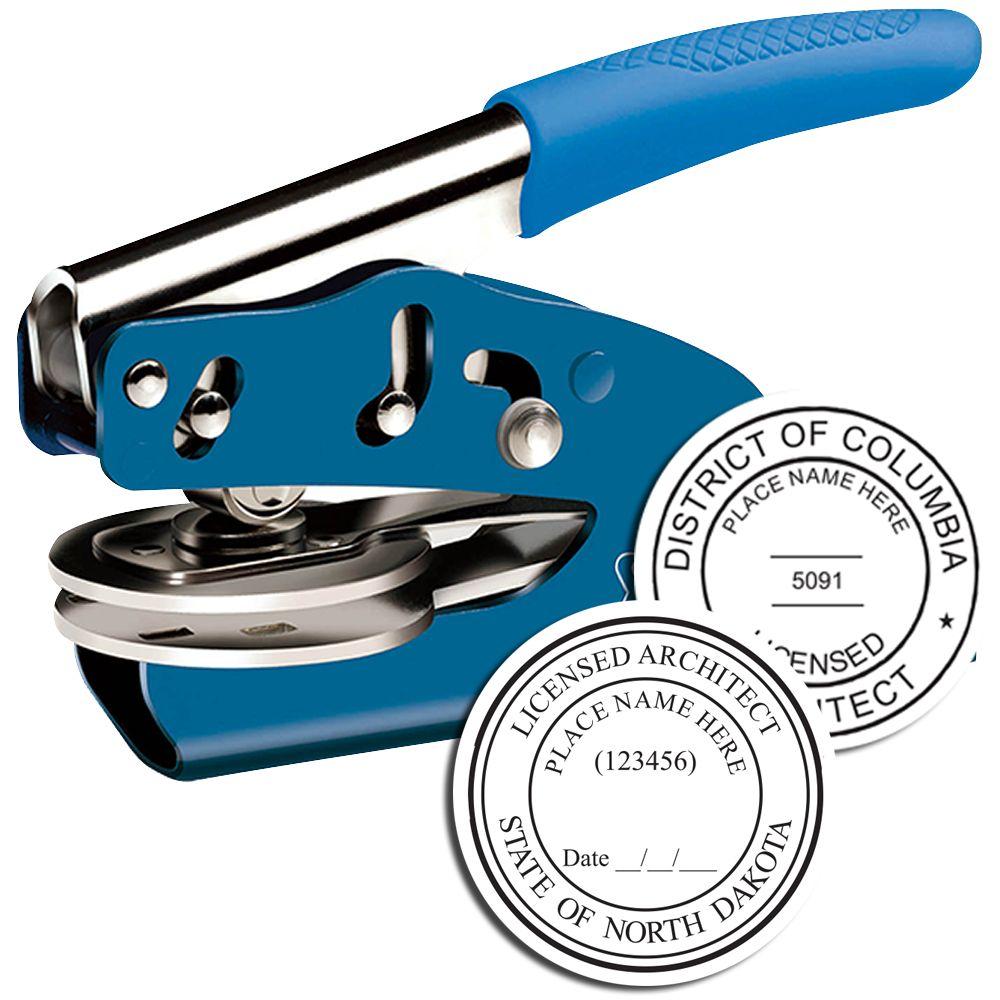
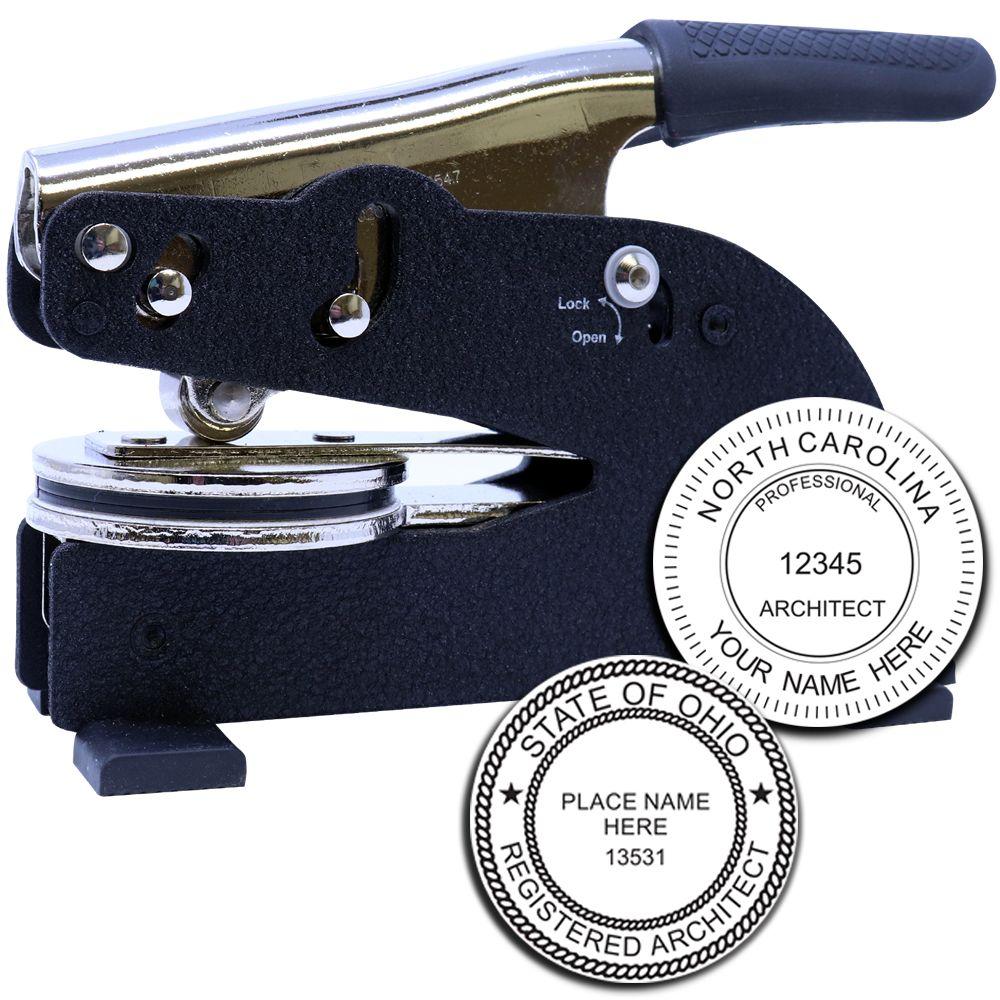
HRS § 464-11 authorizes “a seal or rubber stamp of the design authorized by the board” and HAR § 16-115-8 says seal or stamp throughout, so both an embosser and an inked rubber stamp are lawful. The inked rubber stamp at 1-1/2 inches is the safe buy, because an embossed impression struggles to satisfy the legible-and-reproducible test on photocopies. Whether a computer-generated seal image is permitted is not addressed: the rule defines and permits a digital signature but says nothing about a digital seal graphic. Checked HAR §§ 16-115-2, 16-115-8 and 16-115-9 in the board-posted chapter and HRS § 464-11.
Signing and dating
Hawaii does not use a plain signature and date. HAR § 16-115-9(a) requires an authentication block below the seal stating “This work was prepared by me or under my supervision”, signed by the licensee, and stating the expiration date of the license. The caption printed in the rule is “Expiration Date of the License”, so the date line is not the date of signing. Two further blocks exist: § 16-115-9(b) requires CONSTRUCTION OF THIS PROJECT WILL BE UNDER MY OBSERVATION on plans and specifications filed with building or construction permit applications involving public safety or health, and § 16-115-9(c) combines both statements where the same licensee does the design and the construction observation. Under § 16-115-9(e) the signature must be original or digital, and “The use of rubber signature stamps or other facsimile signatures is prohibited.” Signing across the seal is not required.
The date beside your Hawaii seal is your license expiration date, not today’s date
Almost every other state asks a sealing architect to write the date the document was signed. Hawaii asks for something different. HAR § 16-115-9 builds a three-line authentication block that goes below the seal, and the caption on the second line is “Expiration Date of the License”. A licensee who fills that line with the day they signed has not complied, and a die sold with a DATE caption invites exactly that mistake.
The block itself is the second surprise. The first line reads THIS WORK WAS PREPARED BY ME OR UNDER MY SUPERVISION, and where the same architect will also observe construction, § 16-115-9(b) and (c) add CONSTRUCTION OF THIS PROJECT WILL BE UNDER MY OBSERVATION for plans and specifications filed with a permit application involving public safety or health. That observation statement reaches architects, engineers and landscape architects; it does not reach land surveyors.
The third point is what you cannot do. HAR § 16-115-9(e) prohibits “rubber signature stamps or other facsimile signatures”. The seal may be a rubber stamp. The signature may not.
So the Hawaii order is a 1-1/2 inch outer circle with a 1-1/8 inch inner circle, the legend Licensed Professional Architect and the license number in the center, Hawaii, U.S.A. and the name in the ring, and nothing else. The block below the seal is typed or written on the sheet.
Which documents must be sealed
All plans, specifications, maps, reports, surveys, descriptions and “every sheet in a set of design drawings” prepared by or under the supervision of a licensee, when filed with public officials. The carve-out is structural rather than editorial. HRS § 464-13 exempts privately owned or privately controlled buildings below cost thresholds, currently $40,000 for a one-story building and $35,000 for a two-story building, and $180,000 for a one-story residence and $162,000 for a two-story residence, figures raised by Act 177 of 2023. The exemption does not apply where the principal structural members are reinforced concrete or structural steel with riveted, bolted or welded connections, where the State or a county requires a licensed design professional through special management areas, flood hazard areas, special design districts, conditional use permits or variances, or where a landowner or owners association imposes the requirement. Drafts are not addressed: Hawaii has no preliminary or progress carve-out in the rule.



Electronic and digital seals
HAR § 16-115-2 defines a digital signature as a digital code, generated and authenticated by public encryption, attached to an electronically transmitted document to verify its contents and the sender’s identity, containing encryption protections using a set of algorithms to determine authenticity. No certificate authority, named standard or third-party vendor is required. The digital signature substitutes for the handwritten signature. The rule does not separately authorize an electronic seal graphic, so the conservative practice is a digital signature applied over an image of the board-prescribed design.
Renewal, lapse and retirement
Every license expires April 30 of each even-numbered year and becomes invalid after that date unless renewed. An expired license may be restored within two years on payment of a fee for each renewal period; after two years the person reapplies as a new applicant under the requirements then in effect. HRS § 464-11 makes it “unlawful for anyone to seal or stamp any document with such seal or stamp after the license has expired or has been revoked or suspended unless such license has been renewed or reissued.” Whether a license number changes on reapplication after the two-year window is not addressed in HRS § 464-9 or HAR chapter 16-115. There is no duty to surrender or destroy the device. Because the authentication block carries the expiration date, a renewal changes what you write beside the seal even though it does not change the seal.
Firm requirements
Not applicable. A corporation, partnership or limited liability company may practice architecture in Hawaii provided the person or persons directly in charge of the professional work are licensed, and that person must be a full-time employee, principal, officer, partner, member or manager with legal authority to bind the entity. There is no certificate of authorization, no firm number to carry on the document and no firm seal.
What to check before you order
Order a 1-1/2 inch outside circle with a 1-1/8 inch inner circle. Outer ring: your name as licensed plus Hawaii, U.S.A. Center: the words Licensed Professional Architect, then your license number. Do not add a signature line, a date line or the word SEAL, because the attestation block with the expiration date goes below the seal on the sheet. An inked rubber stamp is the better device, since the rule requires the impression to be legible and reproducible. No proof of licensure is required at the counter and nothing is filed with the board, but avoid type smaller than the board sample supports.
Browse architect stamps and seals.
- Choosing the Right Hawaii Architect Stamp Embossing for You
- Get Your Hawaii Architect Stamp Online in Minutes!
Frequently asked questions
Is an architect seal required in Hawaii?
Yes, on filings with public officials. HRS § 464-11 provides that all plans, specifications, maps and reports prepared by or under the supervision of a licensed architect “shall be stamped with such seal or stamp when filed with public officials,” and HAR § 16-115-8(c) requires documents “submitted to public officials for approval” to be stamped with the authorized seal and authenticated as provided in section 16-115-9. The statute also bars a state or county building official from accepting plans that are not stamped by a licensed architect or by an engineer qualified in the structural branch, unless the structure is exempt under HRS § 464-13.
What has to appear on a Hawaii architect seal?
Two concentric circles, your name as licensed and the words Hawaii, U.S.A. in the outer ring, and Licensed Professional Architect with your license number in the center, under HAR § 16-115-8(a). The branch abbreviation Hawaii engineers add after the license number is an engineering requirement, and HAR § 16-115-8(b), which requires a separate seal for each branch, reaches engineers only.
What size is a Hawaii architect seal?
An inner circle 1-1/8 inches in diameter inside an outer circle 1-1/2 inches in diameter, under HAR § 16-115-8(a)(1). That larger figure is the outside diameter of the device, so a 1-1/2 inch die is the target. The rule adds a performance test on top of the geometry: the licensee “shall use a seal or stamp that is legible and reproducible,” which rules out fine lettering that fills in when the sheet is scanned or reduced.
Can I use an embosser in Hawaii?
Yes. HRS § 464-11 authorizes “a seal or rubber stamp of the design authorized by the board,” and HAR § 16-115-8 says seal or stamp throughout, so both an embosser and an inked rubber stamp are lawful. The inked stamp at 1-1/2 inches is the safer buy, since an embossed impression struggles to satisfy the legible-and-reproducible test on photocopies. Whether a computer-generated seal image is permitted is a separate question the rule does not answer: HAR §§ 16-115-2, 16-115-8 and 16-115-9 define and permit a digital signature but say nothing about a digital seal graphic.
What goes in the Hawaii attestation block?
Three lines below the seal under HAR § 16-115-9(a): the statement that the work was prepared by you or under your supervision, your signature, and the expiration date of your license. Section 16-115-9(b) adds a second statement, CONSTRUCTION OF THIS PROJECT WILL BE UNDER MY OBSERVATION, on plans and specifications filed with building or construction permit applications involving public safety or health, and § 16-115-9(c) combines both where the same licensee does the design and the construction observation. That observation statement reaches architects, engineers and landscape architects, not land surveyors.
Can I use a signature stamp in Hawaii?
No. Under HAR § 16-115-9(e) the signature must be original or digital, and “The use of rubber signature stamps or other facsimile signatures is prohibited.” The seal may be a rubber stamp; the signature may not. Signing across the seal is not required.
Which documents have to be sealed in Hawaii?
All plans, specifications, maps, reports, surveys, descriptions and “every sheet in a set of design drawings” prepared by or under the supervision of a licensee, when filed with public officials. Hawaii has no preliminary or progress carve-out in the rule.
When is a Hawaii project exempt from the architect requirement?
HRS § 464-13 exempts privately owned or privately controlled buildings below cost thresholds, currently $40,000 for a one-story building and $35,000 for a two-story building, and $180,000 for a one-story residence and $162,000 for a two-story residence, figures raised by Act 177 of 2023. The exemption does not apply where the principal structural members are reinforced concrete or structural steel with riveted, bolted or welded connections, where the State or a county requires a licensed design professional through special management areas, flood hazard areas, special design districts, conditional use permits or variances, or where a landowner or owners association imposes the requirement.
What counts as a digital signature in Hawaii?
HAR § 16-115-2 defines it as a digital code, generated and authenticated by public encryption, attached to an electronically transmitted document to verify its contents and the sender’s identity, containing encryption protections using a set of algorithms to determine authenticity. No certificate authority, named standard or third-party vendor is required, and the digital signature substitutes for the handwritten one. Because the rule does not separately authorize an electronic seal graphic, the conservative practice is a digital signature applied over an image of the board-prescribed design.
Does my Hawaii seal change at renewal?
The seal does not, but what you write beside it does, because the authentication block carries the expiration date. Every license expires April 30 of each even-numbered year and becomes invalid after that date unless renewed. An expired license may be restored within two years on payment of a fee for each renewal period; after two years the person reapplies as a new applicant. HRS § 464-11 makes it “unlawful for anyone to seal or stamp any document with such seal or stamp after the license has expired or has been revoked or suspended unless such license has been renewed or reissued.” Whether a license number changes on reapplication after the two-year window is not stated in HRS § 464-9 or HAR chapter 16-115, and there is no duty to surrender or destroy the device.
Does a Hawaii architecture firm need a certificate of authorization?
No. A corporation, partnership or limited liability company may practice architecture in Hawaii provided the person or persons directly in charge of the professional work are licensed, and that person must be a full-time employee, principal, officer, partner, member or manager with legal authority to bind the entity, under HRS § 464-12 and HAR § 16-115-4. There is no certificate of authorization, no firm number to carry on the document and no firm seal.








