
What is a North Carolina Notary Authorized to Do?
Many states have long and complex written laws about notarial duties or powers. Fortunately for those in North Carolina, everything is kept very short and very sweet. The Secretary of the State says on its website that the notaries throughout the state are authorized to:
- Acknowledge signatures
- Administer oaths and affirmations
- Verify and/or prove signatures
And though this seems extremely simple, it is much more in-depth than those three lines of text indicate. This is why the state has taken the step of implementing Notary Public Education Programs throughout the state. They provide education into the legalities, ethics, and even procedural matters associated with the work, and the state is seen as being in the "vanguard of Notary Public education, testing, regulation, and practice". (SOS)
Clearly, this means that the work of any notary in the state is more complex than it might initially seem, and that the use of a North Carolina Notary Public stamp and seal is not to be taken lightly.
Just consider that the documents that they may have to read, handle, or even draft on their own can include the following list of examples given by the Secretary of State:
- Affidavits
- Acknowledgement of Attorney in Fact (power of attorney)
- Verification of Non-subscribing Witness (document signed without the presence of the notary)
- Certificate for Oaths of Affirmation
- Certifications of Wills
Each of these items is handled by the notary, who must use great attention to detail as well as full knowledge of their legal powers to deal with them properly.
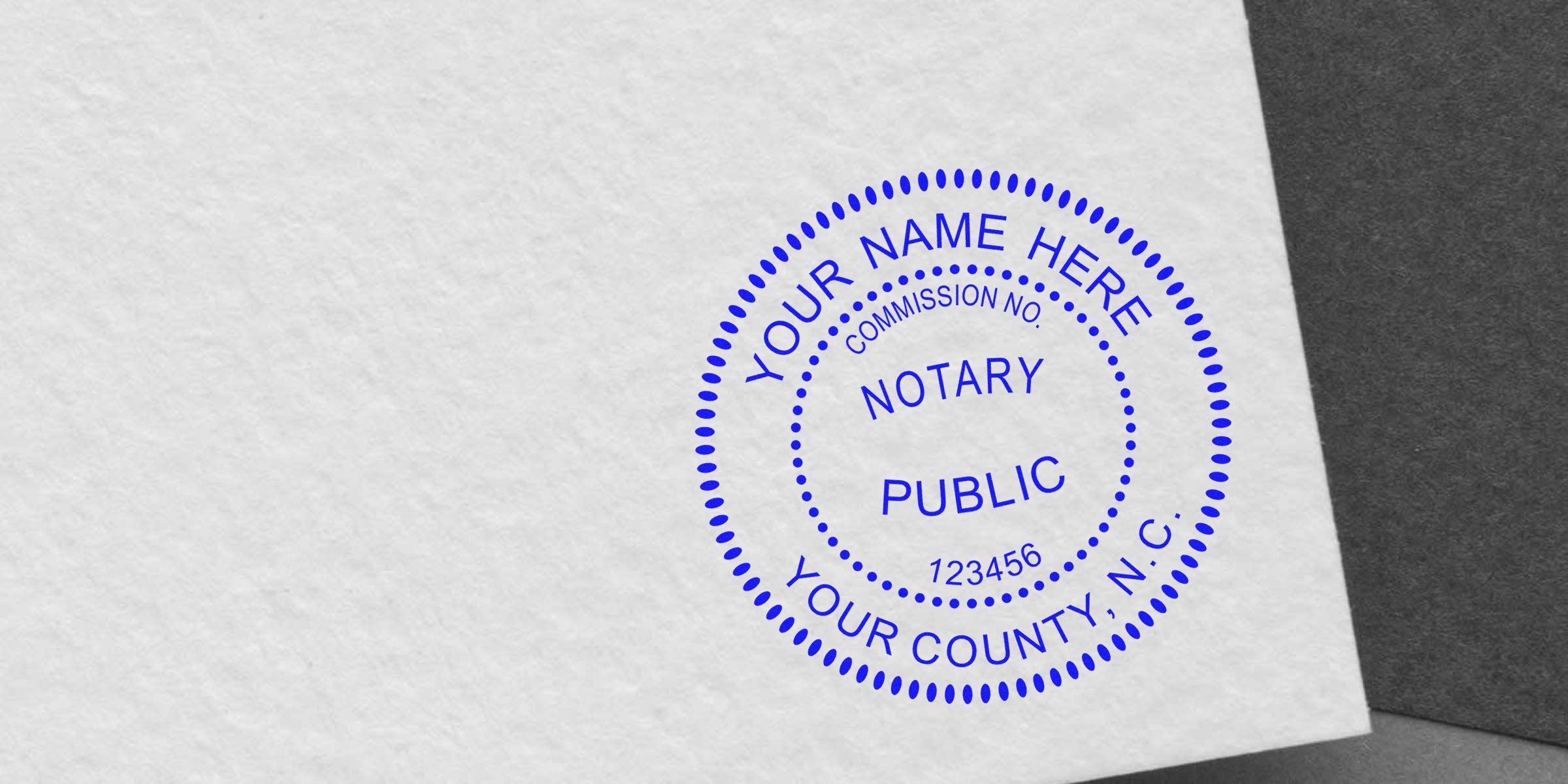
What Will Your North Carolina Notary Seal Look Like?
Then the North Carolina Notary Public stamp and seal is applied as evidence that the notary has done their work. This official acknowledgement creates liability for the notary, and so the North Carolina Notary Public stamp and seal is always used with great care.
Like many other states, the North Carolina Notary Public stamp and seal has to meet a specific set of criteria that includes:
- It must contain the notary's name (as commissioned)
- The phrase "Notary Public"
- The name of the county in which the commission was granted, and including the word "County" or the "Co" abbreviation
- The state name "North Carolina" or the legal abbreviation of "NC"
- A North Carolina Notary Public stamp and seal may be round or rectangular in shape. If round, the North Carolina Notary Public stamp and seal cannot measure less than 1.5" or more than 2". If rectangular, the North Carolina Notary Public stamp and seal must be 1"x2.5"
- The perimeter of a North Carolina Notary Public stamp and seal must feature a visible border
- The expiration of the notary's commission is not required but is convenient
The North Carolina Notary Public stamp and seal should come from a reputable maker to ensure that it is able to meet the demands of the work. After all, a commission lasts for four years. Unless a North Carolina Notary Public stamp and seal is durable enough to withstand daily or frequent use, the text may become unclear and documents may be questioned if the North Carolina Notary Public stamp and seal is difficult to decipher or identify.
Your professionalism is important as a notary in North Carolina. Don't leave things to chance and get a well made stamp or seal that you can count on for many years. Your signature is important, but so too is the mark proving you are a commissioned notary in your state.
Frequently Asked Questions
What size and shape can a North Carolina notary seal be?
A North Carolina notary seal may be round or rectangular. If round, it must measure between 1.5 inches and 2 inches. If rectangular, it must be 1 inch by 2.5 inches.
Is the expiration date required on a North Carolina notary seal?
No, the expiration date of the notary’s commission is not required on the seal in North Carolina, although many notaries choose to include it for convenience.
Can I use either “North Carolina” or “NC” on my notary stamp or seal?
Yes, North Carolina allows either the full state name “North Carolina” or the legal abbreviation “NC” on the notary seal.
What are the most common mistakes to avoid when ordering a North Carolina notary seal?
Common mistakes include using the wrong county, misspelling the notary’s commissioned name, leaving out “Notary Public,” choosing the wrong size or shape, or selecting a seal without a visible border.
What notarizations can a North Carolina notary public perform?
North Carolina notaries are authorized to acknowledge signatures, administer oaths and affirmations, and verify or prove signatures. The state also lists documents such as affidavits, powers of attorney, and certificates for oaths or affirmations as common notarial acts.








