
Written by Acorn Sales Company, manufacturing stamps and seals since 1964 · Reviewed by Holly R, VP of Sales and Marketing at Acorn Sales, against the Delaware Board of Architects, within the Division of Professional Regulation and 24 DE Admin. Code 300, r. 7.6.1, 7.6.2 on 21 September 2026 · Updated 21 September 2026
Three items go next to every Delaware seal, not two. Rule 7.6.2 requires that at each place the seal is imprinted on a technical submission going for a permit there be an original or electronic signature, the date of that signature, and “the date of expiration of the architect’s Delaware registration,” all in close proximity to the seal and in a format substantially similar to the three labeled lines the rule prints. Very few states ask for an expiry date at all, and Delaware asks for it every place the seal appears.
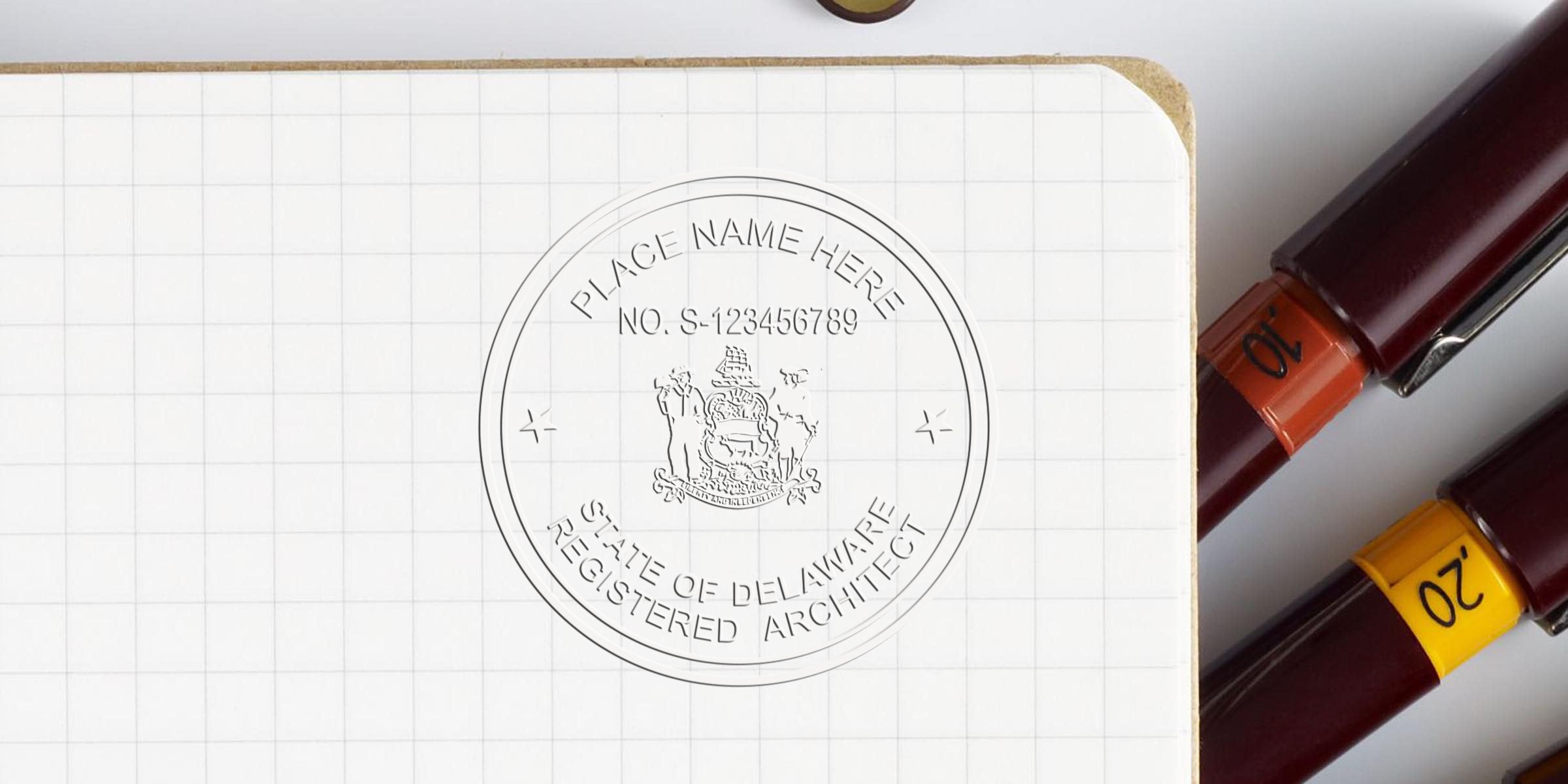
The die itself carries three things: your legal name, your registration number, and the phrase REGISTERED ARCHITECT and STATE OF DELAWARE as rule 7.6.1 prints it. Legal name is a real requirement, not a formality, since the rule states that “The architect shall use his/her legal name on the Certificate of Registration, the seal and the license.” A trade name, a shortened form or a professional byline is a defect.
Size is fixed by picture rather than by figure. Rule 7.6.1 says the seal “shall comply in all respects, including size and format, with the specimen shown below,” and the specimen is an image in the chapter with no printed dimension. Order to that specimen, and do not substitute the Delaware landscape architect, geologist or land surveyor figures, which belong to other boards.
Delaware architect seal requirements at a glance
| Requirement | Delaware rule | Source |
|---|---|---|
| Seal required | Yes | 24 DE Admin. Code 300, r. 7.6.1, 7.6.2 |
| Required elements | Your legal name as it appears on the Certificate of Registration and the license, Your registration number and The phrase REGISTERED ARCHITECT and STATE OF DELAWARE, as printed in the rule | 24 DE Admin. Code 300, r. 7.6.1 |
| Size and shape | Not stated in words. | 24 DE Admin. Code 300, r. 7.6.1 (specimen governs size and format |
| Device allowed | A stamped impression is the baseline and an electronic seal is allowed in its place, on five conditions. | 24 DE Admin. Code 300, r. 7.6.1, 7.6.1.1 |
| Signature and date | Three items go next to the seal, not two. | 24 DE Admin. Code 300, r. 7.6.2, 7.6.6 |
| What must be sealed | All technical submissions which are published or submitted to public authorities for building permits or regulatory approvals: each design, each drawing, each set of specifications, all addenda, and the cover of all other technical submissions. | 24 DE Admin. Code 300, r. 2.2.3, 7.6.2, 7.6.4, 7.6.5 |
| Electronic seal | Delaware states functional criteria rather than naming a technology. | 24 DE Admin. Code 300, r. 7.6.1.1, 7.6.2, 7.6.6 |
| Renewal and lapse | Delaware takes the seal back. | 24 DE Admin. Code 300, r. 6.1, 6.5, 6.6, 6.7 |
| Firm requirements | No certificate of authorization and no firm seal. | 24 DE Admin. Code 300, r. 7.5.1, 2.2.3.4 |
| Regulator | The Delaware Board of Architects, within the Division of Professional Regulation | 24 DE Admin. Code 300 (Board of Architects), read in full from the Delaware Regulations site, principally r. 2.2.3, 6.1, 6.5, 6.6, 6.7, 7.5.1, 7.5.2 and 7.6 (Design and Use of Architect’s Seal, amended 20 DE Reg. 375 (11/01/16)) |
Is a seal required in Delaware?
Rule 7.6.1 creates the device under statutory authority: “Pursuant to 24 Del.C. §313, and subject to 6.7 and 7.5, each architect shall procure a seal, which shall contain the name of the architect; his/her registration number and the phrase” REGISTERED ARCHITECT and STATE OF DELAWARE, which the rule prints as one phrase joined by a double hyphen. Rule 7.6.2 supplies the trigger: “all technical submissions which are published and/or are submitted to public authorities for building permits or regulatory approvals shall be sealed by the architect. Each design, each drawing, each set of specifications, all addenda and the cover of all other technical submissions shall be sealed.” Preliminary designs and drawings submitted to any public or reviewing agency are expressly included.
What must appear on the seal
- Your legal name as it appears on the Certificate of Registration and the license
- Your registration number
- The phrase REGISTERED ARCHITECT and STATE OF DELAWARE, as printed in the rule
Delaware fixes the name format in a way most states do not: “The architect shall use his/her legal name on the Certificate of Registration, the seal and the license.” A trade name, a shortened form or a professional byline is a defect. The seal itself carries only the three items above; the additional Delaware requirements, which are extensive, sit beside the impression on the document rather than on the die. Do not letter the landscape architect legend from 24 DE Admin. Code 200 or the land surveyor legend from chapter 2700 onto an architect device; Delaware runs three separate boards with three separate seal rules and only one of them states a diameter.
Size and shape
Not stated in words. Rule 7.6.1 says the seal “shall comply in all respects, including size and format, with the specimen shown below,” and the specimen is reproduced as an image in the chapter without a printed dimension. The sources here are 24 DE Admin. Code 300 in full, rules 1.0 through 8.0, and checked 24 Del. C. ch. 3. The size is therefore fixed by the Board’s artwork and not by a number you can look up: order to the specimen the Board supplies. Do not substitute the Delaware landscape architect figure of a 1 13/16 inch outside circle, or the Delaware geologist minimum of 1 1/2 inches, or the Delaware land surveyor official pocket size of a 1 inch inner circle and a 1 1/2 inch outer circle; all three belong to other boards.
Embosser, rubber stamp or digital
A stamped impression is the baseline and an electronic seal is allowed in its place, on five conditions. Rule 7.6.1.1 permits an electronic seal and signature in lieu of a stamped impression and original signature when it is a unique identification of the professional, verifiable, under the professional’s direct and sole control, linked to the document so that the electronic seal and signature are invalidated if any data in the document are changed, and when “The graphic image of the electronic seal shall have the same graphic appearance in all respects as 7.6.1 above.” The safe buy is a physical stamp matching the specimen, with a matching graphic image for electronic submissions.
Signing and dating
Three items go next to the seal, not two. Rule 7.6.2 requires that at each place where the seal is imprinted on a technical submission submitted for a permit there shall be an original or electronic signature, the date of the signature, and “the date of expiration of the architect’s Delaware registration,” all in close proximity to the seal, in a format substantially similar to the three labelled lines the rule prints: Signature, Date of signature, and Date of registration expiration. Rule 7.6.6 then forbids removal or alteration: “No person shall remove or alter any seal, signature or date required by 7.61, 7.6.4 and/or 7.6.5.”
Your registration expiry date goes on the sheet, next to every seal
Rule 7.6.2 asks for three things in close proximity to each imprint of the seal: an original or electronic signature, the date of that signature, and the date your Delaware registration expires. The rule even prints the three labelled lines. Very few states ask for an expiry date at all, and Delaware asks for it at every place the seal appears on a permit submission. It is the single most common Delaware defect on an otherwise competent set.
Which documents must be sealed
All technical submissions which are published or submitted to public authorities for building permits or regulatory approvals: each design, each drawing, each set of specifications, all addenda, and the cover of all other technical submissions. Preliminary designs and drawings submitted to a public or reviewing agency count. Two legends must travel with the seal. Rule 7.6.4 requires every technical submission prepared by an architect to carry, wherever the seal appears: “The professional services of the architect are undertaken for and are performed in the interest of [name of person employing architect]. No contractual obligation is assumed by the architect for the benefit of any other person involved in the project.” Rule 7.6.5 requires an architect not employed to furnish construction contract administration services to note that, in minimum 12 point type in close proximity to the seal, in the wording the rule prescribes. Rule 2.2.3 carves out detached one and two family dwellings with their sheds, storage buildings and garages; farm buildings designed for no more than ten occupants; and alterations, renovations or remodelling that do not affect structural or other safety features and do not require a permit.
Electronic and digital seals
Delaware states functional criteria rather than naming a technology. The five conditions in rule 7.6.1.1 are unique identification of the professional, verifiability, direct and sole control by the professional, linkage such that the electronic seal and signature are invalidated if any data in the document are changed, and a graphic image identical in appearance to the specimen. No certificate authority, cryptographic standard or approved vendor is named, and rule 7.6.2 permits the signature at each seal to be an original or electronic signature. Note that the prohibition on removing or altering a seal, signature or date in rule 7.6.6 applies to electronic files as it does to paper.
Renewal, lapse and retirement
Delaware takes the seal back. Rule 6.7 provides that “In the event of revocation, cancellation, suspension or nonrenewal of any registration, the registered architect shall be required immediately to return his/her Certificate of Registration, seal and license to the Board. Civil penalties may be imposed for failure to promptly return the Certificate of Registration, seal and license to the Board. 24 Del.C. §317(d).” Registration is valid for two years with a renewal date of January 31 of even numbered years, twenty-four continuing education units are required with a minimum of eight in each calendar year, and rule 6.5 allows a late renewal within four months of the renewal date. Rule 6.6 provides that a certificate of registration is not transferable. Not addressed: whether the registration number changes on reapplication after a lapse.
Firm requirements
No certificate of authorization and no firm seal. The sources here are 24 DE Admin. Code 300 in full and it contains no firm registration provision and no requirement that a firm number appear on a sealed document. What Delaware does instead is put a resident architect in every office: rule 7.5.1 provides that “Each office in Delaware offering architectural services shall have an architect resident and regularly employed in that office having direct supervision of such work,” and the chapter’s definition of direct supervision requires the supervisor and the supervised individual to work in the same office where personal contact is routine. Out-of-state architects intending to offer services in Delaware or to enter a Delaware design competition must give the Board notice under rule 2.2.3.4 and 24 Del. C. § 303(b)(11) and (12).
What to check before you order
Order to the specimen printed in the Board’s rules: rule 7.6.1 says the seal must comply in all respects, including size and format, with that specimen, and Delaware prints no dimension in words. The face carries your legal name, your registration number and the REGISTERED ARCHITECT and STATE OF DELAWARE phrase. Use your legal name, because the rule requires the same legal name on the certificate, the seal and the license. A physical stamp is the baseline; an electronic seal is allowed if it is unique to you, verifiable, under your sole control, invalidated by any change to the document, and identical in graphic appearance to the specimen. On every permit submission, put your signature, the date of signature and your Delaware registration expiry date beside each seal, and add the professional-services legend and, if applicable, the construction contract administration note in 12 point type. If your registration is ever revoked, cancelled, suspended or not renewed, return the certificate, the seal and the license to the Board straight away.
Browse architect stamps and seals.
Frequently asked questions
Is an architect seal required in Delaware?
Yes. Rule 7.6.1 creates the device under 24 Del. C. § 313, and rule 7.6.2 supplies the trigger: “all technical submissions which are published and/or are submitted to public authorities for building permits or regulatory approvals shall be sealed by the architect. Each design, each drawing, each set of specifications, all addenda and the cover of all other technical submissions shall be sealed.” Preliminary designs and drawings submitted to any public or reviewing agency are expressly included.
What has to appear on a Delaware architect seal?
Your legal name as it appears on the Certificate of Registration and the license, your registration number, and the phrase REGISTERED ARCHITECT and STATE OF DELAWARE as the rule prints it, joined by a double hyphen. That is the whole face. The rest of Delaware’s extensive requirements sit beside the impression on the document rather than on the die. Do not letter the landscape architect legend from 24 DE Admin. Code 200 or the land surveyor legend from chapter 2700 onto an architect device.
What size is a Delaware architect seal?
No figure is printed. Rule 7.6.1 fixes size and format by reference to the specimen image in the chapter, and 24 DE Admin. Code 300 in full, rules 1.0 through 8.0, states no dimension. So the size comes from the Board’s artwork rather than from a number you can look up. Do not substitute the Delaware landscape architect 1 13/16 inch outside circle, the geologist minimum of 1 1/2 inches, or the land surveyor official pocket size of a 1 inch inner circle and 1 1/2 inch outer circle.
Can I use an electronic seal in Delaware?
Yes, in place of a stamped impression and original signature, on five conditions in rule 7.6.1.1: it is a unique identification of the professional, verifiable, under the professional’s direct and sole control, linked to the document so that the electronic seal and signature are invalidated if any data in the document are changed, and “The graphic image of the electronic seal shall have the same graphic appearance in all respects as 7.6.1 above.” A physical stamp matching the specimen, with a matching graphic image for electronic submissions, covers both routes.
What has to go next to the seal on a Delaware permit set?
A signature, the date of that signature, and the date your Delaware registration expires, in close proximity to the seal, in a format substantially similar to the three labeled lines rule 7.6.2 prints: Signature, Date of signature, and Date of registration expiration. Rule 7.6.6 then forbids anyone from removing or altering any seal, signature or date required by the rules.
What legends must travel with a Delaware seal?
Two blocks of prescribed text. Rule 7.6.4 requires every technical submission prepared by an architect to carry, wherever the seal appears: “The professional services of the architect are undertaken for and are performed in the interest of [name of person employing architect]. No contractual obligation is assumed by the architect for the benefit of any other person involved in the project.” Rule 7.6.5 requires an architect not employed to furnish construction contract administration services to note that, in minimum 12 point type, in close proximity to the seal, in the wording the rule prescribes.
Which projects are exempt in Delaware?
Rule 2.2.3 carves out detached one and two family dwellings with their sheds, storage buildings and garages; farm buildings designed for no more than ten occupants; and alterations, renovations or remodeling that do not affect structural or other safety features and do not require a permit. Everything else that is published or submitted to a public authority for a permit or regulatory approval gets the seal.
What digital signature standard does Delaware require?
Functional criteria rather than a named technology. The five conditions in rule 7.6.1.1 are unique identification of the professional, verifiability, direct and sole control by the professional, linkage such that the electronic seal and signature are invalidated if any data in the document are changed, and a graphic image identical in appearance to the specimen. No certificate authority, cryptographic standard or approved vendor is named, and rule 7.6.2 permits the signature at each seal to be an original or an electronic signature. The prohibition in rule 7.6.6 on removing or altering a seal, signature or date applies to electronic files as it does to paper.
What happens to my Delaware seal if my registration lapses?
You return it. Rule 6.7 provides that “In the event of revocation, cancellation, suspension or nonrenewal of any registration, the registered architect shall be required immediately to return his/her Certificate of Registration, seal and license to the Board. Civil penalties may be imposed for failure to promptly return the Certificate of Registration, seal and license to the Board. 24 Del.C. §317(d).” Registration runs two years with a renewal date of January 31 of even numbered years and twenty-four continuing education units, with a minimum of eight in each calendar year. Rule 6.5 allows a late renewal within four months of the renewal date, and rule 6.6 makes a certificate non-transferable. Whether the registration number changes on reapplication after a lapse is not stated.
Does a Delaware architecture firm need a certificate or a seal?
Neither. 24 DE Admin. Code 300 contains no firm registration provision and no requirement that a firm number appear on a sealed document. What Delaware does instead is put a resident architect in every office: rule 7.5.1 provides that “Each office in Delaware offering architectural services shall have an architect resident and regularly employed in that office having direct supervision of such work,” and direct supervision is defined to require the supervisor and the supervised individual to work in the same office where personal contact is routine. Out-of-state architects intending to offer services in Delaware or to enter a Delaware design competition give the Board notice under rule 2.2.3.4 and 24 Del. C. § 303(b)(11) and (12).








