
Written by Acorn Sales Company, manufacturing stamps and seals since 1964 · Reviewed by Holly R, VP of Sales and Marketing at Acorn Sales, against the New Jersey State Board of Architects and N.J.A.C. 13:27 on 21 September 2026 · Updated 21 September 2026
The rubber stamp ban people quote for New Jersey is not the architects’ rule. It sits in N.J.A.C. 13:40-8.1(a), a rule of the State Board of Professional Engineers and Land Surveyors, which requires a digital or impression type seal and says “Alternatives, such as rubber stamp facsimiles of the seal shall not be permitted.” Architects are licensed by a different board, the New Jersey State Board of Architects, and their rules sit in a different chapter, N.J.A.C. 13:27. The engineers’ chapter does not reach them.
What the architects’ own board publishes is more useful. Its fee schedule carries a “Replacement or Duplicate Seal Press Fee” of forty dollars. A seal press is an embossing device, and a board that charges for a replacement is a board that issues the original. So a New Jersey architect’s sealing device comes through the Board rather than from a stamp supplier, which is the opposite of how it works in most states.
Be straightforward about the rest: the codified sealing paragraphs of N.J.A.C. 13:27 is not published in readable form. The Board’s Laws and Regulations page points to the Office of Administrative Law text hosted on LexisNexis, whose landing page requires accepting terms and conditions before the text opens, and offers as the only alternative the Justia unofficial code, which the Board itself flags as possibly not current. Ask the Board for the current codified text before ordering or assuming anything.
New Jersey architect seal requirements at a glance
| Requirement | New Jersey rule | Source |
|---|---|---|
| Seal required | Yes | N.J.A.C. 13:27 |
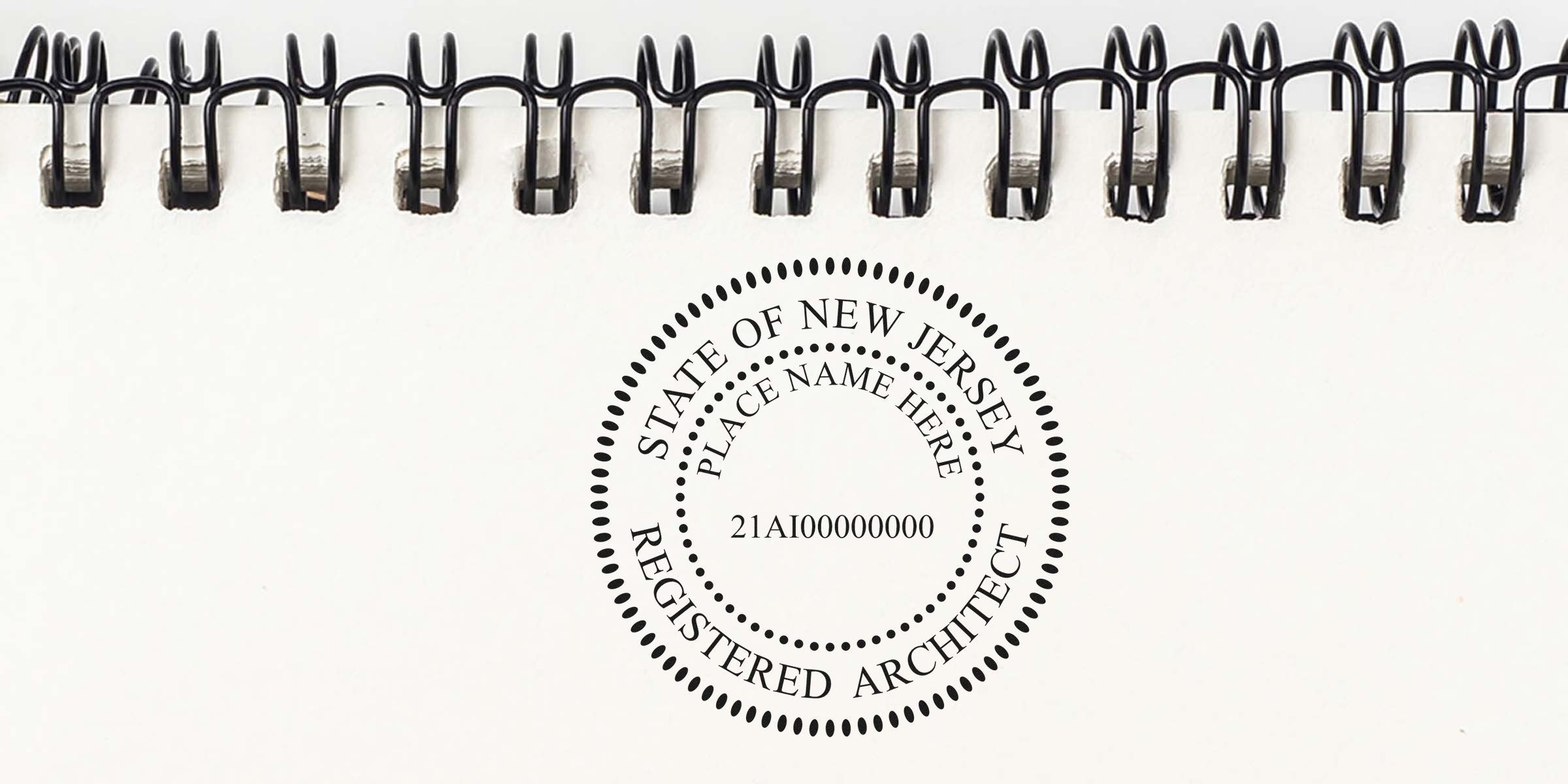
| Required elements | A beaded outer border of elongated ovals; The words “STATE OF NEW JERSEY” around the upper arc; Your place name on a second line beneath it; The words “REGISTERED ARCHITECT” around the lower arc; Your license number in the center, in New Jersey’s long form beginning 21AI; A dotted inner ring enclosing the center block | Acorn Sales production artwork, New Jersey architect seal |
| Size and shape | This is what Acorn actually makes for New Jersey, taken from our own production artwork rather than from a published rule. | Acorn Sales production artwork, New Jersey architect seal |
| Device allowed | A seal press, obtained through the Board. | New Jersey State Board of Architects, Frequently Asked Questions (fee schedule) |
| Signature and date | Not addressed from a primary source. | N.J.A.C. 13:27, codified text not retrieved |
| What must be sealed | Not addressed from a primary source. | N.J.A.C. 13:27, codified text not retrieved |
| Electronic seal | Not addressed from a primary source. | N.J.A.C. 13:40-8.1A (engineers and land surveyors only) |
| Renewal and lapse | Biennial renewal. | New Jersey State Board of Architects, Frequently Asked Questions (renewal, inactive status, reinstatement and fee schedule) |
| Firm requirements | Yes, and separately for each discipline. | New Jersey State Board of Architects, Frequently Asked Questions (Certificate of Authorization) |
| Regulator | The New Jersey State Board of Architects | N.J.S.A. 45:3-1 et seq., Architects statutes, and N.J.S.A. 45:4B-1 et seq., Building Design Services Act, as identified on the Board’s Laws and Regulations page |
Is a seal required in New Jersey?
New Jersey architects are licensed by their own board, the New Jersey State Board of Architects, and their rules sit in N.J.A.C. 13:27, a different chapter from the engineers and land surveyors. The Board’s own published fee schedule confirms that a physical sealing device passes through the Board: it lists a “Replacement or Duplicate Seal Press Fee” of forty dollars among the fees for an active licensee. A seal press is an impression device, and the fee tells you the Board is the source of the licensee’s device rather than a supplier. The codified sealing paragraphs of N.J.A.C. 13:27 is not published in readable form and are identified below as a named gap.
What must appear on the seal
- A beaded outer border of elongated ovals
- The words “STATE OF NEW JERSEY” around the upper arc
- Your place name on a second line beneath it
- The words “REGISTERED ARCHITECT” around the lower arc
- Your license number in the center, in New Jersey’s long form beginning 21AI
- A dotted inner ring enclosing the center block
The list above is Acorn’s own production artwork, not a published specification. It is what we cut and ship for this credential, and it is offered as a starting point rather than as the rule. As for what the state itself publishes: Not addressed from a primary source. The Board publishes its Laws and Regulations page pointing to N.J.A.C. 13:27 through the New Jersey Office of Administrative Law text hosted on LexisNexis, whose landing page requires a user to accept terms and conditions before the text opens, and offers as the only alternative the Justia unofficial code, which the Board itself flags as possibly not current. We did not accept the terms gate and we do not treat an unofficial republication as primary. What can be stated from the Board’s own publication is that the device is a seal press obtained through the Board, at a forty dollar fee for a replacement or duplicate.
Size and shape
This is what Acorn actually makes for New Jersey, taken from our own production artwork rather than from a published rule. No diameter, height or proportion appears in N.J.A.C. 13:40-8.1 or 13:40-8.1A, and the board publishes none. What follows is the die we cut. The printed die measures about 1-9/16 inches across, drawn inside a 1-5/8 inch guide. The word on the face is REGISTERED, not licensed, which is the New Jersey detail an out-of-state template most often gets wrong.
Embosser, rubber stamp or digital
A seal press, obtained through the Board. The Board’s fee schedule lists a Replacement or Duplicate Seal Press Fee of forty dollars, which establishes two things from a primary source: the device is a press, meaning an impression seal rather than an inked stamp, and the Board issues it. A New Jersey architect does not order the seal press itself from a stamp supplier the way an architect in most states does; it comes from the Board.
Supplemental, and worth knowing: the rule governs what seals the document, not what else may sit on the sheet. An inked stamp used alongside a compliant device is a different product doing a different job, and licensees order one for a practical reason: a raised or dry impression photographs and photocopies poorly, so an accompanying inked impression is what keeps the mark legible on the copy that reaches the file. Order the compliant device as your seal, and treat the stamp as the companion it is. Whether N.J.A.C. 13:27 also permits an electronic or digital architect seal could not be verified.
Signing and dating
Not addressed from a primary source. Whether the New Jersey architect must sign across the seal, sign adjacent to it, or date beside it sits in N.J.A.C. 13:27, which we could not read. Do not assume the engineers and land surveyors treatment: the draft signing rule at N.J.A.C. 13:40-8.1(f) and the title block rule at 13:40-8.3 are rules of a different board in a different chapter and do not bind architects.
The engineers’ rubber stamp ban is not your rule, and your device comes from the Board
New Jersey is widely described as a state that prohibits rubber stamp seals for the design professions. That is an overstatement. The prohibition is in N.J.A.C. 13:40-8.1(a), which is a rule of the State Board of Professional Engineers and Land Surveyors and reads that a document shall be sealed with a digital or impression type seal and that “Alternatives, such as rubber stamp facsimiles of the seal shall not be permitted.” Architects are licensed by a different board and their rules are in a different chapter, N.J.A.C. 13:27. The engineers’ chapter does not reach them.
Which documents must be sealed
Not addressed from a primary source. The list of architectural instruments that must be sealed in New Jersey, and whether every sheet or only the cover carries the seal, sits in N.J.A.C. 13:27. Two related statutes the Board does publish are the Architects statutes at N.J.S.A. 45:3-1 and the Building Design Services Act at N.J.S.A. 45:4B-1, which governs who may prepare building design documents in New Jersey and is the statute that allocates work between architects and engineers.
Electronic and digital seals
Not addressed from a primary source. The FIPS PUB 186-4 digital signature standard that New Jersey imposes at N.J.A.C. 13:40-8.1A is a rule of the State Board of Professional Engineers and Land Surveyors and applies to that board’s licensees. Whether the State Board of Architects has adopted an equivalent digital seal standard in N.J.A.C. 13:27 could not be verified. Note that the Division of Consumer Affairs adopted separate Digital Signature and Seals rules for the Board of Examiners of Master Plumbers and the Board of Examiners of Heating, Ventilating, Air Conditioning, and Refrigeration Contractors effective May 18, 2026, which shows the Division adopting these rules board by board rather than division wide.
Renewal, lapse and retirement
Biennial renewal. The Board’s fee schedule lists a biennial renewal fee, a fifty dollar late fee, a one hundred dollar reinstatement application fee and a twenty five dollar replacement certificate fee. The Board states that a licensee who lets a license lapse must complete the reinstatement application, pay the reinstatement fee and all delinquent biennial renewal fees, and document the continuing education hours required for each inactive biennial period. A licensee may elect inactive status, in which case the licensee may not hold out as an architect or practice architecture in New Jersey. Because the device is a Board issued seal press keyed to the licensee, a replacement or duplicate costs forty dollars through the Board.
Firm requirements
Yes, and separately for each discipline. The Board states that a limited liability company or corporation other than a professional service corporation established under N.J.S.A. 14A:17 must obtain a Certificate of Authorization, issued where at least two thirds of directors are licensed architects and at least two thirds of the ownership interest is owned by licensed architects, or on the alternative closely allied professional test with at least one licensed architect director and a minimum of twenty percent of shares owned by licensed architects. The Board is explicit that a firm offering architecture, landscape architecture and engineering needs three certificates: one from the State Board of Architects for architecture, a second from the State Board of Architects for landscape architecture, and a third from the State Board of Professional Engineers and Land Surveyors for engineering.
What to check before you order
Do not start with a stamp supplier. The New Jersey State Board of Architects charges a Replacement or Duplicate Seal Press Fee of forty dollars, which tells you the sealing device is an embossing press that comes through the Board, so ask the Board how to obtain or replace yours. Do not assume the engineers and land surveyors rule applies to you: N.J.A.C. 13:40-8.1, with its ban on rubber stamp facsimiles and its FIPS PUB 186-4 digital seal standard, belongs to a different board. Before ordering anything, get the current codified text of N.J.A.C. 13:27 from the Board, because the chapter is no longer published as a board PDF and the free online versions are either behind a terms of use gate or flagged by the Board itself as possibly not current.
Browse architect stamps and seals.
- The Friendly Guide to New Jersey Architect Stamp Guidelines
- New Jersey Architect Stamp Cost: What You Should Expect
Frequently asked questions
Is an architect seal required in New Jersey?
Yes, and the device passes through the Board. The Board’s published fee schedule lists a Replacement or Duplicate Seal Press Fee of forty dollars among the fees for an active licensee, which establishes that a physical sealing device is part of licensure here and that the Board is its source. The codified sealing paragraphs sit in N.J.A.C. 13:27, adopted under N.J.S.A. 45:3-1 et seq.
Can a New Jersey architect use a rubber stamp?
The prohibition commonly quoted is not an architects’ rule. N.J.A.C. 13:40-8.1(a) bans rubber stamp facsimiles for licensees of the State Board of Professional Engineers and Land Surveyors. Architects fall under N.J.A.C. 13:27 and a different board. What the architects’ board does publish is a Seal Press fee, which points to an impression device rather than an inked stamp. For anything beyond that, get the current codified text of 13:27 from the Board.
Where do I get a New Jersey architect seal?
From the Board, not from a stamp supplier. The Replacement or Duplicate Seal Press Fee of forty dollars tells you both that the device is a press and that the Board issues it. That puts New Jersey architects in the small group of credentials where the seal is not a shop purchase.
What size is a New Jersey architect seal?
No diameter could be verified. The Board’s home page, its Laws and Regulations page and its Frequently Asked Questions including the full fee schedule state none, and the codified N.J.A.C. 13:27 text was unreachable. Do not assume the engineers and land surveyors rule, N.J.A.C. 13:40-8.1, which is silent on size and belongs to a different board anyway. Acorn’s own production artwork for this seal prints at about 1-9/16 inches inside a 1-5/8 inch guide. That is our production record rather than a published rule, so the board remains the authority if it later publishes a figure.
What has to appear on a New Jersey architect seal?
That belongs to the current codified text of N.J.A.C. 13:27, which is not published in readable form. What can be stated from the Board’s own publication is that the device is a seal press obtained through the Board, at a forty dollar fee for a replacement or duplicate. Ask the Board for the specification rather than working from a neighboring state’s artwork. Acorn’s own production artwork carries a beaded outer border, STATE OF NEW JERSEY on the upper arc with the place name beneath it, REGISTERED ARCHITECT on the lower arc, the license number in New Jersey’s long 21AI form in the center, and a dotted inner ring. That is what we cut, not a published specification.
Where do the signature and date go in New Jersey?
That sits in N.J.A.C. 13:27, which could not be read here. Do not assume the engineers and land surveyors treatment: the signing rule at N.J.A.C. 13:40-8.1(f) and the title block rule at 13:40-8.3 are rules of a different board in a different chapter and do not bind architects.
Can I seal electronically in New Jersey?
The FIPS PUB 186-4 digital signature standard New Jersey imposes at N.J.A.C. 13:40-8.1A is a rule of the State Board of Professional Engineers and Land Surveyors and applies to that board’s licensees. Whether the State Board of Architects has adopted an equivalent standard in N.J.A.C. 13:27 could not be verified. It is worth knowing that the Division of Consumer Affairs adopted separate Digital Signature and Seals rules for the Board of Examiners of Master Plumbers and for the Board of Examiners of Heating, Ventilating, Air Conditioning, and Refrigeration Contractors effective May 18, 2026, which shows the Division adopting these rules board by board rather than division wide.
Which documents have to be sealed in New Jersey?
The list of architectural instruments that must be sealed, and whether every sheet or only the cover carries the seal, sits in N.J.A.C. 13:27. Two related statutes the Board does publish are the Architects statutes at N.J.S.A. 45:3-1 and the Building Design Services Act at N.J.S.A. 45:4B-1, which governs who may prepare building design documents in New Jersey and allocates work between architects and engineers.
What happens if my New Jersey license lapses?
Renewal is biennial. The Board’s fee schedule lists a biennial renewal fee, a fifty dollar late fee, a one hundred dollar reinstatement application fee and a twenty five dollar replacement certificate fee. A licensee who lets a license lapse completes the reinstatement application, pays the reinstatement fee and all delinquent biennial renewal fees, and documents the continuing education hours required for each inactive biennial period. A licensee may elect inactive status, in which case the licensee may not hold out as an architect or practice architecture in New Jersey. Because the device is a Board issued seal press keyed to the licensee, a replacement or duplicate costs forty dollars through the Board.
How many certificates of authorization does a New Jersey firm need?
Possibly three. The Board states that a limited liability company or corporation other than a professional service corporation established under N.J.S.A. 14A:17 must obtain a Certificate of Authorization, issued where at least two thirds of directors are licensed architects and at least two thirds of the ownership interest is owned by licensed architects, or on the alternative closely allied professional test with at least one licensed architect director and a minimum of twenty percent of shares owned by licensed architects. The Board is explicit that a firm offering architecture, landscape architecture and engineering needs three certificates: one from the State Board of Architects for architecture, a second from the State Board of Architects for landscape architecture, and a third from the State Board of Professional Engineers and Land Surveyors for engineering. Multidiscipline offices routinely budget for one.








