

Written by Acorn Sales Company, manufacturing stamps and seals since 1964 · Reviewed by Holly R, VP of Sales and Marketing at Acorn Sales, against no Delaware board; the profession is unregulated in this state and Delaware Division of Professional Regulation, boards and commissions listing (no interior design board) on 21 September 2026 · Updated 21 September 2026
Delaware does not license, register or certify interior designers, so no seal is prescribed for the profession. The Division of Professional Regulation publishes the full list of boards and commissions it administers, and the design entries are the Board of Architects, the Board of Landscape Architecture, the Board of Geologists and the Board of Professional Land Surveyors. There is no interior design board, and Title 24 of the Delaware Administrative Code has no interior design chapter, so there is no registration number to inscribe and no legend to letter.
Delaware is worth stating precisely, though, because its architects rule claims the territory rather than leaving it empty. 24 DE Admin. Code 300, r. 2.2.2 provides that services offered in connection with the utilization of space within structures “include space planning and programming, and interior design,” and treats those as part of the practice of architecture, while preserving the practice of landscape architecture and engineering. So the work is not outside every chapter; it sits inside the architects chapter.
For your own stamp, none of that prescribes anything, which means nothing about it is restricted either. Acorn will make it to whatever you want on it: your own name, your firm name, a monogram, your logo, or a credential you actually hold such as NCIDQ. Put your own name, your firm name, and any credential you actually hold. Leave off “Licensed” and “Registered” and any state-issued title unless the state issued you one, because that is the part some states do restrict, and keep anything resembling the REGISTERED ARCHITECT and STATE OF DELAWARE phrase off it.
Delaware interior designer seal requirements at a glance
| Requirement | Delaware rule | Source |
|---|---|---|
| Seal required | Not licensed here | Delaware Division of Professional Regulation, boards and commissions listing (no interior design board) |
| Required elements | Delaware licenses no interior designers and issues no interior designer seal | Delaware Division of Professional Regulation, boards and commissions listing |
| Size and shape | No dimension exists. | Delaware Division of Professional Regulation, boards and commissions listing (no interior design board) |
| Device allowed | Not a regulated purchase. | 24 DE Admin. Code 300, r. 7.6.2 |
| Signature and date | Not addressed, because Delaware has no interior design credential to attach a signature duty to. | 24 DE Admin. Code 300, r. 7.6.2 |
| What must be sealed | No Delaware document requires an interior designer seal. | 24 DE Admin. Code 300, r. 2.2.3, 7.6.2 |
| Electronic seal | Not applicable. | 24 DE Admin. Code 300, r. 7.6.1.1 |
| Renewal and lapse | Not applicable. | Delaware Division of Professional Regulation, boards and commissions listing (no interior design board) |
| Firm requirements | Not applicable. | 24 DE Admin. Code 300, r. 7.5.1 |
| Regulator | No Delaware board; the profession is unregulated in this state | Delaware Division of Professional Regulation boards and commissions listing, which names the Board of Architects, the Board of Landscape Architecture, the Board of Geologists and the Board of Professional Land Surveyors and contains no interior design board |



Is a seal required in Delaware?
Delaware does not license, register or certify interior designers, and therefore issues no interior designer seal. The Division of Professional Regulation publishes the full list of the professional boards and commissions it administers, and interior design is not among them; the design professions on that list are the Board of Architects, the Board of Landscape Architecture, the Board of Geologists and the Board of Professional Land Surveyors. Title 24 of the Delaware Administrative Code has no interior design chapter. There is no board, no registration number to inscribe and no legend to letter.
What must appear on the seal
- Delaware licenses no interior designers and issues no interior designer seal
There is nothing to specify. Because Delaware grants no interior design credential, no wording is authorized and no wording is prohibited by a licensing board. The line that does exist is the architectural one: 24 DE Admin. Code 300, r. 2.2.2 states that services offered in connection with the utilization of space within structures “include space planning and programming, and interior design,” and are part of the practice of architecture, while preserving the practice of landscape architecture and engineering. A Delaware interior design device must not imply architectural registration.
Size and shape
No dimension exists. Delaware prescribes no interior designer seal, so there is no diameter to state. The sources here are the Division of Professional Regulation boards and commissions listing and the Title 24 administrative code chapters for the four Delaware design boards: 300 (Architects), 200 (Landscape Architecture), 2700 (Professional Land Surveyors) and 3600 (Geologists).


Embosser, rubber stamp or digital
Not a regulated purchase. Any device a Delaware interior designer uses is a business or identification stamp, not a professional seal, and it carries no statutory effect. A Delaware building official cannot accept an interior designer stamp in place of an architect seal, because 24 DE Admin. Code 300, r. 7.6.2 requires technical submissions submitted to public authorities for building permits or regulatory approvals to be sealed by the architect.
Signing and dating
Not addressed, because Delaware has no interior design credential to attach a signature duty to. Where a Delaware project requires sealed documents for a permit, the signature, the date of signature and the date of registration expiration beside the seal are the architect’s obligations under 24 DE Admin. Code 300, r. 7.6.2.
There is no Delaware interior designer stamp to buy, and that is the answer
The Division of Professional Regulation administers dozens of Delaware boards. The four that matter to the design professions are Architects, Landscape Architecture, Geologists and Professional Land Surveyors. Interior design is not on the list, there is no Title 24 administrative code chapter for it, and no Delaware agency issues a number that could go on a seal.
Which documents must be sealed
No Delaware document requires an interior designer seal. The sealing duty attaches to the technical submissions listed at 24 DE Admin. Code 300, r. 7.6.2, which are each design, each drawing, each set of specifications, all addenda and the cover of all other technical submissions published or submitted to public authorities, and it is discharged by the registered architect. Rule 2.2.3 exempts detached one and two family dwellings and their accessory buildings, certain farm buildings and non-structural alterations that require no permit.



Electronic and digital seals
Not applicable. The electronic seal criteria at 24 DE Admin. Code 300, r. 7.6.1.1 attach to registered architects, and the electronic seal provision at 24 DE Admin. Code 3600, s. 3.2 attaches to licensed geologists. Delaware has no interior design credential and therefore no electronic interior designer seal standard.
Renewal, lapse and retirement
Not applicable. With no credential there is no renewal cycle, no lapse, no number to change and no device to surrender. Contrast the Delaware architect rule 6.7, which requires the certificate, the seal and the license to be returned to the Board on revocation, cancellation, suspension or nonrenewal.
Firm requirements
Not applicable. Delaware registers no interior design firm and issues no certificate of authorization for interior design. Delaware architecture itself has no firm certificate; what 24 DE Admin. Code 300, r. 7.5.1 requires is an architect resident and regularly employed in each Delaware office offering architectural services.
What to check before you order
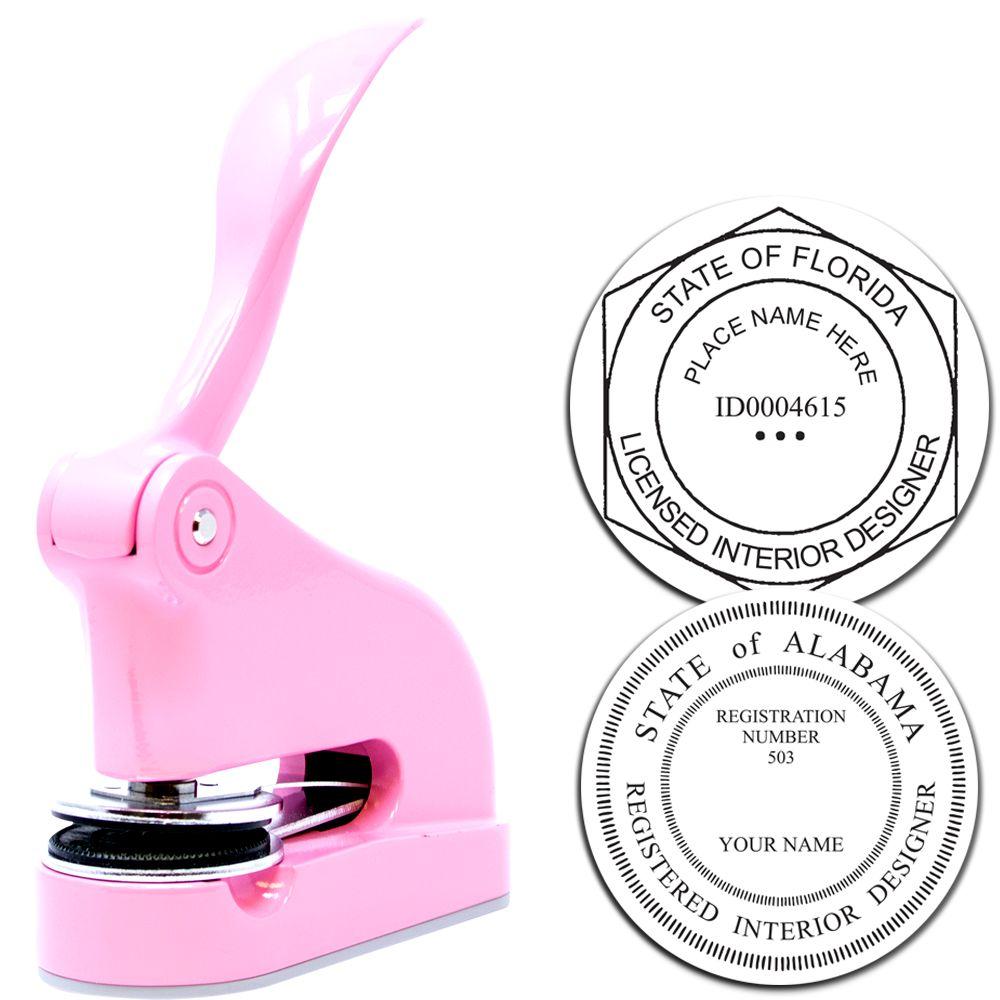
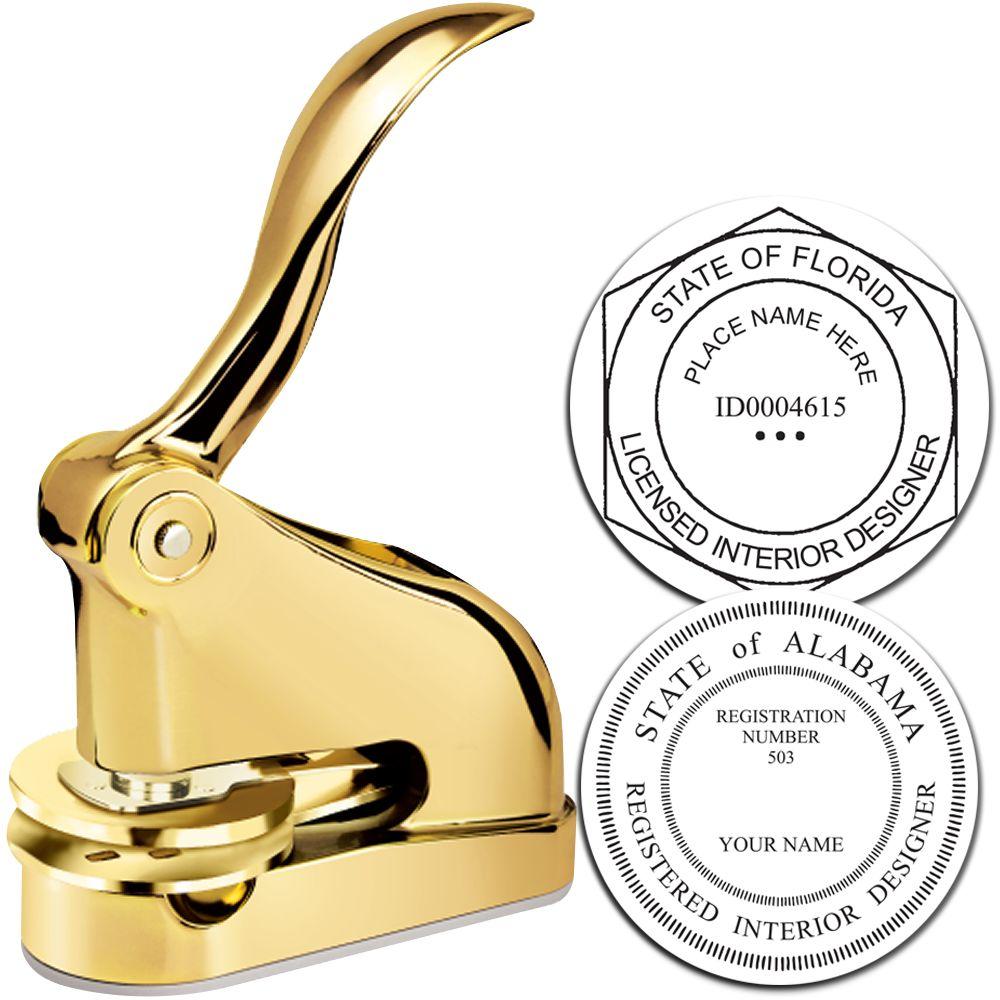
You do not need, and cannot lawfully obtain, a Delaware interior designer seal, because Delaware does not license or register the profession. If you want a device for your own drawings, order a plain identification stamp with your name and firm, and state any out-of-state credential as that state’s credential. Keep the word architect and anything resembling the REGISTERED ARCHITECT and STATE OF DELAWARE phrase off it. If your work is going to a Delaware building official for a permit or regulatory approval, the sealed document has to carry the registered architect’s seal, signature, date of signature and Delaware registration expiry date under 24 DE Admin. Code 300, r. 7.6.2.
Browse interior designer stamps and seals.
Frequently asked questions
Does Delaware license interior designers?
No. The Division of Professional Regulation boards and commissions listing contains no interior design board, and neither Title 24 of the Delaware Code nor the Title 24 administrative code has an interior design chapter. There is no board, no registration number and no legend fixed by anyone.
Is an interior designer seal required in Delaware?
No rule requires one and none is prescribed. The seal provisions in Delaware belong to the four design boards it does run, at 24 DE Admin. Code 300 for architects, 200 for landscape architecture, 2700 for professional land surveyors and 3600 for geologists.
Does Delaware treat interior design as architecture?
Its architects rule does, in part. 24 DE Admin. Code 300, r. 2.2.2 states that services offered in connection with the utilization of space within structures include space planning and programming and interior design, and treats them as part of the practice of architecture, while preserving the practice of landscape architecture and engineering. That makes the scope question more live in Delaware than in a state that simply says nothing.
What can go on a Delaware interior designer stamp?
Your name, your firm name, a monogram, your logo, contact details, or the exact name of a private certification such as the NCIDQ certificate from the Council for Interior Design Qualification. Since nothing prescribes a layout, size and shape are yours. State any out-of-state credential as that state’s credential rather than leaving the state off.
What should I keep off a Delaware interior designer stamp?
The word architect, and anything resembling the REGISTERED ARCHITECT and STATE OF DELAWARE phrase arranged as a seal. Given that r. 2.2.2 places space planning and interior design inside the practice of architecture, a device that edges toward the architect legend is a worse idea here than in most states.
What size should a Delaware interior designer stamp be?
Any size. Delaware prescribes no interior designer seal and therefore no diameter. The Division of Professional Regulation boards listing and the Title 24 administrative code chapters for the four Delaware design boards leave the profession untouched.
Who seals a Delaware permit submission?
The registered architect. 24 DE Admin. Code 300, r. 7.6.2 requires technical submissions submitted to public authorities for building permits or regulatory approvals to be sealed by the architect, and lists them as each design, each drawing, each set of specifications, all addenda and the cover of all other technical submissions. Rule 2.2.3 exempts detached one and two family dwellings and their accessory buildings, certain farm buildings and non-structural alterations that require no permit.
What goes beside the architect seal on a Delaware submission?
Three marks under r. 7.6.2: the signature, the date of signature and the date of registration expiration. That is a fuller block than most states ask for, and it is the architect’s obligation rather than yours.
Can I sign Delaware interior design documents electronically?
Nothing restricts you. The electronic seal criteria at 24 DE Admin. Code 300, r. 7.6.1.1 attach to registered architects, and the electronic seal provision at 24 DE Admin. Code 3600, s. 3.2 attaches to licensed geologists. Delaware has no interior design credential and therefore no electronic interior designer seal standard.
Does my out-of-state interior design seal work in Delaware?
It describes a credential another state issues. A Registered Interior Designer stamp from Alabama or Arkansas, a Certified Interior Designer certificate from Maine and a Registered Interior Designer seal from Louisiana all describe real credentials in their own states and none of them in Delaware. Name the issuing state expressly if you want the registration visible.
Does a Delaware interior design firm register?
No. Delaware registers no interior design firm and issues no certificate of authorization for interior design. Delaware architecture itself has no firm certificate either: what 24 DE Admin. Code 300, r. 7.5.1 requires is an architect resident and regularly employed in each Delaware office offering architectural services.








