

Written by Acorn Sales Company, manufacturing stamps and seals since 1964 · Reviewed by Holly R, VP of Sales and Marketing at Acorn Sales, against the Texas Board of Architectural Examiners and Tex. Occ. Code §§ 1051.654, 1051.702 on 21 September 2026 · Updated 21 September 2026
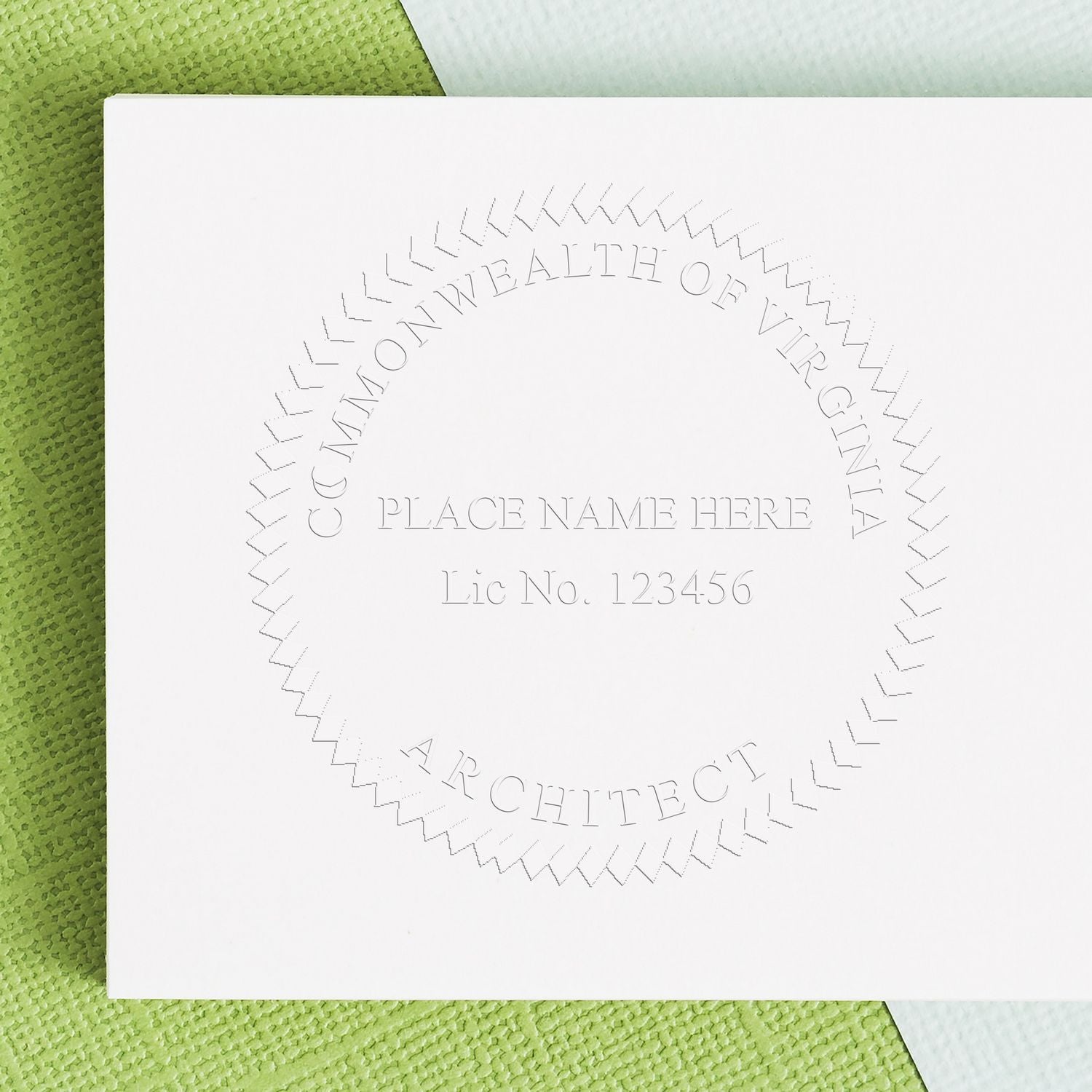
The Texas star is prescribed artwork, not decoration a buyer may drop. Section 1.102(b) does not describe the seal in words. It attaches a picture and says the design “shall be the same as the design of the sample seal shown in this Subsection except that the name of the Architect and the Architect’s registration number shall be substituted for the name and registration number shown on the sample seal.” The figure is a rope edged double border with REGISTERED ARCHITECT arched over the top, STATE OF TEXAS across the bottom, a small star at each side, your name in an inner ring and a large Texas star at the center with the registration number beneath it. A clean modern ring with a number in the middle is not the Texas design.
Texas then does something most states refuse. Section 1.103(a)(1)(B) lets the signature go “across the face of the seal’s image or directly under or adjacent to the seal’s image.” The single limit is in 1.103(a)(2): the signature and date may not conceal or obscure the name or the registration number.
And Texas does not let you simply leave a drawing unsealed. Section 1.101 gives two lawful states and no third: either sealed, signed and dated under 1.103(a), or labeled with your name and the date and clearly marked not for regulatory approval, permitting or construction under 1.103(b). An unmarked, unsealed sheet issued from the office is itself the violation.
Texas architect seal requirements at a glance
| Requirement | Texas rule | Source |
|---|---|---|
| Seal required | Yes | Tex. Occ. Code §§ 1051.654, 1051.702 |
| Required elements | Registered Architect around the top of the outer band; State of Texas around the bottom of the outer band; Your name as registered, in the inner ring; Your registration number, below the star; The Texas star at the center of the seal | Tex. Occ. Code § 1051.654 |
| Size and shape | No smaller than one and one half inches in diameter. | 22 Tex. Admin. Code § 1.102(b) |
| Device allowed | Rubber stamp, impression seal or electronic image, with one condition attached to all three. | 22 Tex. Admin. Code § 1.102(a), (c) |
| Signature and date | Seal, signature and date, in a fixed relationship. | 22 Tex. Admin. Code § 1.103(a) |
| What must be sealed | Construction Documents, sheet by sheet. | 22 Tex. Admin. Code §§ 1.101, 1.103(a), (b) |
| Electronic seal | The rules permit electronic issuance without naming a technology. | 22 Tex. Admin. Code § 1.102(c) |
| Renewal and lapse | Registration is annual in Texas, and the seal carries no date, so the device itself never goes stale. | 22 Tex. Admin. Code §§ 1.103(c), 1.104 |
| Firm requirements | Discretionary, and not currently exercised as a seal requirement. | Tex. Occ. Code § 1051.306 |
| Regulator | The Texas Board of Architectural Examiners | Tex. Occ. Code ch. 1051, principally §§ 1051.306, 1051.654 and 1051.702 |






Is a seal required in Texas?
Texas fixes the design in the statute and the mechanics in the rules. Occupations Code section 1051.702 requires that an architect “shall maintain a seal as approved by the board and shall stamp or impress the seal on each drawing or specification issued from the architect’s office for use in this state.” Section 1051.654 tells the Board what that seal looks like: “The design of the seal must be the same as the design used by the board, except that the words ‘Registered Architect, State of Texas’ must be used instead of ‘Texas Board of Architectural Examiners.’” The Board rules then build the working rule: 22 Texas Administrative Code section 1.101 bars an architect from issuing a regulated document unless it is either sealed, signed and dated under section 1.103(a), or labeled with the architect’s name and date and clearly marked as not usable for regulatory approval, permitting or construction under section 1.103(b).
What must appear on the seal
- Registered Architect around the top of the outer band
- State of Texas around the bottom of the outer band
- Your name as registered, in the inner ring
- Your registration number, below the star
- The Texas star at the center of the seal
Almost nothing. Section 1.102(b) provides that “The design of an Architect’s seal shall be the same as the design of the sample seal shown in this Subsection except that the name of the Architect and the Architect’s registration number shall be substituted for the name and registration number shown on the sample seal.” The figure attached to the rule is a rope edged double border carrying REGISTERED ARCHITECT across the top and STATE OF TEXAS across the bottom, with a small star on each side, the registrant name in an inner ring, a large Texas star at the center and the registration number beneath it. Two things follow. The star is part of the design, not decoration a buyer may drop. And nothing else may be added, so no firm name, no discipline, no expiration date and no AIA lettering.
Size and shape
No smaller than one and one half inches in diameter. Section 1.102(b) gives the floor and no ceiling, and the Board repeats the figure in its published seal guidance. The governing test in section 1.102(a) is legibility on a copy, so an oversized device that still reproduces cleanly is not a violation while an undersized one that blurs is.






Embosser, rubber stamp or digital
Rubber stamp, impression seal or electronic image, with one condition attached to all three. Section 1.102(a) requires the architect to affix “a seal that will produce a clearly visible and legible image of the seal when the document is copied or reproduced,” and then adds that an architect “may not affix or authorize the affixation of an impression or embossing seal on a document requiring a seal unless the impression or embossing seal will produce a clearly visible and legible image of the seal when the document is copied or reproduced.” A bare embossed impression fails that test, so the safe buy is an inked rubber or self inking stamp. Section 1.102(c) confirms that a regulated document “may be issued electronically or in any other format selected by the Architect whose seal and signature are affixed to the document.” The Board also lets registrants download an electronic seal from their online account.
Signing and dating
Seal, signature and date, in a fixed relationship. Section 1.103(a)(1) requires the architect to affix the seal, the signature “(across the face of the seal’s image or directly under or adjacent to the seal’s image)”, and “the date of signing (including the month, day, and year) before the Construction Document is issued by or under the authority of the Architect.” Section 1.103(a)(2) then protects the seal from its own signature: the three marks must be clearly visible and legible on each copy, and “The Architect’s signature and the date may not conceal or obscure the name or registration number on the seal.” Signing across the face is expressly allowed, which is not true everywhere, but obliterating the number is not.
The star is part of the seal, and the signature may cross it
Section 1.102(b) does not describe a Texas architect seal in words. It attaches a picture and says the architect’s design “shall be the same as the design of the sample seal shown in this Subsection” with only the name and registration number swapped. The figure shows a rope edged double border, REGISTERED ARCHITECT arched over the top, STATE OF TEXAS across the bottom, a star at each side, the registrant name in an inner ring and a large Texas star at the center with the registration number beneath it. The star is prescribed artwork. A clean modern ring with a number in the middle is not the Texas design.
Which documents must be sealed
Construction Documents, sheet by sheet. Section 1.103(a)(3) lists them: each sheet of drawings or electronic equivalent; each specification, with the qualification that where a specification sits inside a bound grouping with a table of contents or index listing each individual specification the seal goes in at least one conspicuous location on the bound document, while any individual specification sheet issued separately must be sealed individually; each sheet or electronic equivalent identifying the project and listing the sealed Construction Documents, such as a title sheet, table of contents or index; and each architectural drawing and specification forming part of an addenda, change order, construction change directive or other Supplemental Document. Documents issued for other purposes take the alternative route in section 1.103(b): the architect’s name, the date of issue and the statement “Not for regulatory approval, permitting, or construction” in a conspicuous location. A drawing or specification in a Feasibility Study must go one way or the other under section 1.103(b)(2).







Electronic and digital seals
The rules permit electronic issuance without naming a technology. Section 1.102(c) allows a regulated document to be issued electronically or in any other format the architect selects, provided the seal and signature are affixed. There is no Texas architect rule adopting a hash standard, a certificate authority or a named product, which is a real divergence from the Texas engineering side. The Board’s practical answer is its own: registrants can log into their account and download an editable electronic seal.
Renewal, lapse and retirement
Registration is annual in Texas, and the seal carries no date, so the device itself never goes stale. What ends is the authority to use it. Section 1.104(a) allows an architect to affix the seal only to documents prepared by the architect or under the architect’s Supervision and Control, except as provided in section 1.105 for Prototypical Design. Section 1.104(c) limits use of an architect’s seal, a copy of it or a replica of it to the architect and persons with the architect’s consent. Section 1.104(e) adds a rule most states omit: “Once a Construction Document bearing an Architect’s seal is issued, the seal may not be removed.” Nothing in subchapter F requires surrender or destruction of the device, and the registration number does not change. Separately, section 1.103(c) makes the sealing architect responsible for keeping the sealed original or a legible copy for at least ten years from the date of signature.
Firm requirements
Discretionary, and not currently exercised as a seal requirement. Occupations Code section 1051.306 says the Board “by rule may require a firm, partnership, corporation, or association that engages in the practice of architecture, landscape architecture, or interior design to register with the board,” which is permissive. Subchapter F carries no firm element and no firm registration number belongs on the seal; the seal design in section 1.102(b) is limited to the individual’s name and registration number. Firm identity belongs in the title block. This is the opposite of the Texas engineering side, where a firm registration number is a live obligation.
What to check before you order
Order a circular seal at least one and one half inches across, cut to the sample figure attached to 22 Texas Administrative Code section 1.102(b): rope style double border, REGISTERED ARCHITECT arched across the top, STATE OF TEXAS across the bottom, a star at each side, your name as registered in the inner ring, the Texas star at the center and your registration number below it. Choose ink over an embosser, because section 1.102(a) requires an image that stays clearly visible and legible when the document is copied. Add nothing else: no firm name, no expiration date, no discipline line. The Board also lets you download an electronic version of your seal from your online account for electronic issuance.
Browse architect stamps and seals.
- The Basics of Using Texas Architecture Seals and Embossers
- Avoid Mistakes When You Place Your Texas Architect Stamp Order
Frequently asked questions
Is an architect seal required in Texas?
Yes. Occupations Code section 1051.702 requires that an architect “shall maintain a seal as approved by the board and shall stamp or impress the seal on each drawing or specification issued from the architect’s office for use in this state.” Section 1051.654 tells the Board what that seal looks like: “The design of the seal must be the same as the design used by the board, except that the words ‘Registered Architect, State of Texas’ must be used instead of ‘Texas Board of Architectural Examiners.’”
What has to appear on a Texas architect seal?
Five elements from the sample figure attached to section 1.102(b): REGISTERED ARCHITECT around the top of the outer band, STATE OF TEXAS around the bottom, your name as registered in the inner ring, your registration number below the star, and the Texas star at the center. Nothing else may be added, so no firm name, no discipline, no expiration date and no AIA lettering.
What size is a Texas architect seal?
No smaller than one and one half inches in diameter. Section 1.102(b) gives the floor and no ceiling, and the Board repeats the figure in its published seal guidance. The governing test in section 1.102(a) is legibility on a copy, so an oversized device that still reproduces cleanly is not a violation while an undersized one that blurs is.
Can I use an embosser in Texas?
Only if it reproduces, which in practice rules the dry embosser out. Section 1.102(a) requires the architect to affix “a seal that will produce a clearly visible and legible image of the seal when the document is copied or reproduced,” and adds that an architect “may not affix or authorize the affixation of an impression or embossing seal on a document requiring a seal unless the impression or embossing seal will produce a clearly visible and legible image of the seal when the document is copied or reproduced.” An inked rubber or self inking stamp is the safe buy.
Where do the signature and date go on a Texas seal?
Section 1.103(a)(1) requires the architect to affix the seal, the signature “(across the face of the seal’s image or directly under or adjacent to the seal’s image),” and “the date of signing (including the month, day, and year) before the Construction Document is issued by or under the authority of the Architect.” Section 1.103(a)(2) requires the three marks to be clearly visible and legible on each copy, and provides that “The Architect’s signature and the date may not conceal or obscure the name or registration number on the seal.”
Which documents have to be sealed in Texas?
Construction Documents, sheet by sheet. Section 1.103(a)(3) lists each sheet of drawings or electronic equivalent; each specification, with the qualification that where a specification sits inside a bound grouping with a table of contents or index listing each individual specification the seal goes in at least one conspicuous location on the bound document, while any individual specification sheet issued separately must be sealed individually; each sheet or electronic equivalent identifying the project and listing the sealed Construction Documents, such as a title sheet, table of contents or index; and each architectural drawing and specification forming part of an addenda, change order, construction change directive or other Supplemental Document.
How do I issue an unsealed drawing in Texas?
By labeling it. Section 1.103(b) requires the architect’s name, the date of issue and the statement “Not for regulatory approval, permitting, or construction” in a conspicuous location. A drawing or specification in a Feasibility Study must go one way or the other under section 1.103(b)(2).
Can I issue Texas documents electronically?
Yes. Section 1.102(c) confirms that a regulated document “may be issued electronically or in any other format selected by the Architect whose seal and signature are affixed to the document.” There is no Texas architect rule adopting a hash standard, a certificate authority or a named product, which is a real divergence from the Texas engineering side. The Board’s practical answer is its own: registrants can log into their account and download an editable electronic seal.
Can a sealed Texas document be unsealed later?
No. Section 1.104(e) adds a rule most states omit: “Once a Construction Document bearing an Architect’s seal is issued, the seal may not be removed.” Section 1.104(a) allows an architect to affix the seal only to documents prepared by the architect or under the architect’s Supervision and Control, except as provided in section 1.105 for Prototypical Design, and 1.104(c) limits use of the seal, a copy of it or a replica of it to the architect and persons with the architect’s consent.
How long do I keep sealed documents in Texas?
At least ten years. Section 1.103(c) makes the sealing architect responsible for keeping the sealed original or a legible copy for at least ten years from the date of signature.
Does my Texas seal go stale at renewal?
No. Registration is annual in Texas and the seal carries no date, so the device itself never goes stale and the registration number does not change. What ends is the authority to use it. Nothing in subchapter F requires surrender or destruction of the device.
Does a Texas architecture firm register?
Only if the Board requires it, and the seal never carries the firm. Occupations Code section 1051.306 says the Board “by rule may require a firm, partnership, corporation, or association that engages in the practice of architecture, landscape architecture, or interior design to register with the board,” which is permissive. Subchapter F carries no firm element and no firm registration number belongs on the seal, whose design is limited to the individual’s name and registration number. Firm identity belongs in the title block. That is the opposite of the Texas engineering side, where a firm registration number is a live obligation.








