
Written by Acorn Sales Company, manufacturing stamps and seals since 1964 · Reviewed by Holly R, VP of Sales and Marketing at Acorn Sales, against title 3 of the Virgin Islands Code, including the Revised Uniform Law on Notarial Acts added in 2022, together with the Office of the Lieutenant Governor’s notary FAQ, renewal application and bulletins. We could not confirm whether several older sections of the original notary chapter survive the 2022 act, could not locate any promulgated notary regulations, and did not review the territory’s recording statutes. Confirm anything operative with the Notary Public Division on 21 September 2026 · Updated 21 September 2026
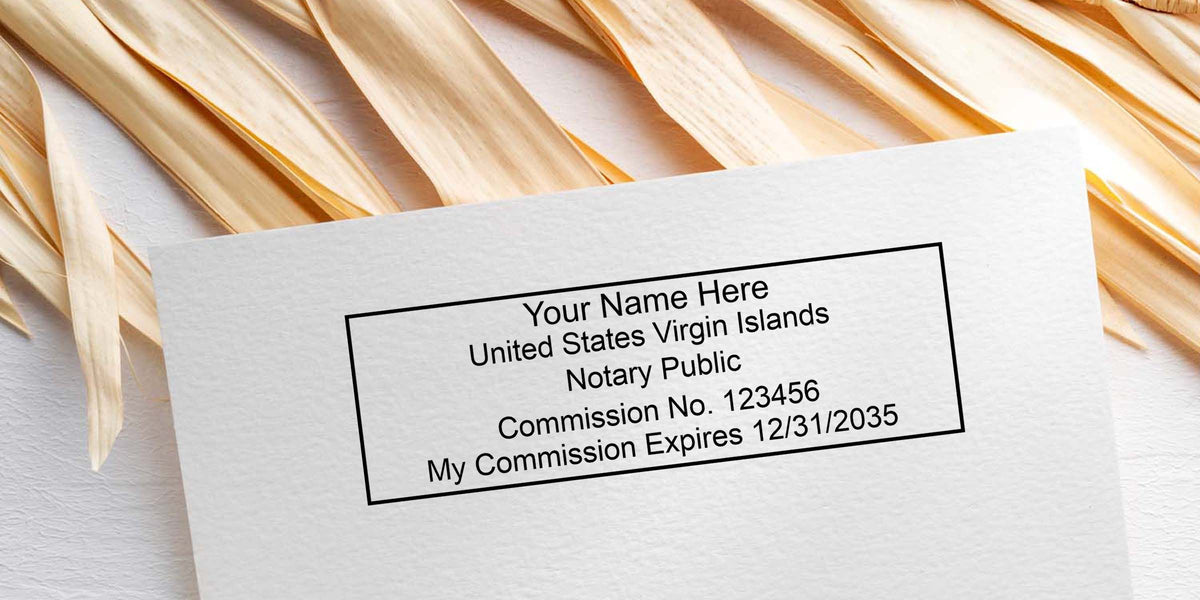
Very little from a mainland state transfers to the Virgin Islands. The Office of the Lieutenant Governor tells applicants that territory law requires both an impression seal and a blue ink stamp, so this is a two-device jurisdiction. The seal carries your name, “NOTARY PUBLIC”, your NP number, your expiration date and your judicial district. And when your commission ends you deposit the seal with the Lieutenant Governor rather than destroying it.
Virgin Islands notary stamp requirements at a glance
| Requirement | Virgin Islands rule | Source |
|---|---|---|
| Stamp required | Yes | 3 V.I.C. § 825(b) |
| Required wording | Your name as it appears on your commission documents; The words “NOTARY PUBLIC”; Your Notary Public number, in the territory’s NP format; Your commission expiration date; Your judicial district, shown as St. Thomas and St. John or St. Croix | 3 V.I.C. § 827(1) |
| Size and shape | Not addressed. | 3 V.I.C. §§ 827, 828 (silent) |
| Ink color | Blue, and we should be precise about where that comes from. | Office of the Lieutenant Governor notary FAQ and Notary Bulletin 2026-3 |
| Embosser | Required in addition to the ink stamp, which makes the Virgin Islands a two-device jurisdiction and unlike any US state. | 3 V.I.C. § 825(b) |
| Commission term | Terms run four years, with a $5,000 bond and a $75 renewal fee, and applications are filed within two months of expiry. | 3 V.I.C. §§ 771(a), 773(a), 831(e), (h), (j) |
| Name or address change | Not addressed. | 3 V.I.C. §§ 771(a), 773(a), 831(e), (h), (j) |
| Lost or stolen stamp | Notify the Office of the Lieutenant Governor promptly on discovering the device is lost or stolen. | 3 V.I.C. § 828(a), (b)(1), (b)(2), (c), (d) |
| Commissioning authority | The Lieutenant Governor of the United States Virgin Islands, through the Notary Public Division on St. Croix and St. Thomas | title 3 of the Virgin Islands Code, including the Revised Uniform Law on Notarial Acts added in 2022, together with the Office of the Lieutenant Governor’s notary FAQ, renewal application |
Rules for other states are on notary stamp requirements by state.
Is a notary stamp required in Virgin Islands?
Yes, on every notarial act on a paper record, and the duty is in the certificate section: “If a notarial act regarding a tangible record is performed by a notary public, an official stamp must be affixed to or embossed on the certificate.” Read the rest, because it is narrower than it looks: for a notarial officer other than a notary public the stamp may be affixed, and on an electronic record it is also only may, provided the certificate carries the required information.
The governing text is 3 V.I.C. § 825(b); § 827.
What must appear on a Virgin Islands notary stamp?
- Your name as it appears on your commission documents
- The words “NOTARY PUBLIC”
- Your Notary Public number, in the territory’s NP format
- Your commission expiration date
- Your judicial district, shown as St. Thomas and St. John or St. Croix
Only three of those are in the code. The statute requires your name, jurisdiction and commission expiration date, and then delegates everything else to “other information required by the Office of the Lieutenant Governor.” The NP number and the judicial district come from the Office’s own forms and FAQ under that delegation. You will also be asked to submit an imprint of your seal to the Office as part of the commissioning process, so the seal is not usable the moment it arrives.
What size and shape must a Virgin Islands notary stamp be?
Not addressed. Neither the official stamp section nor the stamping device section specifies a size, shape or dimension, and none appears in the Office’s FAQ, renewal application or bulletins. The only constraint is that the stamp be “capable of being copied together with the record.”
Notary public stamps are made to these conventions, and we check your lines against the statutory wording before we make the stamp.
What ink color is required for a Virgin Islands notary stamp?
Blue, and we should be precise about where that comes from. No ink color appears in the code. The Office of the Lieutenant Governor’s FAQ states that Virgin Islands law “requires that a Notary Public use both an impression seal and a blue ink stamp”, and its 2026 bulletin refers to the notary’s embossing seal and blue ink stamp. Treat this as a requirement of the commissioning authority riding on the statute’s delegation, not as a statutory one. We were not able to review the territory’s recording statutes, so we cannot tell you whether anything further applies there.
More on the trade-off in stamp ink color rules.
Is a notary embosser required or optional in Virgin Islands?
Required in addition to the ink stamp, which makes the Virgin Islands a two-device jurisdiction and unlike any US state. The Office’s FAQ says Virgin Islands law requires a notary to use “both an impression seal and a blue ink stamp”, and the older code section required an official impression seal. We will flag the tension honestly: § 825(b) reads “affixed to or embossed on”, which is disjunctive on its face. The defensible course is to carry both, because that is what the commissioning authority tells applicants to buy.
Notary embossing seal kits and inked stamp kits cover both formats. See also notary stamp vs. embosser.
Two devices, blue ink, and you hand the seal back at the end
Almost nothing you know from a mainland state transfers cleanly to the Virgin Islands, and three differences matter most when you order.
You need two devices. The Office of the Lieutenant Governor tells applicants that Virgin Islands law requires both an impression seal and a blue ink stamp. Most US states treat an embosser as optional decoration; here it is part of the expected kit. We will note in fairness that the statute’s own wording reads “affixed to or embossed on”, which sounds like a choice. Buy both anyway, because that is what the commissioning authority asks for.
You deposit the seal, you do not destroy it. On expiration, resignation, revocation or suspension the stamping device goes to the Office of the Lieutenant Governor, which takes an impression and keeps it with your records. A notary following the usual mainland advice to cut up an expired stamp is doing the wrong thing here.
And new commissions are currently closed. The territory caps notaries at 600 by statute, and the Notary Public Division states it is not accepting new applications. Existing notaries may renew. That can change, so confirm with the Office rather than taking our word for it.
One more worth carrying: the audio-video retention period for remote acts is five years here, not the ten that most of the mainland uses.
Do I need a new stamp when my commission is renewed or my name changes?
Terms run four years, with a $5,000 bond and a $75 renewal fee, and applications are filed within two months of expiry. The territory also charges an annual fee on top of the four-year commission, and outstanding annual fees must be cleared at renewal. A new seal is required, because the expiration date is on it and an imprint of the seal is filed with the Office during commissioning. We could not confirm whether NP numbers persist across terms, so check the number on your new commission before ordering.
Not addressed. Neither the older chapter nor the newer subchapter contains a name-change or address-change deadline, and we checked both. The Office posts a change-of-name form and asks for letters with supporting documents to update records, but we found no day count anywhere, so we are not going to invent one.
What do I do if my Virgin Islands notary stamp is lost or stolen?
Notify the Office of the Lieutenant Governor promptly on discovering the device is lost or stolen. No fixed deadline in days appears anywhere in the territory’s notary provisions.
How do I dispose of an expired Virgin Islands notary stamp?
You deposit it. You do not destroy it. This is the single most likely thing for a mainland-written page to get wrong. On suspension you deposit the stamping device with the Office of the Lieutenant Governor for the term of the suspension. On expiration, resignation or revocation you deposit it with the Office in the judicial division of your residence, and “The Lieutenant Governor shall make an impression of such seal and keep such impression with the records of the notary public.” On death or incompetency the personal representative, guardian or any other person knowingly in possession does the same. A 2026 bulletin on a notary’s death offers destruction or surrender as alternatives and mentions thirty days; the statute says deposit, with no day count, and we are flagging the difference rather than resolving it.
More on retiring an old device in how to dispose of an expired notary stamp.
Can I notarize electronically or remotely in Virgin Islands?
Authorized by statute, with notification to the Office before your first act on electronic records and an audio-video recording for remote acts. Note the retention period, because it differs from the mainland norm and is easy to import wrongly: the recording “must be retained for at least five years”, not ten. A journal is required, and attorneys licensed in the Virgin Islands are exempt from it, kept ten years and deposited with the Office when your commission ends. We could not confirm that the Office has operationalized remote notarization: its FAQ does not address it and no registration form appears among the published downloads, so ask before relying on it.
If you need your seal as an image file for electronic work, see electronic notary seal images.
Related Virgin Islands guides
Next step
Have your commission details in front of you before you order, because they go on the stamp and a wrong line means a reorder. Then browse notary public stamps, or contact us and we will check your wording against the statute before we make it.
Frequently asked questions about Virgin Islands notary seals
Is a notary seal required in the US Virgin Islands?
Yes for tangible records: an official stamp must be affixed to or embossed on the certificate. Note the narrower parts of the same provision: for a notarial officer other than a notary public, and on an electronic record, the stamp is only permissive.
Do I really need two devices in the Virgin Islands?
That is what the commissioning authority says. The Office of the Lieutenant Governor's FAQ states that Virgin Islands law requires a notary to use both an impression seal and a blue ink stamp. We will note in fairness that the statute itself reads “affixed to or embossed on”, which sounds like a choice. Buy both, because that is what the Office asks applicants to buy.
What has to appear on a Virgin Islands notary seal?
Your name as it appears on your commission documents, the words “NOTARY PUBLIC”, your Notary Public number, your commission expiration date, and your judicial district. Only your name, jurisdiction and expiration date are in the code; the NP number and judicial district come from the Office's own forms under the statute's delegation.
What ink color does the Virgin Islands require?
Blue, according to the Office of the Lieutenant Governor's FAQ and bulletins. No ink color appears in the code itself, so treat this as a requirement of the commissioning authority rather than a statutory one.
What do I do with my seal when my Virgin Islands commission ends?
You deposit it with the Office of the Lieutenant Governor, in the judicial division where you live. The Office takes an impression and keeps it with your records. The same applies on suspension, resignation, revocation and death. A notary following mainland advice to destroy an expired stamp is doing the wrong thing here.
Can I become a new notary in the Virgin Islands?
Not at the moment. The territory caps notaries at 600 by statute, and the Notary Public Division states it is not accepting new applications. Existing notaries may renew. That can change, so confirm with the Office rather than relying on this page.
How long are audio-video recordings kept for remote acts?
Five years, not the ten that most mainland jurisdictions use. This is an easy number to import wrongly from a US state page.
Do I need a new seal at renewal?
Yes. Your expiration date is on the seal, and an imprint is filed with the Office during commissioning. We could not confirm whether NP numbers persist across terms, so check the number on your new commission before ordering.
How confident are you in this page?
Reasonably, with named limits. The Virgin Islands adopted the Revised Uniform Law on Notarial Acts in 2022 and we worked from the code and the Office's own forms and bulletins. We could not confirm whether several older sections survive that act, could not locate any promulgated notary regulations, and did not review the territory's recording statutes. Confirm anything operative with the Notary Public Division.








