

Written by Acorn Sales Company, manufacturing stamps and seals since 1964 · Reviewed by Holly R, VP of Sales and Marketing at Acorn Sales, against chapter 140 of the Wisconsin Statutes, Wis. Admin. Code ch. DFI-CCS 25, and the Department of Financial Institutions Notary Public Handbook and Notary FAQ. One sourcing caveat we would rather state than smooth over: Wis. Stat. § 140.18 and § 59.43(2m) were read from a verbatim reproduction of the official text rather than from the Legislature’s own site, which served some sections and then repeatedly refused during the research session. Those two carry the disposal rule, the lost-or-stolen rule and the recording ink colors. Section 59.43(2m) was independently corroborated against the Dane County and Milwaukee County Register of Deeds document standards, which match it. Both should be re-verified against docs.legis.wisconsin.gov before anyone relies on them for a legal purpose on 21 September 2026 · Updated 21 September 2026
Wisconsin requires a stamp or seal on every tangible record, and the duty is in the appointment section rather than the section headed “Official stamp”. It carries your name, the words “Notary Public” and “State of Wisconsin”. The expiration date is optional on the stamp and mandatory on the certificate, and that choice matters more than it looks: printing the date on the die makes it a four-year consumable, while leaving it off lets one stamp last indefinitely.
Wisconsin notary stamp requirements at a glance
| Requirement | Wisconsin rule | Source |
|---|---|---|
| Stamp required | Yes | Wis. Stat. §§ 140.02(3)(a), 140.15(2) |
| Required wording | Your name, which the department reads as having to include your complete legal last name; The words “Notary Public”; The words “State of Wisconsin”; Any other information required by the department; An impression capable of being copied together with the record | Wis. Stat. § 140.17(1m) |
| Size and shape | Not addressed by statute. | Wis. Stat. §§ 140.17, 140.18 (silent) |
| Ink color | Not addressed by the notary act or the notary rules. | Wis. Stat. ch. 140 and Wis. Admin. Code ch. DFI-CCS 25 (silent) |
| Embosser | Permitted as a full alternative, expressly. | Wis. Stat. §§ 140.01(10), (15), 140.15(2), 140.17(1m)(b) |
| Commission term | Terms run four years for non-attorneys, on a certificate that states the expiration date, with a $500 bond, and the department gives at least 30 days notice before a commission expires. | Wis. Stat. §§ 140.02(1d), (1f), (2)(a), (6m), 140.17(1m), (2m), (3), 140.18(1)(b), 140.15(1)(e) |
| Name or address change | The statute covers address only: “Written notice of any change of address shall be given to the department within 10 days of the change.” The administrative rule is broader, and it contains a duty with no statutory counterpart: a notary “shall provide the department with written notice… of any change of name, seal or stamp, and address, including primary email address, within 10 days of the change.” Read that twice. | Wis. Stat. §§ 140.02(1d), (1f), (2)(a), (6m), 140.17(1m), (2m), (3), 140.18(1)(b), 140.15(1)(e) |
| Lost or stolen stamp | “Promptly”, with no fixed number of days: if the stamping device is lost or stolen, you or your personal representative or guardian must promptly notify the department on discovering it. | Wis. Stat. § 140.18(1)(a), (1)(b), (1)(c), (2) |
| Commissioning authority | The Wisconsin Department of Financial Institutions, which the act simply calls the department | chapter 140 of the Wisconsin Statutes, Wis. Admin. Code ch. DFI-CCS 25, |
Rules for other states are on notary stamp requirements by state.







Is a notary stamp required in Wisconsin?
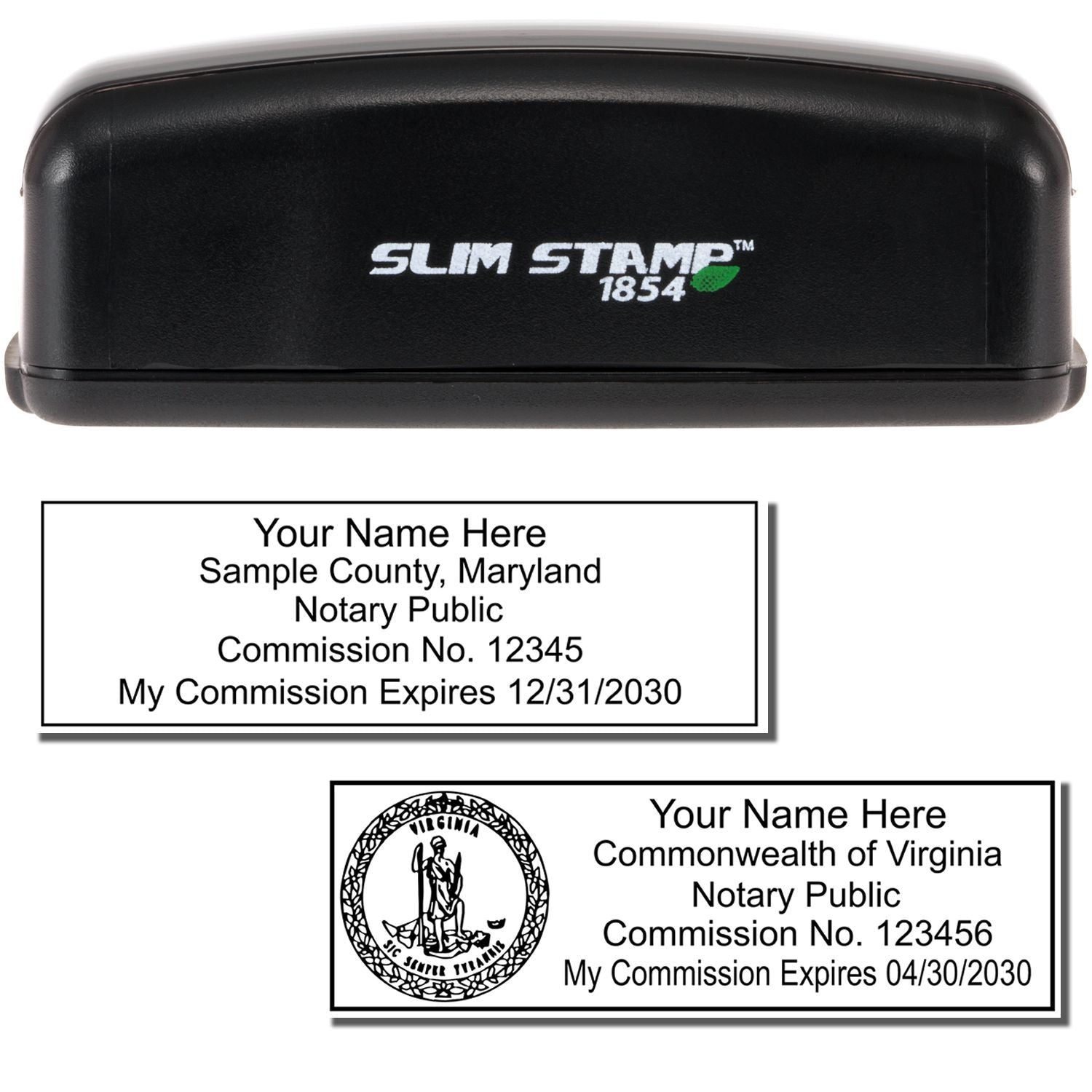
Yes, on every tangible record, and the sentence that requires it is not in the section titled “Official stamp”. Section 140.17 describes only what the stamp must say. The duty to own one sits in the appointment section: “Every notary public shall provide an official stamp that satisfies the requirements under s. 140.17.” A second duty, to use it, sits in the certificate section: “If a notarial act regarding a tangible record is performed by a notary public, an official stamp must be affixed to or embossed on the certificate.” The department puts the timing bluntly in its handbook: “It is your responsibility to provide an engraved official seal or official rubber stamp prior to completing the application form”, so in Wisconsin you buy the seal before you apply.
The governing text is Wis. Stat. §§ 140.02(3)(a), 140.15(2); DFI Notary Public Handbook.
What must appear on a Wisconsin notary stamp?
- Your name, which the department reads as having to include your complete legal last name
- The words “Notary Public”
- The words “State of Wisconsin”
- Any other information required by the department
- An impression capable of being copied together with the record
Two features make Wisconsin unusual. First, the commission expiration date is optional on the stamp: it “may include the notary public’s commission expiration date if applicable”. It is mandatory on the certificate, though, which must indicate the date of expiration of your commission, so a notary whose stamp omits it has to write or type it on every single notarization. Second, § 140.17(3) is a closed list: the stamp “may not include information other than the information required under sub. (1m) or permitted under sub. (2m)”. No address, no commission number, no county, no slogans, no decorative marks. That is a real constraint on what anyone may lawfully put on a Wisconsin stamp. One flag on the elements list itself: the statute says only “the notary public’s name”, and the requirement that it include your complete legal last name comes from the DFI handbook and FAQ rather than from the statute or any rule.
What size and shape must a Wisconsin notary stamp be?
Not addressed by statute. Sections 140.17 and 140.18 impose no dimensions, no shape and no border. The only statutory constraint on form is functional: the stamp must be capable of being copied together with the record. The department fills the gap in its handbook and FAQ, and its position is generous: “The seal or stamp may be of any size or shape, but must state the words ‘Notary Public,’ ‘State of Wisconsin,’ and your name which must include your legal last name.” Treat that as guidance rather than as a rule, because it is not one.
Notary public stamps are made to these conventions, and we check your lines against the statutory wording before we make the stamp.







What ink color is required for a Wisconsin notary stamp?
Not addressed by the notary act or the notary rules. The sources here are §§ 140.01, 140.02, 140.15, 140.16, 140.17, 140.18, 140.20 and 140.27, and every section of Wis. Admin. Code ch. DFI-CCS 25, and none of them mentions ink or color; the handbook and FAQ are silent too. The recording statute is where color lives, and unlike Minnesota this one does reach your stamp: for a register of deeds, “the ink is black, blue, or red, except that signatures and coded notations on maps may be other colors”, alongside a legibility standard requiring the document to reproduce on a copier, a microfilm camera or an optical scanner. So purple, green and novelty colors are out for anything being recorded. Note that the same subsection treats a nonconforming instrument as validly recorded once it is accepted and indexed, which makes this a gatekeeping standard rather than a validity rule, and that is exactly why counties enforce it hard at intake and often narrow it further: Milwaukee County publishes “All ink must be black or red” and Dane County publishes the same. Statute allows black, blue or red. Two of the largest counties allow black or red. Black is the only universally safe choice.
More on the trade-off in stamp ink color rules.
Is a notary embosser required or optional in Wisconsin?
Permitted as a full alternative, expressly. The definition of an official stamp covers “a physical image affixed to or embossed on a tangible record”, the certificate section says the stamp must be “affixed to or embossed on the certificate”, the department’s rule accepts certificates “affixed or embossed with an official stamp or official seal”, and the handbook says outright that “you may use both a rubber stamp and an engraved seal (embosser)”. Here is the catch nobody reads. Section 140.17(1m)(b) still requires the stamp to be capable of being copied together with the record, and a dry raised impression photocopies as nothing, which also fails the register of deeds legibility standard. Our advice: the embosser is the legal equal of an inked stamp in Wisconsin and a poor substitute for one in practice. Buy it as a supplement, or buy an embosser you can ink or foil, and do not rely on a blind emboss alone for anything that will be recorded or scanned.
Notary embossing seal kits and inked stamp kits cover both formats. See also notary stamp vs. embosser.
Putting the expiration date on a Wisconsin stamp is optional, and it is a self-destruct
Wisconsin requires three things on a notary stamp: your name, the words “Notary Public” and the words “State of Wisconsin”. The commission expiration date is not among them. The statute says the stamp “may include the notary public’s commission expiration date if applicable”, and that word may is doing more work than anyone realizes.
Read it next to the disposal rule. Section 140.18(1)(b) requires you to disable the stamping device on resignation, revocation or expiration of the commission, “or on the expiration of the date set forth in the stamping device, if any”. So printing the date is a choice that binds you: a dated Wisconsin stamp must be destroyed on the date printed on it and replaced every four years. An undated one survives renewal after renewal. For an attorney holding a permanent Wisconsin commission, which has no expiration date at all, an undated stamp can last the whole career.
The trade is real and you should hear both halves. The expiration date is mandatory on the certificate even when it is absent from the stamp, so an undated stamp means writing or typing the date on every notarization, and forgetting is exactly what Wisconsin registers of deeds reject for. Milwaukee County publishes the requirement in those words. Dated stamp: no writing, guaranteed reorder every four years. Undated stamp: buy once, write the date every time.
Two more that catch people. Section 140.17(3) is a closed list, so a commission number, a county, an address or a decorative flourish on a Wisconsin stamp is a statutory violation, not a preference. And buying a new stamp is itself reportable to DFI within 10 days, in writing, under Wis. Admin. Code § DFI-CCS 25.02(2). That duty appears nowhere in chapter 140, and it is the single most-missed Wisconsin obligation.
Do I need a new stamp when my commission is renewed or my name changes?
Terms run four years for non-attorneys, on a certificate that states the expiration date, with a $500 bond, and the department gives at least 30 days notice before a commission expires. Attorneys licensed to practice law in Wisconsin get a permanent commission and no bond, on application with a $50 fee and a certificate of good standing. Whether you need a new stamp at renewal depends entirely on what you had printed on it, and this is the most useful thing on the Wisconsin page. Because the date is optional on the stamp but the disposal rule requires you to disable the device “on the expiration of the date set forth in the stamping device, if any”, a dated stamp is a guaranteed four-year replacement cycle and an undated stamp survives renewal indefinitely. The trade is that an undated stamp obliges you to supply the expiration date on every certificate. Attorneys on permanent commissions have no expiration date at all, so an undated stamp is the natural choice and can last a career.
The statute covers address only: “Written notice of any change of address shall be given to the department within 10 days of the change.” The administrative rule is broader, and it contains a duty with no statutory counterpart: a notary “shall provide the department with written notice… of any change of name, seal or stamp, and address, including primary email address, within 10 days of the change.” Read that twice. Buying a new stamp in Wisconsin is itself a reportable event, within 10 days, in writing, to DFI, and it is nowhere in chapter 140. The handbook adds the sequencing for a name change: submit the Address, Name and Seal change form “PRIOR to using your new name and seal for notary purposes”. The department’s FAQ is relaxed about whether a name change forces a new stamp, saying you may keep using the current signature and stamp until the commission expires, or change both sooner at no extra fee. An address change never forces a new stamp, since § 140.17(3) forbids an address on it in the first place.






What do I do if my Wisconsin notary stamp is lost or stolen?
“Promptly”, with no fixed number of days: if the stamping device is lost or stolen, you or your personal representative or guardian must promptly notify the department on discovering it. The handbook sharpens that to “immediately”, in writing, and then adds an instruction that reaches the replacement itself: “order a new seal or stamp that has a different appearance than your previous one.” That different-appearance rule is handbook guidance rather than statute, but it is a direct instruction about the design of the replacement, and a vendor filling a lost-stamp order should honor it.
How do I dispose of an expired Wisconsin notary stamp?
Required, and the list of triggers is longer than most states: on resignation, revocation or expiration of the commission, or on the expiration of the date set forth in the stamping device, you must “disable the stamping device by destroying, defacing, damaging, erasing, or securing it against use in a manner that renders it unusable”. On death or adjudication of incompetency the personal representative, guardian or any other person knowingly in possession must do the same. The underlying security duty runs alongside: you are responsible for the device and may not let another individual use it to perform a notarial act.
More on retiring an old device in how to dispose of an expired notary stamp.
Can I notarize electronically or remotely in Wisconsin?
Wisconsin splits these cleanly. Plain electronic notarization needs no registration at all: you simply select one or more tamper-evident technologies, and “a person may not require a notary public to perform a notarial act with respect to an electronic record with a technology that the notary public has not selected”. Remote notarization does require notice: before your first act for a remotely located individual you notify the department and identify the technology you intend to use, and where the department has set standards the technology must conform and be approved. Technology providers are pre-approved through the department’s rules, which also require the notary to have reviewed and understood the remote statute and all guidance on the department’s website, and to be comfortable and competent with the technology. Electronic seal contents are not separately specified, because § 140.17 governs the official stamp in both tangible and electronic form, and there is no Wisconsin analogue to an identifying number. The audio-video recording is kept at least seven years. And Wisconsin requires no journal at all, not even for remote acts: “Keeping a notarial logbook, or journal, is not required in Wisconsin, although you are encouraged to do so.”
If you need your seal as an image file for electronic work, see electronic notary seal images.
Related Wisconsin guides
Next step
Have your commission details in front of you before you order, because they go on the stamp and a wrong line means a reorder. Then browse notary public stamps, or contact us and we will check your wording against the statute before we make it.
Frequently asked questions about Wisconsin notary seals
Is a notary stamp required in Wisconsin?
Yes, for tangible records. The sentence that requires it is not in the section titled “Official stamp”, which only describes what the stamp must say. The duty to have one sits in the appointment section, which is why reading only the stamp section leaves you unsure whether you need one.
What has to appear on a Wisconsin notary stamp?
Your name, the words “Notary Public” and the words “State of Wisconsin”, plus anything else the department requires. The impression must be capable of being copied together with the record.
Should I put my expiration date on a Wisconsin stamp?
Probably not, and this is the most useful decision you will make when ordering. The date is optional on the stamp but mandatory on the certificate. Print it on the die and you have created a self-destruct, because Wisconsin requires you to disable the device “on the expiration of the date set forth in the stamping device, if any.” Leave it off and the same stamp survives renewal after renewal.
Can I use an embosser in Wisconsin?
Wisconsin permits both formats. As with every state, remember that a dry raised impression does not photocopy or scan well, so an inked stamp is the practical choice for anything being recorded or transmitted.
How long does a Wisconsin notary commission last?
Four years for non-attorneys, with a $500 bond, and the department gives at least 30 days notice before a commission expires. Attorneys licensed to practice in Wisconsin hold a permanent commission, which makes the undated-stamp choice even more worthwhile for them.
What ink color does Wisconsin require?
The notary act and the notary rules specify none. Check the recording requirements if your documents go to a register of deeds, since county recording standards address ink colors separately from notary law.
Do I have to tell Wisconsin when I change my stamp?
Yes, and this one is easy to miss because it is in the administrative rules rather than the statute: a change of seal or stamp must be reported to the department within 10 days. Most states have no equivalent duty at all.
Do I need a new stamp when my Wisconsin commission is renewed?
Only if you put the expiration date on it. A stamp carrying just your name, “Notary Public” and “State of Wisconsin” has nothing on it that changes at renewal.








