

Written by Acorn Sales Company, manufacturing stamps and seals since 1964 · Reviewed by Holly R, VP of Sales and Marketing at Acorn Sales, against the Michigan Law on Notarial Acts (2003 PA 238, MCL 55.261 to 55.315), MCL 565.201, and the Michigan Secretary of State notary services pages. One sourcing caveat, stated plainly: legislature.mi.gov blocks automated retrieval, so the statutory text quoted here was read from a verbatim third-party reproduction of the Michigan Compiled Laws and cross-checked against the Secretary of State’s own guidance. MCL 55.287 and MCL 565.201 are the two load-bearing sections and are worth confirming against the official site before you rely on them. on 21 September 2026 · Updated 21 September 2026
Michigan requires no notary stamp or seal. The Secretary of State says so directly. What Michigan requires instead is a block of information printed, typed or stamped near your signature, and it contains one item almost no other state asks for on the face of the document: the date the notarial act was performed. If you do choose to use a stamp, it must carry everything that block requires. And Michigan states flatly that a notary shall not use an embosser alone.
Michigan notary stamp requirements at a glance
| Requirement | Michigan rule | Source |
|---|---|---|
| Stamp required | No | MCL 55.287(1), (2), (3) |
| Required wording | Your name exactly as it appears on your application for commission; The statement “Notary public, State of Michigan, County of ______.”; The statement “My commission expires ______.”; If performing the act in a county other than your county of commission, the statement “Acting in the County of ______.”; The date the notarial act was performed; If applicable, whether the act was performed using an electronic notarization system under section 26a or a remote electronic notarization platform under section 26b | MCL 55.287(2) |
| Size and shape | Not addressed. | MCL 55.287(2) (quality only) |
| Ink color | Not addressed in the notary act. | MCL 55.287 and the rest of Act 238 (silent) |
| Embosser | Permitted alongside a reproducible imprint, and flatly prohibited on its own. | MCL 55.287(3) |
| Commission term | Michigan terms are not a uniform length, which trips up every notary who has been told to renew every six years. | MCL 55.269(2), 55.271(1)(f), (2), 55.273(1), (2), (3), 55.279(1), (2), (3), 55.281(1), (2), (3), (4), 55.287(2)(b), (c) |
| Name or address change | Michigan gives you no day count, only a word: “immediately”. A notary “shall immediately apply to the secretary… for a corrected notary public commission” upon a change of name, a change of residence or business address, or the issuance of a commission containing an error. | MCL 55.269(2), 55.271(1)(f), (2), 55.273(1), (2), (3), 55.279(1), (2), (3), 55.281(1), (2), (3), (4), 55.287(2)(b), (c) |
| Lost or stolen stamp | Not addressed, from the same sections. | MCL 55.281, 55.287, 55.291, 55.299 to 55.303, 55.313 (all silent) |
| Commissioning authority | The Michigan Secretary of State, through the Office of the Great Seal, after your bond and oath have been filed with a county clerk | the Michigan Law on Notarial Acts (2003 PA 238, MCL 55.261 to 55.315), MCL 565.201, |
Rules for other states are on notary stamp requirements by state.




Is a notary stamp required in Michigan?
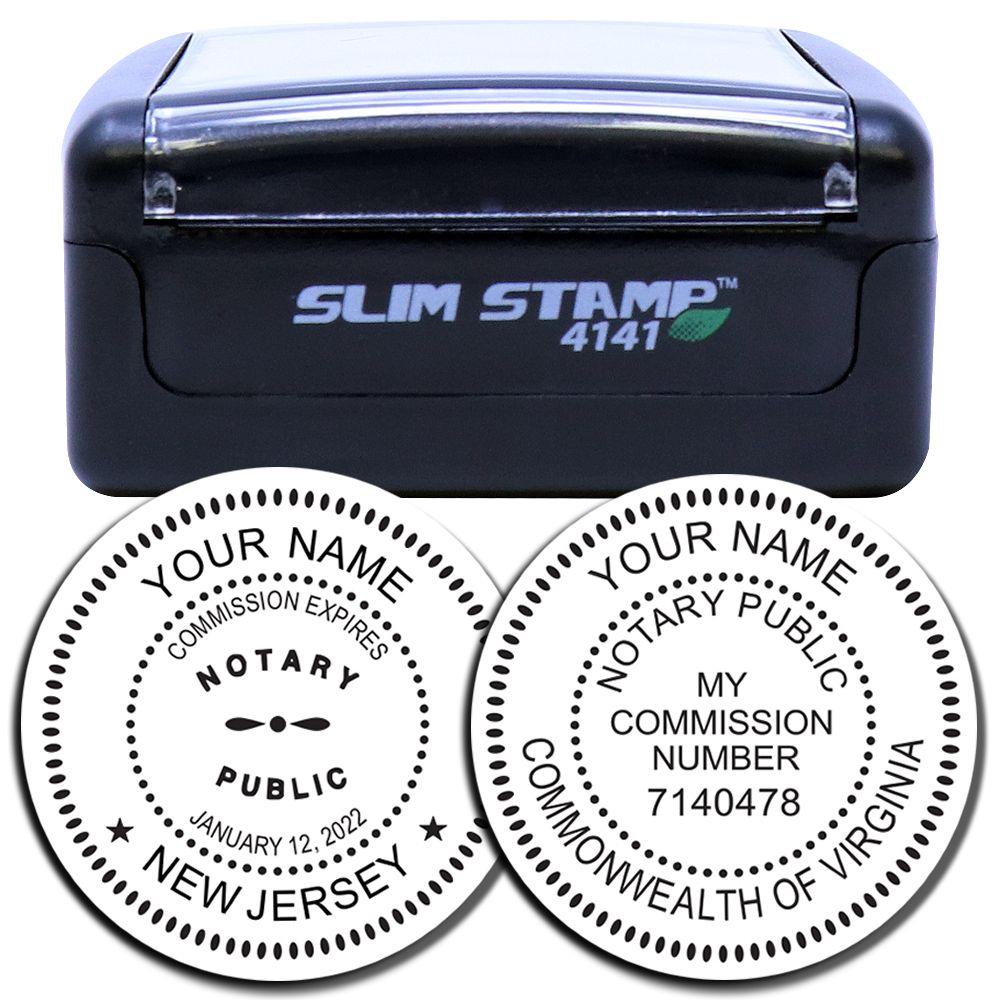
No. Michigan does not require a stamp or a seal. The Secretary of State says it plainly on its own notary pages: “The MiLONA does not require Notaries to use an embossed seal or rubber stamp on a document.” What Michigan requires instead is the information. On each record you notarize, and “immediately near the notary public’s signature, as is practical”, you must “print, type, stamp, or otherwise imprint mechanically or electronically sufficiently clear and legible to be read by the secretary and in a manner capable of photographic reproduction” the six items listed in MCL 55.287(2). Do not stop at the first half of the rule, because the same section governs a stamp you choose to use anyway: MCL 55.287(3) permits a stamp, seal or electronic process only if it “contains all of the information required under subsection (2)”, then adds that “the notary public shall not use the stamp, seal, or electronic process in a manner that renders anything illegible on the record being notarized” and that “A notary public shall not use an embosser alone or use any other method that cannot be reproduced.” Optional device, mandatory contents
The governing text is MCL 55.287(1), (2), (3); Michigan SOS Notary Services.
What must appear on a Michigan notary stamp?
- Your name exactly as it appears on your application for commission
- The statement “Notary public, State of Michigan, County of ______.”
- The statement “My commission expires ______.”
- If performing the act in a county other than your county of commission, the statement “Acting in the County of ______.”
- The date the notarial act was performed
- If applicable, whether the act was performed using an electronic notarization system under section 26a or a remote electronic notarization platform under section 26b
That list is what the block must contain, not what a stamp can realistically carry. Two of the six items are variable and cannot be baked into a die: the “Acting in the County of” line, which applies only when you act outside your county of commission, and the date of the notarial act, which changes every time. A practical Michigan stamp carries your name, the “Notary public, State of Michigan, County of” line and the expiration line, and leaves fill-in lines for the rest. MCL 55.287(2) expressly allows this, because it accepts the prescribed format “or in a similar format that conveys all of the same information”. Nothing is added by administrative rule: MCL 55.315 authorizes rulemaking, but Michigan has promulgated no notary stamp rule.
What size and shape must a Michigan notary stamp be?
Not addressed. Michigan imposes no dimension, no shape and no border requirement anywhere in Act 238. The sources here are 55.287 (the operative provision), 55.285, 55.285a, 55.286, 55.286a, 55.286b, 55.286c, 55.286d, 55.291, 55.293, 55.313, 55.315, and the definitions at 55.263, 55.265 and 55.267, none of which even define the words seal, stamp or emboss. The only standard the act sets for the imprint is a quality one: it must be legible enough to be read by the Secretary and “capable of photographic reproduction”.
Notary public stamps are made to these conventions, and we check your lines against the statutory wording before we make the stamp.






What ink color is required for a Michigan notary stamp?
Not addressed in the notary act. Every section we checked is silent on color: 55.263, 55.265, 55.267, 55.285, 55.285a, 55.286, 55.286a, 55.286b, 55.286c, 55.286d, 55.287, 55.291, 55.293, 55.313 and 55.315. The act cares about reproducibility, not color. Outside the act the picture changes, and for recordable documents it changes in a way you should plan around. A register of deeds “shall not receive for recording” an instrument unless each signature or mark “is in black or dark blue ink”, and unless each sheet “Is legibly printed in black ink on white paper that is not less than 20-pound weight” in 10-point type or its equivalent. Be precise about what that does and does not say: the black-ink clause governs the printing on the sheet, the black-or-dark-blue clause governs signatures, and neither is written as a notary stamp rule. Michigan law does not mandate black stamp ink. But because the register must refuse a non-compliant instrument outright, black is the safe choice for any Michigan stamp used on recordable documents.
More on the trade-off in stamp ink color rules.
Is a notary embosser required or optional in Michigan?
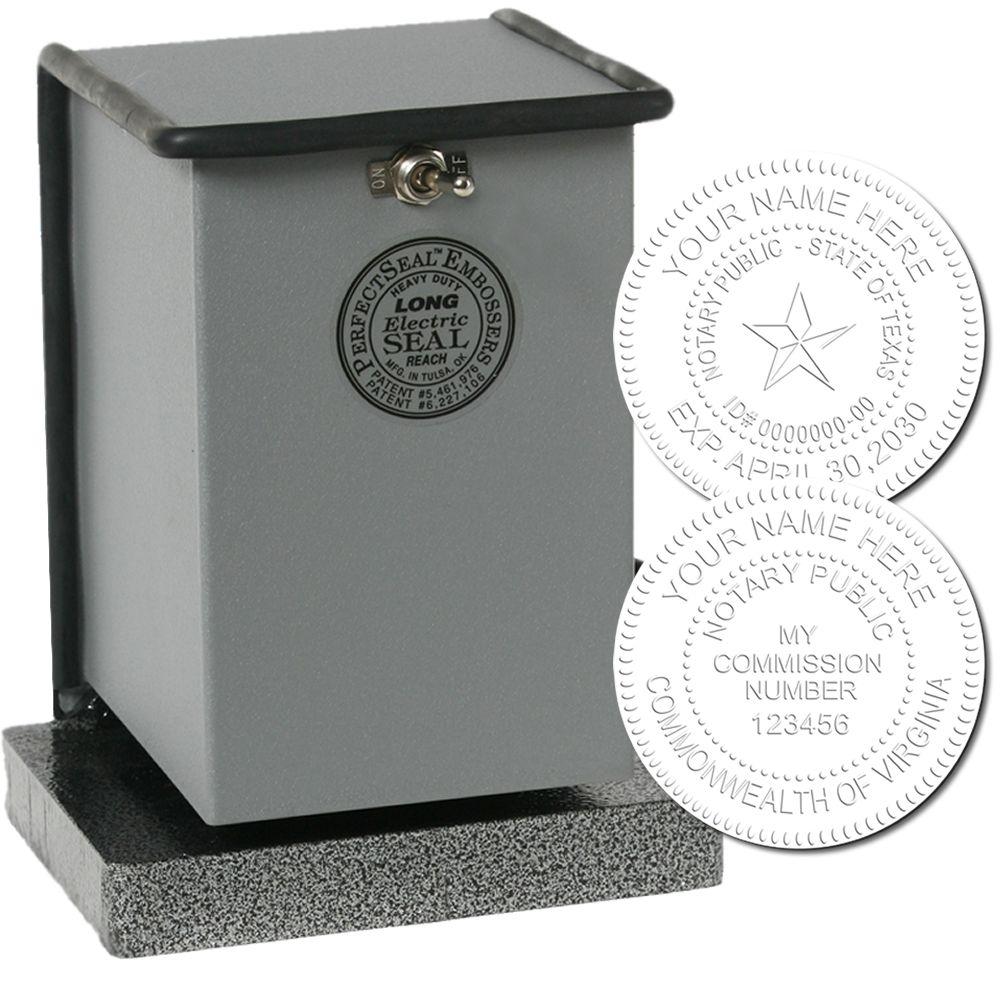
Permitted alongside a reproducible imprint, and flatly prohibited on its own. MCL 55.287(3) ends with the sentence that catches notaries arriving from embosser states: “A notary public shall not use an embosser alone or use any other method that cannot be reproduced.” The Secretary of State adds the practical reason to own one anyway: documents intended for use outside Michigan “may require an embossed Notary seal”.
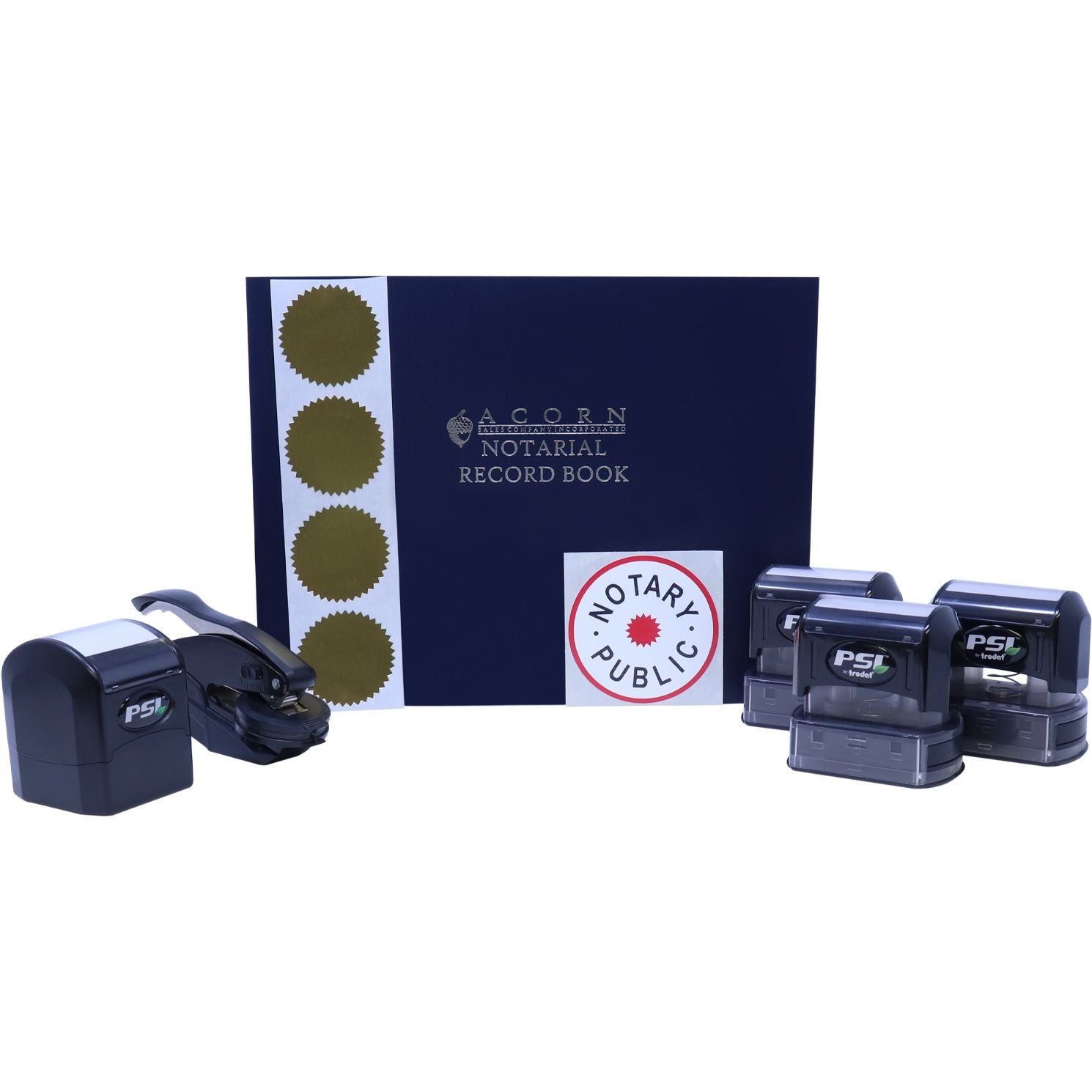
Notary embossing seal kits and inked stamp kits cover both formats. See also notary stamp vs. embosser.
The stamp is optional. The date of the notarial act is not.
Michigan notaries hear “no seal required” and stop reading, and that is where the trouble starts. MCL 55.287(2) requires a block of six items near your signature on every record, and one of them is the date the notarial act was performed. Most off-the-shelf Michigan stamps have no date line at all, so the notary stamps the block, signs, and leaves out a mandatory element. A second item catches people the same way: “Acting in the County of ______” is required whenever you notarize outside your county of commission. Michigan notaries may act anywhere in the state, but they have to say so on the page when they do.
A third has been law since 2019 and is still widely ignored. The block must disclose whether the act was performed with an electronic notarization system under section 26a or a remote platform under section 26b.
And the optional stamp is still a regulated stamp. MCL 55.287(3) is one sentence that begins permissively and ends with three mandates: it must contain everything subsection (2) requires, it must not render anything on the record illegible, and “A notary public shall not use an embosser alone or use any other method that cannot be reproduced.” There is no “Michigan does not require a seal, so anything goes.”
One consolation, and one sting in it. Illegibility does not undo your work: “The illegibility of the statements required under subsection (2) does not affect the validity of the transaction or record that was notarized” (55.287(4)). But a register of deeds can still refuse to record the instrument under MCL 565.201, which separately requires the notary’s name to be legibly printed, typewritten or stamped on the same page near the notary’s signature. That recording rule is the strongest practical argument for buying a stamp in a state that does not require one.
Do I need a new stamp when my commission is renewed or my name changes?
Michigan terms are not a uniform length, which trips up every notary who has been told to renew every six years. A commission runs “from the date of appointment until the notary’s birthday occurring not less than 6 years and not more than 7 years after the date of his or her appointment”. Reappointment is not automatic either: “The secretary shall not automatically reappoint a notary public.” You apply for an original appointment, no more than 60 days before expiry, and you file a fresh $10,000 surety bond and oath with the county clerk within the 90 days before that application. Michigan-licensed attorneys are exempt from the bond and are mailed a reappointment form at least 90 days out. On the stamp: if you use one, yes, you need a new one each term whenever the die carries a printed expiration date, because that date changes and the county of commission can change too. A stamp with a blank expiration line can carry over, since 55.287(2) accepts any similar format conveying the same information.
Michigan gives you no day count, only a word: “immediately”. A notary “shall immediately apply to the secretary… for a corrected notary public commission” upon a change of name, a change of residence or business address, or the issuance of a commission containing an error. Separately you must “immediately notify both the secretary and the county clerk of his or her appointment” of any change in the factual information in your application. The Secretary then notifies the county clerk when a corrected commission issues. There is no charge to correct the record, and the Secretary of State uses a Notary Request for Notice of Change form rather than a reapplication. A lost, mutilated or illegible commission certificate is a separate $10 application.






What do I do if my Michigan notary stamp is lost or stolen?
Not addressed, from the same sections. There is no reporting duty and no deadline for a lost or stolen Michigan stamp. Report a theft to local law enforcement regardless, and stop using any die that no longer states your current commission.
How do I dispose of an expired Michigan notary stamp?
Not addressed. Michigan imposes no duty to destroy, deface or surrender a stamp when a commission expires, is resigned or is revoked. The sources here are 55.287 (the stamp provision), 55.291 (prohibited conduct, nine subsections, none of which mention seals, stamps, surrender or destruction), 55.281 (which covers the paper commission certificate only), 55.313 (records retention), 55.299 through 55.303 (violations, revocation and reapplication), and the full 37-section index of Act 238. This follows from the stamp being optional in the first place: Michigan regulates the information, not the device. Destroying an obsolete die anyway is the sensible course.
More on retiring an old device in how to dispose of an expired notary stamp.
Can I notarize electronically or remotely in Michigan?
Both authorized, with no separate commission but a mandatory notification you cannot skip: “Before a notary public performs the notary public’s initial notarial act electronically, the notary public shall notify the secretary that the notary public will be performing notarial acts electronically and identify the electronic notarization system the notary public intends to use.” You choose your own tamper-evident system from those approved under section 26a, and nobody may force you to use one you did not select. Remote electronic notarization platforms are approved separately under section 26b, with identity proofing and credential analysis through the platform on top of a government photo ID. There is no separate electronic seal statute: MCL 55.287(2) applies to each record, tangible or electronic, and 55.287(3) expressly allows “an electronic process that contains all of the information required under subsection (2)”. Retention runs on three different clocks. There is no journal requirement for ordinary paper notarizations. A journal is required only for remote electronic acts, kept in one bound tangible or tamper-evident electronic format and “retained for at least 10 years after the performance of the last notarial act”, with the audio and video recordings held at least ten years as well. Separately, anyone who performed a notarial act and created a record of it must keep those records “for at least 5 years” after the act.
If you need your seal as an image file for electronic work, see electronic notary seal images.
Related Michigan guides
Next step
Have your commission details in front of you before you order, because they go on the stamp and a wrong line means a reorder. Then browse notary public stamps, or contact us and we will check your wording against the statute before we make it.
Frequently asked questions about Michigan notary seals
Is a notary stamp required in Michigan?
No. Michigan's notary act does not require an embossed seal or a rubber stamp. What it requires is that specific information appear near your signature on the document.
What must appear near my signature in Michigan?
Six items: your name exactly as it appears on your commission application; the statement “Notary public, State of Michigan, County of ___”; the statement “My commission expires ___”; the county where you are acting if different from your county of commission; the date the notarial act was performed; and, if applicable, whether the act was performed by electronic or remote electronic notarization.
Why does Michigan require the date of the act on the document?
Because the statute lists it among the information that must appear near your signature. This catches people out constantly, since most states treat the date as part of the certificate wording rather than part of the notary block. A stamp that omits it does not satisfy the requirement on its own.
If a stamp is optional, is it unregulated?
No. If you use a stamp it must contain everything the statute requires near your signature, and it must not render anything on the document illegible. Michigan also closes off the embosser route in full: “A notary public shall not use an embosser alone or use any other method that cannot be reproduced.” Reproducibility, not the device, is what the statute cares about.
What size and ink color does Michigan require?
The notary act specifies neither: no dimension, no shape, no border, no color. But do not stop at the notary act if the document is headed for a register of deeds. The recording statute provides that a register “shall not receive for recording” an instrument unless each signature or mark “is in black or dark blue ink” and each sheet is legibly printed in black on white paper of at least 20-pound weight. Those clauses reach the signatures and the sheet rather than your stamp, but they make black or dark blue the only sensible choice for recordable work.
Does an illegible Michigan notary block void the notarization?
No. The statute says the illegibility of the required statements does not affect the validity of the transaction or record that was notarized. The practical problem sits elsewhere and it is not discretionary: under the recording act a register of deeds shall not receive an instrument for recording unless the notary’s name is legibly printed, typewritten or stamped on the same page near the notary’s signature. Valid notarization, unrecordable document.
Do I need a new stamp when my Michigan commission is renewed?
If you use a stamp and it carries your expiration date, yes. Because no stamp is required at all, some Michigan notaries avoid the issue by printing the block instead.
How are Michigan notaries commissioned?
Through a process involving the county clerk as well as the state, which differs from the purely state-level process in most states. Your county of commission appears in the required wording, so it matters on the document even though no seal carries it.








