
Written by Acorn Sales Company, manufacturing stamps and seals since 1964 · Reviewed by Molly, VP Marketing at Acorn Sales, against the Revised Uniform Law on Notarial Acts at 57 Pa.C.S. §§ 301 to 331, 4 Pa. Code chapter 167 and the Department of State’s notary guidance on 20 September 2026 · Updated 20 September 2026
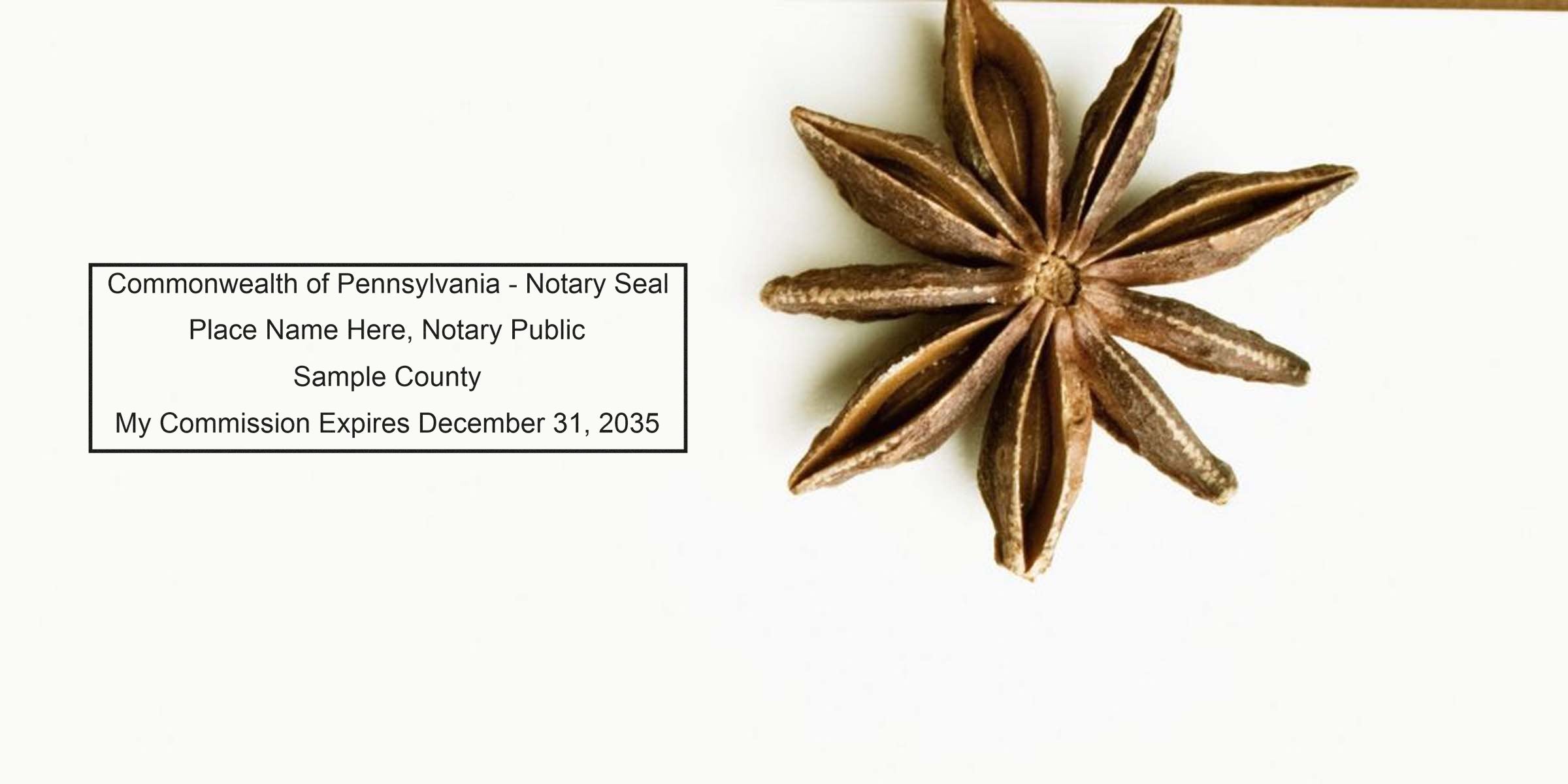
Pennsylvania is more prescriptive about the face of the stamp than almost any state. It must be a rubber stamp, no more than 1 inch by 3.5 inches with a plain border, and it must show six things in a mandated order: “Commonwealth of Pennsylvania”, “Notary Seal”, your name with “Notary Public”, the county where you keep an office, your expiration date, and your seven-digit commission identification number. Nothing may be abbreviated except a name suffix, which is why Pennsylvania allows an unusually wide stamp.
Pennsylvania notary stamp requirements at a glance
| Requirement | Pennsylvania rule | Source |
|---|---|---|
| Stamp required | Yes | 57 Pa.C.S. §§ 315(b)(1), 317(1) |
| Required wording | “Commonwealth of Pennsylvania”; “Notary Seal”; Your name as it appears on your commission, with “Notary Public”; The county in which you maintain an office; The date your commission expires; Your seven-digit commission identification number | 57 Pa.C.S. § 317(1) |
| Size and shape | A maximum of 1 inch high by 3.5 inches wide, with a plain border, and it must be a rubber stamp. | 57 Pa.C.S. § 317(1), (2), (3) |
| Ink color | Not addressed. | 57 Pa.C.S. §§ 315(b)(1), 317 (silent on color) |
| Embosser | Permitted only as a supplement, and the statute forecloses the alternative in four words: the seal “must be a rubber stamp.” The Department of State says it directly, that notaries may use an embosser “in addition to the rubber stamp seal” but that it “may not replace the rubber stamp seal.” An embosser in Pennsylvania is a flourish with no legal standing of its own. | 57 Pa.C.S. § 317(1) |
| Commission term | Terms run four years, and a new stamp is required at every renewal, because the seal carries both your commission expiration date and, by regulation, your seven-digit commission identification number. | 57 Pa.C.S. § 321(d.1), (d.2), (e) |
| Name or address change | Notify the Department of State within 30 days of any change to the information on file. | 57 Pa.C.S. § 321(d.1), (d.2), (e) |
| Lost or stolen stamp | The statute says notify the Department promptly on discovering the device is lost or stolen, with no day count. | 57 Pa.C.S. § 318(a)(2), (a)(2.1), (a)(3), (b) |
| Commissioning authority | The Pennsylvania Department of State, through the Bureau of Commissions, Elections and Legislation | the Revised Uniform Law on Notarial Acts at 57 Pa.C.S. §§ 301 to 331, 4 Pa. Code chapter 167 |
Rules for other states are on notary stamp requirements by state.
Is a notary stamp required in Pennsylvania?
Yes, on every notarial act, and the duty is imposed twice. The seal section says a notary “shall provide and keep an official seal, which shall be used to authenticate all the acts, instruments and attestations of the notary public”, while the affixation command sits in the certificate section: “If a notarial act regarding a tangible record is performed by a notary public, an official stamp shall be affixed to the certificate near the notary public’s signature in a form capable of photographic reproduction.” Quote only the seal section and you miss the reproduction standard.
The governing text is 57 Pa.C.S. §§ 315(b)(1), 317(1).
What must appear on a Pennsylvania notary stamp?
- “Commonwealth of Pennsylvania”
- “Notary Seal”
- Your name as it appears on your commission, with “Notary Public”
- The county in which you maintain an office
- The date your commission expires
- Your seven-digit commission identification number
Two things about that list are unusual. It is an ordered list, not a free layout: the statute says the seal “must show clearly in the following order.” And abbreviations are prohibited, except for name suffixes, so “PA”, “Notary Pub.” and “Comm.” all fail. The seven-digit commission identification number is required by the Department’s regulation rather than by the statute, which authorizes it through a catch-all for “any other information required by the department.” Note also that the county is the county of your office, not your residence.
What size and shape must a Pennsylvania notary stamp be?
A maximum of 1 inch high by 3.5 inches wide, with a plain border, and it must be a rubber stamp. The statute also requires that the seal “be capable of being copied together with the record to which it is affixed or attached or with which it is logically associated.” In practice that means a bordered rectangle, and the width allowance is generous because six ordered lines of unabbreviated text have to fit.
Notary public stamps are made to these conventions, and we check your lines against the statutory wording before we make the stamp.
What ink color is required for a Pennsylvania notary stamp?
Not addressed. We checked 57 Pa.C.S. §§ 306.1, 315, 317, 318, 319, 320 and 321 and the Department of State’s own notary equipment guidance, and none specifies a color. Pennsylvania also has no statewide document-formatting statute of the kind Oklahoma and Oregon use, because recording standards are set county by county, and the county standards we checked require legibility rather than a color. The operative standard is the statutory one: the stamp must be “in a form capable of photographic reproduction.”
More on the trade-off in stamp ink color rules.
Is a notary embosser required or optional in Pennsylvania?
Permitted only as a supplement, and the statute forecloses the alternative in four words: the seal “must be a rubber stamp.” The Department of State says it directly, that notaries may use an embosser “in addition to the rubber stamp seal” but that it “may not replace the rubber stamp seal.” An embosser in Pennsylvania is a flourish with no legal standing of its own.
Notary embossing seal kits and inked stamp kits cover both formats. See also notary stamp vs. embosser.
Six lines, in order, with no abbreviations
Pennsylvania is more prescriptive about the face of the stamp than almost any other state, and the three rules that trip people up are all about text rather than about law.
The elements have a mandatory order. The statute says the seal “must show clearly in the following order” and then lists them: Commonwealth of Pennsylvania, Notary Seal, your name with “Notary Public”, your county, your expiration date. Rearranging them to fit a narrower die is not a layout choice.
Nothing may be abbreviated except a name suffix. Not “PA”, not “Comm. Exp.”, not “Notary Pub.” That is why Pennsylvania allows a stamp up to 3.5 inches wide, which is wider than any other state we supply: six unabbreviated lines need the room.
And the county is the county of your office, not your home. Move your office across a county line and you have 30 days to register your signature in the new county and buy a new stamp, even though nothing about your commission has otherwise changed.
Two recent changes worth noting if your information is a year or two old: the seal now carries a seven-digit commission identification number, and the bond rose to $25,000 for anyone appointed or reappointed on or after 28 March 2026. If you held a commission on that date you may keep your existing seal until it expires.
Do I need a new stamp when my commission is renewed or my name changes?
Terms run four years, and a new stamp is required at every renewal, because the seal carries both your commission expiration date and, by regulation, your seven-digit commission identification number. Both change on reappointment. There is a grandfather provision worth knowing: a notary holding a current commission on 28 March 2026 may keep using the existing seal until that commission expires, so the commission number only has to appear on your next die. Separately, the bond rose to $25,000 for anyone appointed or reappointed on or after that date.
Notify the Department of State within 30 days of any change to the information on file. A name change also means registering your new signature with the Prothonotary or Recorder in the county where your office is, and buying a new rubber stamp. A move to a different county is the same: register in the new county and buy a new stamp within 30 days of moving, because the county is on the seal.
What do I do if my Pennsylvania notary stamp is lost or stolen?
The statute says notify the Department promptly on discovering the device is lost or stolen, with no day count. The Department’s own Report of Loss or Theft form imposes 15 days from discovery, citing its regulations. Work to the 15 days. Filing a police report and notifying recorders of deeds are described as things you may wish to do rather than as requirements.
How do I dispose of an expired Pennsylvania notary stamp?
It depends how the commission ended, and Pennsylvania splits the two cases. On resignation or expiration, or on the expiration date set out in the device, you disable it yourself by destroying, defacing, damaging, erasing or securing it against use. On suspension or revocation, you “shall surrender possession of the stamping device to the department.” The Department adds the practical version: do not send your old stamp in unless your commission was suspended or revoked.
More on retiring an old device in how to dispose of an expired notary stamp.
Can I notarize electronically or remotely in Pennsylvania?
Both are authorized and both require prior notification to the Department, using an approved solution provider from the Department’s published list. For electronic records you select the tamper-evident technology and notify before your first act. For remote acts, identity is established by personal knowledge, a credible witness, or “at least two different types of identity proofing processes or services”, and the audio-visual recording is retained at least ten years. The certificate must indicate that the act involved communication technology. A journal is mandatory for all notarial acts, and it does not stay with you: within 30 days of expiration, resignation or revocation you deliver it to the recorder of deeds of the county where you last maintained an office.
If you need your seal as an image file for electronic work, see electronic notary seal images.
Related Pennsylvania guides
Next step
Have your commission details in front of you before you order, because they go on the stamp and a wrong line means a reorder. Then browse notary public stamps, or call 804-359-0505 and we will check your wording against the statute before we make it.
Frequently asked questions about Pennsylvania notary seals
Is a notary seal required in Pennsylvania?
Yes, and the duty appears twice. You shall provide and keep an official seal used to authenticate all your acts, and separately, an official stamp shall be affixed to the certificate near your signature “in a form capable of photographic reproduction.” A page quoting only the seal section misses that reproduction standard.
What has to appear on a Pennsylvania notary seal?
Six things in this order: “Commonwealth of Pennsylvania”; “Notary Seal”; your name as commissioned with “Notary Public”; the county where you maintain an office; your commission expiration date; and your seven-digit commission identification number. The statute requires that order explicitly.
Can I abbreviate anything on a Pennsylvania stamp?
No, except a name suffix. “PA”, “Notary Pub.” and “Comm. Exp.” are all non-compliant. That prohibition is the reason Pennsylvania permits a stamp up to 3.5 inches wide, which is wider than any other state we supply.
Which county goes on a Pennsylvania notary seal?
The county where you maintain an office, not where you live. Move your office across a county line and you have 30 days to register your signature in the new county and buy a new stamp, even though nothing else about your commission has changed.
Can I use an embosser in Pennsylvania?
Only as a supplement. The statute says the seal “must be a rubber stamp”, and the Department of State confirms an embosser may be used in addition to the rubber stamp but may not replace it.
Do I need a new stamp when my Pennsylvania commission is renewed?
Yes, because the seal carries both your expiration date and your commission identification number. There is a grandfather provision worth knowing: a notary holding a current commission on 28 March 2026 may keep using the existing seal until that commission expires, so the commission number only has to appear on your next die.
Where does my Pennsylvania notary journal go?
To the recorder of deeds, not to the state and not your own shelf. A journal is mandatory for all notarial acts, and within 30 days of expiration, resignation or revocation you deliver it to the recorder of deeds of the county where you last maintained an office.
What if my Pennsylvania notary stamp is lost or stolen?
The statute says notify the Department promptly with no day count, but the Department's own Report of Loss or Theft form imposes 15 days from discovery. Work to the 15 days.
What do I do with my old Pennsylvania stamp?
It depends how the commission ended. On resignation or expiration you disable it yourself. On suspension or revocation you surrender it to the Department. The Department's practical guidance: do not send your old stamp in unless your commission was suspended or revoked.








