
Written by Acorn Sales Company, manufacturing stamps and seals since 1964 · Reviewed by Holly R, VP of Sales and Marketing at Acorn Sales, against chapter 1 of title 46 of the Utah Code, the Notaries Public Reform Act, as amended by S.B. 139 (2026), the Lieutenant Governor’s Notary Public Study Guide and Handbook, and the recording provisions at Utah Code §§ 57-3-101 and 57-3-106 on 21 September 2026 · Updated 21 September 2026
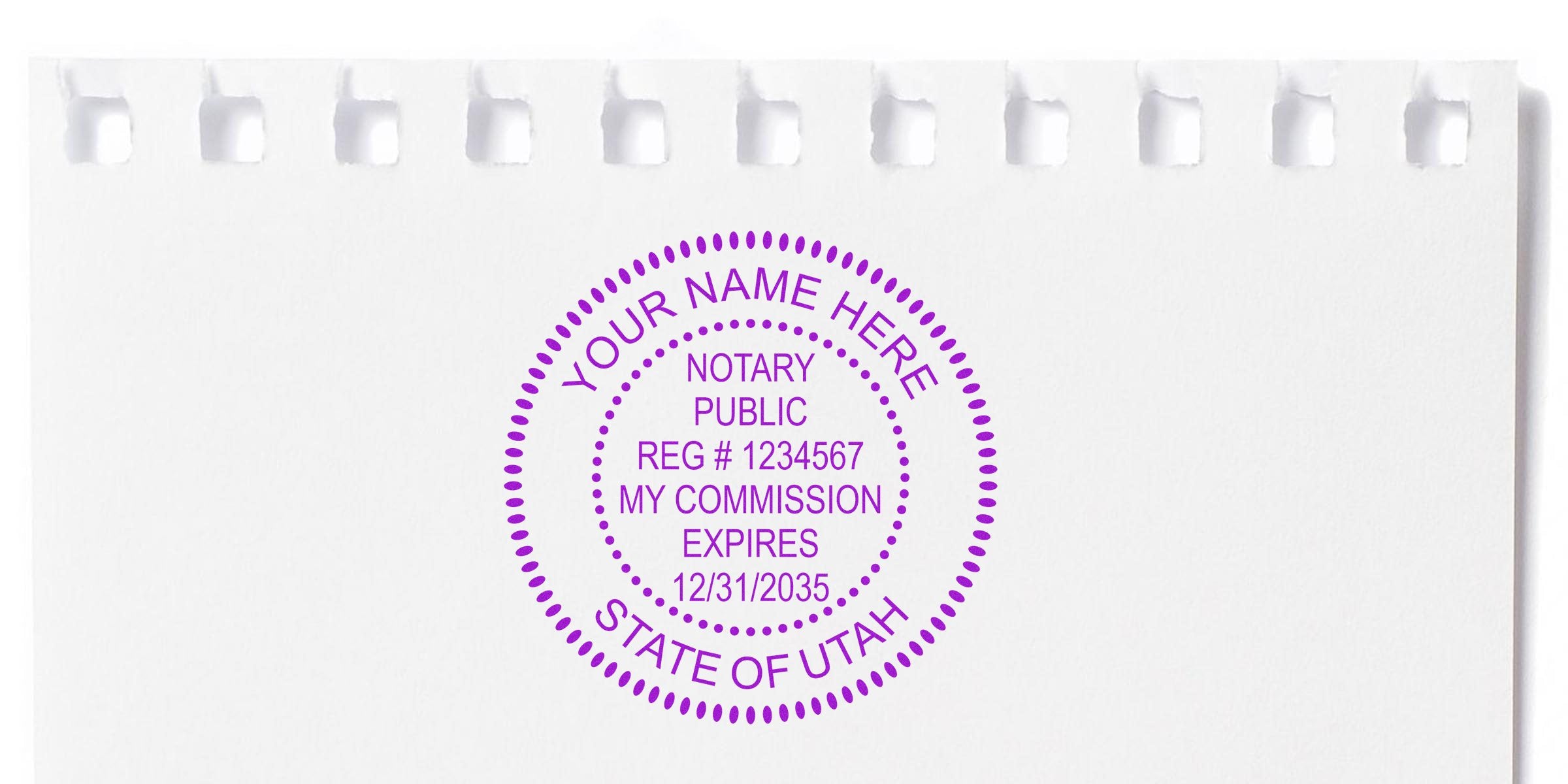
Utah has the most-missed ink rule in the country, and it is in the statute rather than a handbook: your seal must be purple for in-person notarizations and black for remote ones. A black Utah seal sold for in-person work is simply the wrong product. The seal carries your name exactly as commissioned, the words “notary public” and “state of Utah”, your commission number, and a facsimile of the great seal of the state, inside a rectangular border no larger than 1 by 2.5 inches.
Utah notary stamp requirements at a glance
| Requirement | Utah rule | Source |
|---|---|---|
| Stamp required | Yes | Utah Code § 46-1-16(2)(a), (7), (8) |
| Required wording | Your name exactly as indicated on your commission; The words “notary public”, “state of Utah” and “my commission expires on”; Your commission number, exactly as indicated on your commission; A facsimile of the great seal of the state; A rectangular border no larger than one inch by two and one-half inches | Utah Code § 46-1-16(3)(b) |
| Size and shape | Rectangular, with a border no larger than 1 inch by 2.5 inches, and that is a statutory cap rather than a guideline. | Utah Code § 46-1-16(3)(b)(v) |
| Ink color | Purple for in-person work, black for remote, by statute. | Utah Code § 46-1-16(2)(c)(i), (ii) |
| Embosser | Supplement only, never a substitute. | Utah Code § 46-1-16(4) |
| Commission term | Terms run four years, and Utah has no renewal process at all. | Utah Code §§ 46-1-3(5)(a)(i), (5)(b)(ii), 46-1-16(3)(b)(ii), (iii), 46-1-20(1), (4) |
| Name or address change | Notify the Lieutenant Governor within 30 days of either change. | Utah Code §§ 46-1-3(5)(a)(i), (5)(b)(ii), 46-1-16(3)(b)(ii), (iii), 46-1-20(1), (4) |
| Lost or stolen stamp | Notify law enforcement immediately and give written notice to the Lieutenant Governor on discovering unlawful interference with, or the loss, damage or destruction of, your seal, your journal or your electronic materials. | Utah Code § 46-1-16(9)(a), (10) |
| Commissioning authority | The Lieutenant Governor of Utah, under the Notaries Public Reform Act | chapter 1 of title 46 of the Utah Code, the Notaries Public Reform Act, as amended by S.B. 139 (2026), the Lieutenant Governor’s Notary Public Study Guide |
Rules for other states are on notary stamp requirements by state.
Is a notary stamp required in Utah?
Yes, and the duty is in the seal section itself rather than hidden in the certificate rules: “a notary shall keep an official seal, and a remote notary shall keep an electronic seal and electronic signature, that is the exclusive property of the notary.” Two narrow carve-outs let you omit the imprint, on plats and maps and on electronic messages, and both are set out below.
The governing text is Utah Code § 46-1-16(2)(a), (7), (8).
What must appear on an Utah notary stamp?
- Your name exactly as indicated on your commission
- The words “notary public”, “state of Utah” and “my commission expires on”
- Your commission number, exactly as indicated on your commission
- A facsimile of the great seal of the state
- A rectangular border no larger than one inch by two and one-half inches
Unusually, every item on that list is statutory, including the shape, the size cap and the great seal. Nothing here rests on a handbook. The statute also sets the quality standard, requiring a “sharp, legible, and photographically reproducible rendering” of all of it. One honest caveat on the electronic side: we could not locate a Utah administrative rule chapter for notaries, and yet § 46-1-3.7 grants rulemaking authority and § 46-1-17(2)(a)(ii) requires an electronic seal to comply with “the standards established by rule”. So treat the technical standards for an electronic seal as possibly supplemented by a rule we could not resolve. The physical seal requirements above are complete as stated. Note finally that § 46-1-16(6) forbids using the seal “independent of a notarial certificate”: stamping a document that carries no certificate is a violation.
What size and shape must an Utah notary stamp be?
Rectangular, with a border no larger than 1 inch by 2.5 inches, and that is a statutory cap rather than a guideline. Utah is one of the very few states that legislates the die size. A circular Utah seal does not comply, whatever a template site offers you, and neither does a rectangle that runs past 2.5 inches to fit a long name. If your name and commission number will not sit inside that border legibly, the answer is a tighter layout, not a bigger stamp, because the statute also demands a sharp and photographically reproducible rendering.
Notary public stamps are made to these conventions, and we check your lines against the statutory wording before we make the stamp.
What ink color is required for an Utah notary stamp?
Purple for in-person work, black for remote, by statute. This is the single most missed seal rule in the country and it is not a handbook preference: “Each official seal used for an in-person notarization shall be in purple ink… Each official seal used for a remote notarization shall be rendered in black.” Both sentences sit in § 46-1-16(2)(c), and S.B. 139 in 2026 carried both forward unchanged. The sources here are § 46-1-16 in full and §§ 46-1-17, 46-1-6.5 and 46-1-3.6 for any competing reference. The recording title adds nothing on color: it asks only that a document be “sufficiently legible for the recorder to make certified copies”. So purple is required, and it still has to copy cleanly.
More on the trade-off in stamp ink color rules.
Is a notary embosser required or optional in Utah?
Supplement only, never a substitute. The statute is explicit about it: a notary “may use an embossed seal impression that is not photographically reproducible in addition to, but not in place of” the required seal. So an embosser is lawful in Utah as a second impression alongside your purple stamp, and an embossed impression on its own leaves the notarization without a compliant seal. If you want one, order it as an extra rather than as the seal.
Notary embossing seal kits and inked stamp kits cover both formats. See also notary stamp vs. embosser.
Purple ink in person, black for remote, and a document we have to collect
Utah has the most distinctive ink rule in the country, and it is statutory rather than a handbook preference. “Each official seal used for an in-person notarization shall be in purple ink”, and “Each official seal used for a remote notarization shall be rendered in black.” A black Utah stamp used for in-person work is a non-compliant product, and it is sold constantly by vendors working from a generic template. Both sentences survived the 2026 amendments untouched.
Two more content rules trip up template orders. The die must carry a facsimile of the great seal of the state, so a plain text stamp fails, and it must be rectangular inside a border no larger than 1 inch by 2.5 inches, so a circular Utah seal fails. Your commission number is required too, which is why you cannot order before your commission issues.
And then the rule that binds us rather than you. § 46-1-17(1): a person may not provide an official seal to an individual claiming to be a notary unless that individual presents a copy of the commission attached to a notarized declaration. Utah is the only one of these four states with a seller-side duty, and an honor system checkbox does not satisfy it. Have your commission copy and the notarized declaration ready when you order a Utah seal, from us or from anyone.
Two carve-outs almost nobody knows, both in your favor. On notarial certificates for annexations, subdivisions, maps or plats, other than remote notarizations, the imprint may be omitted if you sign in permanent ink and supply your name, commission number, the phrase “A notary public commissioned in Utah” and the expiration date. On notarial certificates for electronic messages or documents, the seal may be omitted if your name, commission number, “notary public”, “state of Utah” and the expiration date appear electronically within the document.
Do I need a new stamp when my commission is renewed or my name changes?
Terms run four years, and Utah has no renewal process at all. The statute sends you back to the start: an individual whose commission expires and who wants another “shall submit a new application”, and the Lieutenant Governor’s office says plainly that renewal is not offered. A new seal is required for every new commission, forced by the die’s own contents, since it must carry “my commission expires on” with the date and your commission number exactly as the commission states them. The official Study Guide says it directly: a notary shall obtain a new official seal when the notary receives a new commission. Every four years in Utah is a fresh application, a fresh exam and a fresh seal.
Notify the Lieutenant Governor within 30 days of either change. A name change must include the required documentation and a bond policy rider; an address change covers a new residential or business address. Both go through the Utah Notary Request Portal, along with resignations, remote applications and complaints. A name change also forces a new seal, because the die must show your name exactly as commissioned.
What do I do if my Utah notary stamp is lost or stolen?
Notify law enforcement immediately and give written notice to the Lieutenant Governor on discovering unlawful interference with, or the loss, damage or destruction of, your seal, your journal or your electronic materials. The standard is immediately, with no fixed number of days. S.B. 139 gave this teeth from the other direction: unlawful interference with a notary, meaning unauthorized use, forging or damaging a notary’s signature, seal, journal or electronic recordings, is now a class B misdemeanor.
How do I dispose of an expired Utah notary stamp?
Destroy the official seal and certificate on resignation, expiration or revocation. A remote notary has more to do and a clock attached: you must also destroy the coding, disk, certificate, card, software or password that enables affixation of the electronic signature or seal, and then certify compliance to the Lieutenant Governor within 10 days. That 10 day certification is a real obligation and is missed constantly.
More on retiring an old device in how to dispose of an expired notary stamp.
Can I notarize electronically or remotely in Utah?
Remote notarization is a separate certification layered on your commission, not a notification: you first become a commissioned notary under § 46-1-3, then apply for a remote notary certification and pay the fee. The electronic seal carries the same five content elements as your physical seal and differs only in color, rendered in black rather than purple. You create an electronic recording of each remote act and store it under the retention rules. A journal is required and is retained ten years after the last recorded act, after which you destroy it by shredding or another method that renders it illegible, and it must stay in your exclusive custody and may not be used by anyone else for any purpose. S.B. 139 added a journal contents section at § 46-1-14.1 for commissions issued on or after 6 May 2026 and a secondary authentication of identity requirement for remote acts, meaning dynamic knowledge-based authentication or biometric analysis.
If you need your seal as an image file for electronic work, see electronic notary seal images.
Who is allowed to sell you a Utah notary seal?
Utah restricts who may sell you a seal, and the duty falls on the seller. § 46-1-17(1): a person may not provide an official seal to an individual claiming to be a notary unless the individual presents a copy of the commission attached to a notarized declaration. The declaration tracked by the statute reads that the signer is a notary public duly commissioned by the state of Utah, with a commission starting date, a commission expiration date and a commission number filled in. For electronic seals, § 46-1-17(2)(a) bars anyone from creating, obtaining or possessing one unless they are a notary and the seal meets the standards established by rule, and § 46-1-17(2)(b) carves out a business that creates or holds an electronic seal for the sole purpose of providing it to a certified notary. In plain terms: a Utah order cannot ship on a checkbox. Send us your commission copy and the notarized declaration with the order.
Related Utah guides
Next step
Have your commission details in front of you before you order, because they go on the stamp and a wrong line means a reorder. Then browse notary public stamps, or contact us and we will check your wording against the statute before we make it.
Frequently asked questions about Utah notary seals
Does Utah really require purple ink?
Yes, for in-person notarizations, and it is statutory rather than guidance. Each official seal used for an in-person notarization must be purple; a seal used for remote notarization must be black. This is the single most commonly missed seal rule in the United States, and a black seal bought for in-person work does not comply.
What has to appear on a Utah notary seal?
Your name exactly as indicated on your commission; the words “notary public”, “state of Utah” and your commission number exactly as on your commission; a facsimile of the great seal of the state; and a rectangular border no larger than one inch by two and a half inches.
Do I need to send you anything to buy a Utah seal?
Yes, and this is a statutory duty on us rather than on you: a person may not provide an official seal to an individual claiming to be a notary unless the individual presents a copy of the individual's notarial commission, attached to a notarized declaration. So a Utah order needs your commission copy plus that notarized declaration, which recites your commission start date, expiration date and commission number.
What size must a Utah notary seal be?
Rectangular, with a border no larger than 1 inch by 2.5 inches. That is a statutory cap rather than a guideline.
Does Utah have a renewal process?
No, and this surprises people. Utah has no renewal procedure at all: a notary whose commission expires applies again from the start. Terms run four years.
Do I need a new seal when my Utah commission ends?
Yes. Your commission number and the commission details are on the seal, and since Utah sends you through a fresh application rather than a renewal, treat every term as a new seal.
Can a non-notary own a Utah electronic seal?
No. Utah bars a person who is not a notary from creating, obtaining or possessing an electronic seal, with a narrow carve-out for a business supplying a certified notary. That is unusual and worth knowing if your employer wants to hold your credentials.
Why does Utah want the state seal on the notary seal?
Because the statute lists a facsimile of the great seal of the state among the required elements. Most states prohibit the state seal on a notary stamp, so a supplier working from general practice will get Utah backwards, just as they do with New Mexico.








